

I’m reading:
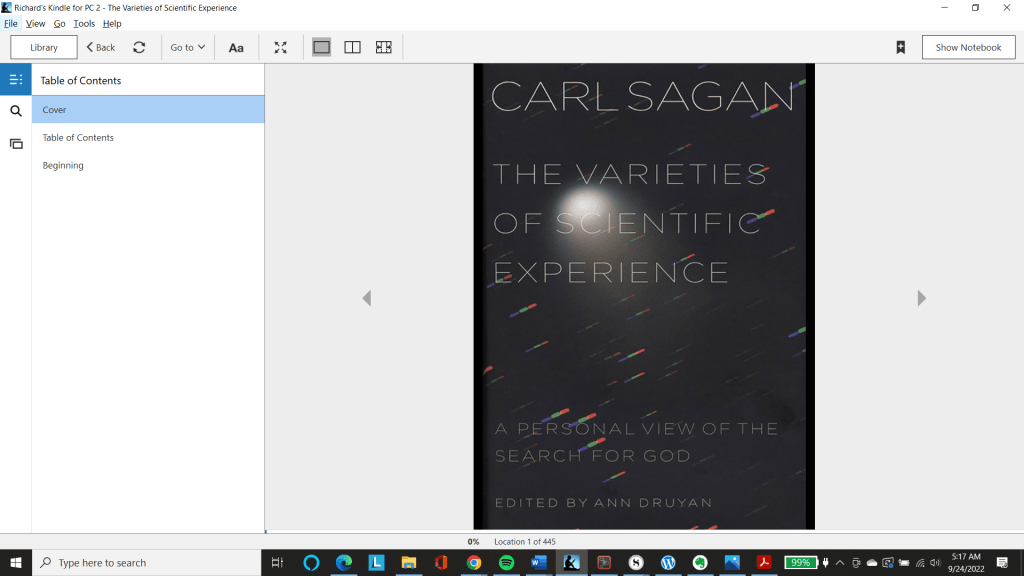
The Varieties of Scientific Experience is a great book by the brilliant, humble, and awe-inspiring Carl Sagan.
Here’s the book abstract from Amazon:
“Ann Druyan has unearthed a treasure. It is a treasure of reason, compassion, and scientific awe. It should be the next book you read.” —Sam Harris, author of The End of Faith
“A stunningly valuable legacy left to all of us by a great human being. I miss him so.” —Kurt Vonnegut
Carl Sagan’s prophetic vision of the tragic resurgence of fundamentalism and the hope-filled potential of the next great development in human spirituality
The late great astronomer and astrophysicist describes his personal search to understand the nature of the sacred in the vastness of the cosmos. Exhibiting a breadth of intellect nothing short of astounding, Sagan presents his views on a wide range of topics, including the likelihood of intelligent life on other planets, creationism and so-called intelligent design, and a new concept of science as “informed worship.” Originally presented at the centennial celebration of the famous Gifford Lectures in Scotland in 1985 but never published, this book offers a unique encounter with one of the most remarkable minds of the twentieth century.
And, here’s a taste of what to expect—an extract from the Editor’s Introduction:
[Carl] avidly studied the world’s religions, both living and defunct, with the same hunger for learning that he brought to scientific subjects. He was enchanted by their poetry and history. When he debated religious leaders, he frequently surprised them with his ability to out-quote the sacred texts. Some of these debates led to longstanding friendships and alliances for the protection of life.
However, he never understood why anyone would want to separate science, which is just a way of searching for what is true, from what we hold sacred, which are those truths that inspire love and awe. His argument was not with God but with those who believed that our understanding of the sacred had been completed.
Science’s permanently revolutionary conviction that the search for truth never ends seemed to him the only approach with sufficient humility to be worthy of the universe that it revealed. The methodology of science, with its error-correcting mechanism for keeping us honest in spite of our chronic tendencies to project, to misunderstand, to deceive ourselves and others, seemed to him the height of spiritual discipline. If you are searching for sacred knowledge and not just a palliative for your fears, then you will train yourself to be a good skeptic.
The idea that the scientific method should be applied to the deepest of questions is frequently decried as “scientism.” This charge is made by those who hold that religious beliefs should be off-limits to scientific scrutiny—that beliefs (convictions without evidence that can be tested) are a sufficient way of knowing. Carl understood this feeling, but he insisted with Bertrand Russell that “what is wanted is not the will to believe, but the desire to find out, which is the exact opposite.” And in all things, even when it came to facing his own cruel fate—he succumbed to pneumonia on December 20, 1996, after enduring three bone-marrow transplants—Carl didn’t want just to believe: He wanted to know.
Until about five hundred years ago, there had been no such wall separating science and religion. Back then they were one and the same. It was only when a group of religious men who wished “to read God’s mind” realized that science would be the most powerful means to do so that a wall was needed. These men—among them Galileo, Kepler, Newton, and, much later, Darwin—began to articulate and internalize the scientific method. Science took off for the stars, and institutional religion, choosing to deny the new revelations, could do little more than build a protective wall around itself.
Science has carried us to the gateway to the universe. And yet our conception of our surroundings remains the disproportionate view of the still-small child. We are spiritually and culturally paralyzed, unable to face the vastness, to embrace our lack of centrality and find our actual place in the fabric of nature. We batter this planet as if we had someplace else to go. That we even do science is a hopeful glimmer of mental health. However, it’s not enough merely to accept these insights intellectually while we cling to a spiritual ideology that is not only rootless in nature but also, in many ways, contemptuous of what is natural.
Carl believed that our best hope of preserving the exquisite fabric of life on our world would be to take the revelations of science to heart. And that he did. “Every one of us is, in the cosmic perspective, precious,” he wrote in his book Cosmos. “If a human disagrees with you, let him live. In a hundred billion galaxies you will not find another.” He lobbied NASA for years to instruct Voyager 2 to look back to Earth and take a picture of it from out by Neptune. Then he asked us to meditate on that image and see our home for what it is—just a tiny “pale blue dot” afloat in the immensity of the universe.
He dreamed that we might attain a spiritual understanding of our true circumstances. Like a prophet of old, he wanted to arouse us from our stupor so that we would take action to protect our home. Carl wanted us to see ourselves not as the failed clay of a disappointed Creator but as starstuff, made of atoms forged in the fiery hearts of distant stars. To him we were “starstuff pondering the stars; organized assemblages of 10 billion billion billion atoms considering the evolution of atoms; tracing the long journey by which, here at least, consciousness arose.”
For him science was, in part, a kind of “informed worship.” No single step in the pursuit of enlightenment should ever be considered sacred; only the search was. This imperative was one of the reasons he was willing to get into so much trouble with his colleagues for tearing down the walls that have excluded most of us from the insights and values of science. Another was his fear that we would be unable to keep even the limited degree of democracy we have achieved.
Our society is based on science and high technology, but only a small minority among us has even a superficial understanding of how they work. How can we hope to be responsible citizens of a democratic society, informed decision makers regarding the inevitable challenges posed by these newly acquired powers?
This vision of a critically thoughtful public, awakened to science as a way of thinking, impelled him to speak at many places where scientists were not usually found: kindergartens, naturalization ceremonies, an all-black college in the segregated South of 1962, at demonstrations of nonviolent civil disobedience, on the Tonight show. And he did this while maintaining a pioneering, astonishingly productive, fearlessly interdisciplinary scientific career.
Sagan, Carl (2006-11-01T23:58:59.000). The Varieties of Scientific Experience . Penguin Publishing Group. Kindle Edition.

 Richard L. Fricks