I’m currently taking a writing, blogging, and coaching sabbatical due to family health issues. For now, I’ll repost selected articles from my Fiction Writing School. I encourage you to take the time to read these powerful, awe-inspiring words.
“You don’t have to think very hard to realize that our dread of both relationships and loneliness … has to do with angst about death, the recognition that I’m going to die, and die very much alone, and the rest of the world is going to go merrily on without me.”
BY MARIA POPOVA
On May 21, 2005 David Foster Wallace took the podium at Kenyon College and delivered the now-legendary This Is Water, one of history’s greatest commencement addresses — his timeless meditation on the meaning of life and the grueling work required in order to stay awake to the world rather than enslaved by one’s own self-consuming intellect. It included this admonition:
Think of the old cliché about “the mind being an excellent servant but a terrible master.” This, like many clichés, so lame and unexciting on the surface, actually expresses a great and terrible truth. It is not the least bit coincidental that adults who commit suicide with firearms almost always shoot themselves in: the head. They shoot the terrible master.
Three years later, on September 12, 2008, Wallace murdered his own terrible master — not by firearms, but by hanging himself. Several months prior, frustrated with the disorienting side effects of the antidepressant he had been taking to alleviate his 20-year struggle with depression, he had attempted to wean himself off the medication. His personal tragedy was soon inscribed into the modern-day literary canon, turning him into a kind of public patron-saint of the Tortured Genius archetype.
Conversations with David Foster Wallace (public library) — an essential, the essential, collection of 22 interviews and profiles of the beloved author — reveals with empathic granularity Wallace’s conflicted relationship with life and death, and its slow, subtly menacing evolution.
In an interview by Larry McCaffery, originally published in the Review of Contemporary Fiction in 1993, 31-year-old Wallace appears already remarkably aware of the mortality paradox, the exorcism of which he sees as the highest achievement of fiction:
You don’t have to think very hard to realize that our dread of both relationships and loneliness, both of which are like sub-dreads of our dread of being trapped inside a self (a psychic self, not just a physical self), has to do with angst about death, the recognition that I’m going to die, and die very much alone, and the rest of the world is going to go merrily on without me. I’m not sure I could give you a steeple-fingered theoretical justification, but I strongly suspect a big part of real art-fiction’s job is to aggravate this sense of entrapment and loneliness and death in people, to move people to countenance it, since any possible human redemption requires us first to face what’s dreadful, what we want to deny.
This dark whimsy is what lends literature its mesmerism, and in it Wallace sees both redemption and remedy for our existential dance with anxiety:
If you’re going to try not just to depict the way a culture’s bound and defined by mediated gratification and image, but somehow to redeem it, or at least fight a rearguard against it, then what you’re going to be doing is paradoxical. You’re at once allowing the reader to sort of escape self by achieving some sort of identification with another human psyche — the writer’s, or some character’s, etc. — and you’re also trying to antagonize the reader’s intuition that she is a self, that she is alone and going to die alone. You’re trying somehow both to deny and affirm that the writer is over here with his agenda while the reader’s over there with her agenda, distinct. This paradox is what makes good fiction sort of magical, I think. The paradox can’t be resolved, but it can somehow be mediated — “re-mediated,” since this is probably where poststructuralism rears its head for me — by the fact that language and linguistic intercourse is, in and of itself, redeeming, remedying.
The reader walks away from real art heavier than she came to it. Fuller. All the attention and engagement and work you need to get from the reader can’t be for your benefit; it’s got to be for hers. What’s poisonous about the cultural environment today is that it makes this so scary to try to carry out. Really good work probably comes out of a willingness to disclose yourself, open yourself up in spiritual and emotional ways that risk making you look banal or melodramatic or naive or unhip or sappy, and to ask the reader really to feel something. To be willing to sort of die in order to move the reader, somehow. Even now I’m scared about how sappy this’ll look in print, saying this. And the effort actually to do it, not just talk about it, requires a kind of courage I don’t seem to have yet. … Maybe it’s as simple as trying to make the writing more generous and less ego-driven.
How wistful to consider that, fifteen years later, Wallace took his young self’s advice all too seriously, too literally, too extremely — for isn’t suicide the ultimate, most tragic, and most permanent denial of the ego?
But perhaps most prescient of all — most heartbreaking, most humbling, most harrowing — is something Wallace said to one interviewer particularly preoccupied with the root of the author’s genius:
That was his whole thing. “Are you normal?” “Are you normal?” I think one of the true ways I’ve gotten smarter is that I’ve realized that there are ways other people are a lot smarter than me. My biggest asset as a writer is that I’m pretty much like everybody else. The parts of me that used to think I was different or smarter or whatever almost made me die.
I’m currently taking a writing, blogging, and coaching sabbatical due to family health issues. For now, I’ll repost selected articles from my Fiction Writing School. I encourage you to take the time to read these powerful, awe-inspiring words.
“Writing, at its best, is a lonely life,”Hemingway proclaimed in his short and memorable 1954 Nobel acceptance speech. In Death in the Afternoon (public library) — Hemingway’s exquisite 1932 meditation on the tradition of bullfighting, “the emotional and spiritual intensity and pure classic beauty” of which served as profound inspiration for his art — the celebrated author offers some timeless wisdom on the discipline, dignity, and craft of writing.
In an observation particularly applicable to the sensationalist faux-grandeur of web journalism, Hemingway admonishes against the cult of the epic:
This too to remember. If a man writes clearly enough any one can see if he fakes. If he mystifies to avoid a straight statement, which is very different from breaking so-called rules of syntax or grammar to make an effect which can be obtained in no other way, the writer takes a longer time to be known as a fake and other writers who are afflicted by the same necessity will praise him in their own defense. True mysticism should not be confused with incompetence in writing which seeks to mystify where there is no mystery but is really only the necessity to fake to cover lack of knowledge or the inability to state clearly. Mysticism implies a mystery and there are many mysteries; but incompetence is not one of them; nor is overwritten journalism made literature by the injection of a false epic quality. Remember this too: all bad writers are in love with the epic.
Unlike the essayist, who E. B. White has argued is necessarily an egotist, the novel writer should write herself out of the story, yet her characters should spring to life from the wholeness of her being:
When writing a novel a writer should create living people; people not characters. A character is a caricature. If a writer can make people live there may be no great characters in his book, but it is possible that his book will remain as a whole; as an entity; as a novel. If the people the writer is making talk of old masters; of music; of modern painting; of letters; or of science then they should talk of those subjects in the novel. If they do not talk of those subjects and the writer makes them talk of them he is a faker, and if he talks about them himself to show how much he knows then he is showing off. No matter how good a phrase or a simile he may have if he puts it in where it is not absolutely necessary and irreplaceable he is spoiling his work for egotism. Prose is architecture, not interior decoration, and the Baroque is over. For a writer to put his own intellectual musings, which he might sell for a low price as essays, into the mouths of artificially constructed characters which are more remunerative when issued as people in a novel is good economics, perhaps, but does not make literature. People in a novel, not skillfully constructed characters, must be projected from the writer’s assimilated experience, from his knowledge, from his head, from his heart and from all there is of him. If he ever has luck as well as seriousness and gets them out entire they will have more than one dimension and they will last a long time.
A good writer should know as near everything as possible. Naturally he will not. A great enough writer seems to be born with knowledge. But he really is not; he has only been born with the ability to learn in a quicker ratio to the passage of time than other men and without conscious application, and with an intelligence to accept or reject what is already presented as knowledge. There are some things which cannot be learned quickly and time, which is all we have, must be paid heavily for their acquiring. They are the very simplest things and because it takes a man’s life to know them the little new that each man gets from life is very costly and the only heritage he has to leave. Every novel which is truly written contributes to the total knowledge which is there at the disposal of the next writer who comes, but the next writer must pay, always, a certain nominal percentage in experience to be able to understand and assimilate what is available as his birthright and what he must, in turn, take his departure from.
And yet, just like the art of conversation, the art of writing is ruined equally by parading the writer’s knowledge and by obfuscating the lack thereof:
If a writer of prose knows enough about what he is writing about he may omit things that he knows and the reader, if the writer is writing truly enough, will have a feeling of those things as strongly as though the writer had stated them. The dignity of movement of an ice-berg is due to only one-eighth of it being above water. A writer who omits things because he does not know them only makes hollow places in his writing. A writer who appreciates the seriousness of writing so little that he is anxious to make people see he is formally educated, cultured or well-bred is merely a popinjay. A serious writer may be a hawk or a buzzard or even a popinjay, but a solemn writer is always a bloody owl.
I’m currently taking a writing, blogging, and coaching sabbatical due to family health issues. For now, I’ll repost selected articles from my Fiction Writing School. I encourage you to take the time to read these powerful, awe-inspiring words.
On March 7, 1942, writing from university to his best friend and literary-minded comrade-in-arms, Eugenio Scalfari, in the typical tone of irreverent facetiousness the two shared, 18-year-old Calvino extols the joy and art of writing letters::
A fine thing it is to have a distant friend who writes long letters full of drivel and to be able to reply to him with equally lengthy letters full of drivel; fine not because I like to plunge into captious polemics nor because I enjoy getting certain ideas into the head of some idiot from the Urbe, but because writing long letters to friends means having a moral excuse for not studying.
In the same letter, Calvino admonishes Eugenio about the mixed motives of the publishing world — at least as an 18-year-old aspiring writer saw it:
Don’t trust the big names that support youth movements: it’s fashionable to show you’re favoring youth.
Several weeks later, Calvino — who had gone to university to study agriculture but found himself increasingly drawn to literature as he immersed himself in the dullness of his major — shares with Eugenio an intense expression of the inner contradiction that defines being human, the increasing inner tug-of-war between the disinterested agronomist and self-conscious poet:
It will perhaps please you to know that, as regards the famous italcalvinian dualism, the agronomist is about to lose out, and the poet will emerge as the clear winner. My revision for the exams is still today in a deplorable state and offers no hope of recovery. The Easter holidays, which were filled with the pleasures of cheerful cycling trips along the Via Aurelia and daring but unsuccessful pursuits of Riviera Amazons, have long disappeared. The poet, on the other hand, has been more productive: he has finished the famous Brezza di terra (Land Breeze) and would now do well to go off and hide. The work is solemn rubbish and I don’t think I’ll have the courage to present it, not even in Florence. Rhetoric, artifice, and trite Pirandellian ideas grafted onto pompous D’Annunzian language. But also daring, warmth, enthusiasm and, what counts above all, real poetry.
In early May of 1942, after Eugenio sends Italo one of his poems, Calvino echoes Wordsworth as he articulates his budding philosophy on poetry, then trails off in a meta-affirmation:
I’ve read your poem. I too, if you remember, wrote a Hermetic poem in my early youth. I know that gives enormous satisfaction to the person who writes it. But whether the person who reads it shares this enthusiasm is another matter. It’s too subjective, Hermeticism, do you see? And I see art as communication. The poet turns in on himself, tries to pin down what he has seen and felt, then pulls it out so that others can understand it. But I can’t understand these things: these discourses about the ego and the non-ego I leave to you. Yes, I understand, there’s the struggle to express the inexpressible, typical of modern art, and these are all fine things, but I …
I’m a regular guy, I like well-defined outlines, I’m old-fashioned, bourgeois. My stories are full of facts, they have a beginning and an end. For that reason they will never be able to find success with the critics, nor occupy a place in contemporary literature. I write poetry when I have a thought that I absolutely have to bring out, I write to give vent to my feelings and I write using rhyme because I like it, tum-tetum tumtetum tum te-tum, because I’ve got no ear, and poetry without rhyme or meter seems like soup without salt, and I write (mock me, you crowds! Make me a figure of public scorn!) I write … sonnets … and writing sonnets is boring, you have to find rhymes, you have to write hendecasyllables so after a while I get bored and my drawer is overflowing with unfinished short poems.
In July of the following year, still in school and approaching his 20th birthday, Italo grumbles to Eugenio in frustration over his creative process, which seems to disobey the general principles of intuitive incubation and unconscious processing:
I’m still too ignorant to write articles and as for my output of short stories, a famous summer of overproduction has been followed by years of crisis. … All the ideas currently in my head are subject to a strange phenomenon: while I work on them and perfect them continuously from the philosophical point of view, they stay rudimentary and barely sketched on the dramatic and artistic side. In my creativity thought has the upper hand over imagination.
Having long left school and working on his second novel, Calvino found himself no less full of inner contradiction and resistance to the calling of the writing life and its grueling routines. In a November 1948 letter to his friend Silvio Micheli, he voices, as if in a desperate effort to reconcile, his conflicted desires :
When you’re working you get buried, drowned under things. You’ve no more friends nor art. Only when you’ve an evening or afternoon free can you roam the streets or court a girl. That’s all. In short, working is pointless. I mean, from the point of view of education. But it’s essential. I cannot — and I don’t want to — live the writer’s life, that is to say write for a living. The novel I was writing, which for months and months had sucked all my blood (because, stubborn as I am, I was determined to finish it even though I no longer felt it was going anywhere), is dead, awful, full of wonderful clever things but desperately bad, forced, it’ll never work and I must not finish it. And I must not write for some time now otherwise I’d make more mistakes. I hope that Einaudi will publish my short stories eventually, they’re the only thing I believe in and which I believe are useful.
A few weeks prior, Calvino had written to another friend:
For seven or eight months now I’ve been mucking about with a novel that I began in a moment of weakness and it’s turning out to be very bad, causing me to waste lots of my time. But at least it’ll get rid of my desire to write novels for four or five years, which is what I dream of doing, and will allow me to study kind of seriously and learn to write decently.
On July 27, 1949, Calvino writes to Cesare Pavese:
To write well about the elegant world you have to know it and experience it to the depths of your being just as Proust, Radiguet and Fitzgerald did: what matters is not whether you love it or hate it, but only to be quite clear about your position regarding it.
In early December of the same year, Calvino writes to literary critic Geno Pampaloni, who had just reviewed the author’s second major published work, the short-story collection The Crow, expressing once again his inner turmoil:
My problem today is how to escape from the limits of these books, from this definition of me as a writer of adventures, fairy-tales, and fun, in which I can’t express myself or realize myself to the full.
In a lengthy letter to literary critic Mario Motta dated January 16, 1950, Calvino addresses the alleged death of the novel, a death toll still nervously resounding today:
There have been so many debates on the novel in the last thirty years, both by those who claimed it was dead and by those who wanted it to be alive in a certain way, that if one conducts the debate without serious preliminary work to establish the terms of the question as it has to be set up and as it has never been set up before, we’ll end up saying and making others say a lot of commonplaces.
Calvino echoes Herbert Spencer’s admonition that “to have a specific style is to be poor in speech” in a March 1950 letter to Elsa Morante, one of the most influential postwar novelists, whom he had befriended:
The fact is that I already feel I am a prisoner of a kind of style and it is essential that I escape from it at all costs: I’m now trying to write a totally different book, but it’s damned difficult; I’m trying to break up the rhythms, the echoes which I feel the sentences I write eventually slide into, as into pre-existing molds, I try to see facts and things and people in the round instead of being drawn in colors that have no shading. For that reason the book I’m going to write interests me infinitely more than the other one.
As dangerous as the blind adhesion to a style, Calvino writes in a May 1959 letter, is the blind reliance on tools, the cult of medium over message — but harnessing the power of tools is one of the craft’s greatest arts:
One should never have taboos about the tools we use, that as long as the thought or images or style one wants to put forward do not become deformed by the medium, one must on the contrary try to make use of the most powerful and most efficient of those tools.
The creative process, however, is an entirely different matter for Calvino, one where efficiency and merit aren’t necessarily correlated. In August of the same year, he complains to his friend Luigi Santucci about his creative block and sluggish daily routine — and yet he accepts that state, resigns to it as a given of the writing life. Above all, he adds to other famous meditations on why writers write — including ones from George Orwell, David Foster Wallace, Joan Didion, Mary Karr, Isabel Allende, Susan Orlean, Joy Williams, and Charles Bukowski — and speaks to the difference between a career and a calling, that profound and unshakable sense of purpose that is the mark of good art:
You can imagine how slowly my fictional output has been going this summer, you who know how much labor, dissatisfaction, irritability, uncertainty this work costs … However — and this is the point — it is worth it. Or rather: one does not ask if it’s worth it. We are people, there is no doubt, who exist solely insofar as we write, otherwise we don’t exist at all. Even if we did not have a single reader any more, we would have to write; and this not because ours can be a solitary job, on the contrary it is a dialog we take part in when we write, a common discourse, but this dialog can still always be supposed to be taking place with authors of the past, with authors we love and whose discourse we are forcing ourselves to develop, or else with those still to come, those we want through our writing to configure in one particular way rather than another. I am exaggerating: heaven help those who write without being read; for that reason there are too many people writing today and one cannot ask for indulgence for someone who has little to say, and one cannot allow trade-union or corporate sympathies.
In the same letter, he returns to the question of the novel and his relationship with fiction:
Even more annoying are those who theorize that the novel has to be like this or like that, that one must write the novel, etc. Let them go to hell! How much energy is wasted in Italy in trying to write the novel that obeys all the rules. The energy might have been useful to provide us with more modest, more genuine things, that had less pretensions: short stories, memoirs, notes, testimonials, or at any rate books that are open, without a preconceived plan.
Personally, I believe in fiction because the stories I like are those with a beginning and an end. I try to write them as they best come to me, depending on what I have to say. We are in a period when in literature and especially in fiction one can do anything, absolutely anything, and all styles and methods coexist. What the public (and also the critics) require are books (“open” novels) that are rich in substance, density, tension.
Three years later, in April of 1962, Calvino returns to his conception of fiction, this time with more dimension and more sensitivity to the inherent contradictions of literature:
One cannot construct in fiction a harmonious language to express something that is not yet harmonious. We live in a cultural ambience where many different languages and levels of knowledge intersect and contradict each other.
In October of the following year, feeling yet constrained by that “cultural ambience,” Calvino fantasizes about freely and wholeheartedly immersing himself in modernism:
Secretly I dream that soon, once the kingdom of literature has been divided between the two opposing factions of traditionalists and innovators, who are united by a common and equal insensitivity to words, I will be able finally to write works that are clandestine, pursuing an ideal of modern prose to hand down to the generations which eventually, God knows when, will understand …
But he is far from conceiving of the writer as a solitary creature working in isolation, in service of some egoic genius. In a December 1967 letter, he parenthetically acknowledges the labyrinth of literature:
One writes most of all in order to take part in a collective enterprise.
Similarly, in a letter penned a few months later, he recognizes the writer’s mind — like that of any great thinker — needs to be a cross-disciplinary one:
Every field of writing cannot be indifferent to other fields.
As a young man my aspiration was to become a “minor writer.” (Because it was always those that are called “minor” that I liked most and to whom I felt closest.) But this was already a flawed criterion because it presupposes that “major” writers exist. Basically, I am convinced that not only are there no “major” or “minor” writers, but writers themselves do not exist — or at least they do not count for much. As far as I am concerned, you still try too hard to explain Calvino with Calvino, to chart a history, a continuity in Calvino, and maybe this Calvino does not have any continuity, he dies and is reborn every second. What counts is whether in the work that he is doing at a certain point there is something that can relate to the present or future work done by others, as can happen to anyone who works, just because of the fact that they are creating such possibilities.
Calvino, in fact, is largely uncomfortable with the conventions of literary fame. In September of 1968, in a warm letter to John Woodhouse, who had just written the first book on Calvino, he reflects on the perils of prestige:
The public figure of the writer, the writer-character, the “personality-cult” of the author, are all becoming for me more and more intolerable in others, and consequently in myself. In short, if a critic writes about a problem and makes reference to one (or more) of my works in relation to that problem, this gives me the sense that my work is not pointless. Whereas the prospect of my bust crowned with laurel appearing along with the other busts in the hall of famous writers gives me no joy at all.
The only kind of literature that is possible today: a literature that is both critical and creative.
In the summer of 1973, he returns to the idea that all literature is interconnected or, as Virginia Woolf memorably put it, “words belong to each other,” and laments the literary landscape of the time:
I am very discouraged by this general dearth of books coming out, a desert that also affects me, removes my desire to write, because books cannot grow if they don’t find around them the company of other books their same age and that are congenial to them.
One of his most prescient and timely meditations comes from a November 1975 letter and, once again, dissents against the artificial and detrimental hierarchies of the literary world:
The distinction between journalists and writers put in those terms does not distinguish anything at all: one cannot say a priori that a writer just because he is a writer is more capable of handling ideas and of seeing what is essential than a journalist when we are dealing with a good journalist.
In late 1979, having just turned fifty-six, Calvino reflects on his nature as a writer, reflecting also on the era’s evolution and presaging our present culture of compressed timelines:
The fact is that I have always been more a writer of short stories than a novelist, and it is second nature to me to close — both in formal and conceptual terms — even a story that remains open; to condense into a short narrative space all the elements that give a sense of completion to the story. However, I do not mean by this that I am in favor only of short time-spans — or rather, there is no doubt that we are living in a period in which time has been shattered, there is no room to breathe, no possibility of foreseeing and planning ahead, and that this rhythm is imposed on what I write — but ideally I believe more and more that the only thing that counts is what moves in long, very long time-spans, both in geological eras and in the history of society. Trying to work out the directions in which these things are moving is very difficult; for that reason I feel more and more incapable of understanding what really is happening in a world which does nothing but prove each model wrong.
This jack-of-all-trades kind of writing does not give me any satisfaction at all, even though, yes, it is also a vocation of mine, but it is certainly the most time-consuming and least useful activity I could be doing, and what’s more in recent times what I manage to come up with are only boring things and my conscience is only at peace if I manage to entertain people.
And still, for all his tremendous insight and wisdom, Calvino is also a relentless devil’s advocate against himself, brimming with mischievous self-consciousness and self-derision that bespeaks one of the grand truths of creative life: No great artist can afford to take himself too seriously. Even in his formative years, Calvino intuited this: 19-year-old Italo tells Eugenio after writing his friend a lengthy letter full of youth’s typical early grapples with philosophy:
I found this letter that I had started to write yesterday evening and I reread it with interest. Dammit, what a lot of drivel I managed to write! In the end it’s impossible to understand anything in it. But better that way: the less one understands the more posterity will appreciate my profundity of thought. In fact, let me say:
I’m currently taking a writing, blogging, and coaching sabbatical due to family health issues. For now, I’ll repost selected articles from my Fiction Writing School. I encourage you to take the time to read these powerful, awe-inspiring words.
“Perfectionism is the voice of the oppressor, the enemy of the people. It will keep you cramped and insane your whole life.”
BY MARIA POPOVA
Anne Lamott’s Bird by Bird: Some Instructions on Writing and Life (public library) is among my ten favorite books on writing — a treasure trove of insight both practical and profound, timelessly revisitable and yielding deeper resonance each time. Lamott adds to the collected wisdom of great writers with equal parts candor and conviction, teaching us as much about writing as she does about creativity at large and, even beyond that, about being human and living a full life — because, after all, as Lamott notes in the beginning, writing is nothing more nor less than a sensemaking mechanism for life:
One of the gifts of being a writer is that it gives you an excuse to do things, to go places and explore. Another is that writing motivates you to look closely at life, at life as it lurches by and tramps around.
What makes Lamott so compelling is that all of her advice comes not from the ivory tower of the pantheon but from an honest place of exquisite vulnerability and hard-earned life-wisdom. She recounts her formative years and where she headed once she encountered that inevitable fork in the road where we can choose between being shut in and shut down by our traumatic experiences, or using them as fertile clay for character-building:
I started writing when I was seven or eight. I was very shy and strange-looking, loved reading above everything else, weighed about forty pounds at the time, and was so tense that I walked around with my shoulders up to my ears, like Richard Nixon. I saw a home movie once of a birthday party I went to in the first grade, with all these cute little boys and girls playing together like puppies, and all of a sudden I scuttled across the screen like Prufrock’s crab. I was very clearly the one who was going to grow up to be a serial killer, or keep dozens and dozens of cats. Instead, I got funny. I got funny because boys, older boys I didn’t even know, would ride by on their bicycles and taunt me about my weird looks. Each time felt like a drive-by shooting. I think this is why I walked like Nixon: I think I was trying to plug my ears with my shoulders, but they wouldn’t quite reach. So first I got funny and then I started to write, although I did not always write funny things.
[…]
All I ever wanted was to belong, to wear that hat of belonging.
In seventh and eighth grades I still weighed about forty pounds. I was twelve years old and had been getting teased about my strange looks for most of my life. This is a difficult country to look too different in — the United States of Advertising, as Paul Krassner puts it — and if you are too skinny or too tall or dark or weird or short or frizzy or homely or poor or nearsighted, you get crucified. I did.
So she found refuge in books, searching for “some sort of creative or spiritual or aesthetic way of seeing the world and organizing it in [her] head.” To find that, she became a writer and began fantasizing about getting published, about “the thrill of seeing oneself in print,” as the highest form of existential validation. When she published her first book, she awaited the affirming grandeur of public approval and secretly thought that “trumpets would blare, major reviewers would proclaim that not since Moby Dick had an American novel so captured life in all of its dizzying complexity.” Of course, none of this happened — not with the first book, nor the second or third or fourth or fifth. Instead, what Lamott found was a deeper kind of reward — that sensation “unmerited grace” that Annie Dillard so eloquently captured in her timeless meditation on the writing life. Lamott echoes Ray Bradbury on rejection and reflects:
I still encourage anyone who feels at all compelled to write to do so. I just try to warn people who hope to get published that publication is not all that it is cracked up to be. But writing is. Writing has so much to give, so much to teach, so many surprises. That thing you had to force yourself to do — the actual act of writing — turns out to be the best part. It’s like discovering that while you thought you needed the tea ceremony for the caffeine, what you really needed was the tea ceremony. The act of writing turns out to be its own reward.
[…]
I tell my students that the odds of their getting published and of it bringing them financial security, peace of mind, and even joy are probably not that great. Ruin, hysteria, bad skin, unsightly tics, ugly financial problems, maybe; but probably not peace of mind. I tell them that I think they ought to write anyway.
But, one might wonder, why? Lamott answers beautifully:
My writer friends, and they are legion, do not go around beaming with quiet feelings of contentment. Most of them go around with haunted, abused, surprised looks on their faces, like lab dogs on whom very personal deodorant sprays have been tested.
But I also tell [my students] that sometimes when my writer friends are working, they feel better and more alive than they do at any other time. And sometimes when they are writing well, they feel that they are living up to something. It is as if the right words, the true words, are already inside them, and they just want to help them get out. Writing this way is a little like milking a cow: the milk is so rich and delicious, and the cow is so glad you did it.
For her, the essence of writing is about something simple, something immutable about being human:
Good writing is about telling the truth. We are a species that needs and wants to understand who we are.
[…]
Hope, as Chesterton said, is the power of being cheerful in circumstances that we know to be desperate. Writing can be a pretty desperate endeavor, because it is about some of our deepest needs: our need to be visible, to be heard, our need to make sense of our lives, to wake up and grow and belong.
At the heart of writing, Lamott argues, lies a capacity for quiet grit and a willingness to decondition the all too human tendency to get so overwhelmed by the enormity of the journey that we’re too paralyzed to take the first step. She recounts this wonderful anecdote, after which the book is titled:
Thirty years ago my older brother, who was ten years old at the time, was trying to get a report on birds written that he’d had three months to write, which was due the next day. We were out at our family cabin in Bolinas, and he was at the kitchen table close to tears, surrounded by binder paper and pencils and unopened books on birds, immobilized by the hugeness of the task ahead. Then my father sat down beside him, put his arm around my brother’s shoulder, and said, “Bird by bird, buddy. Just take it bird by bird.”
Perfectionism is the voice of the oppressor, the enemy of the people. It will keep you cramped and insane your whole life, and it is the main obstacle between you and a shitty first draft.
[…]
Perfectionism is a mean, frozen form of idealism, while messes are the artist’s true friend. What people somehow (inadvertently, I’m sure) forgot to mention when we were children was that we need to make messes in order to find out who we are and why we are here — and, by extension, what we’re supposed to be writing.
Writing is about learning to pay attention and to communicate what is going on.
[…]
The writer is a person who is standing apart, like the cheese in “The Farmer in the Dell” standing there alone but deciding to take a few notes. You’re outside, but you can see things up close through your binoculars. Your job is to present clearly your viewpoint, your line of vision. Your job is to see people as they really are, and to do this, you have to know who you are in the most compassionate possible sense. Then you can recognize others.
To be a good writer, you not only have to write a great deal but you have to care. You do not have to have a complicated moral philosophy. But a writer always tries, I think, to be a part of the solution, to understand a little about life and to pass this on.
As we live, we begin to discover what helps in life and what hurts, and our characters act this out dramatically. This is moral material. … A moral position is a passionate caring inside you. We are all in danger now and have a new everything to face, and there is no point gathering an audience and demanding its attention unless you have something to say that is important and constructive. My friend Carpenter says we no longer need Chicken Little to tell us the sky is falling, because it already has. The issue now is how to take care of one another.
In order to be a writer, you have to learn to be reverent. If not, why are you writing? Why are you here? … Think of reverence as awe, as presence in and openness to the world. Think of those times when you’ve read prose or poetry that is presented in such a way that you have a fleeting sense of being startled by beauty or insight, by a glimpse into someone’s soul. All of a sudden everything seems to fit together or at least to have some meaning for a moment. This is our goal as writers, I think; to help others have this sense of — please forgive me — wonder, of seeing things anew, things that can catch us off guard, that break in on our small, bordered worlds. When this happens, everything feels more spacious.
[…]
There is ecstasy in paying attention. You can get into a kind of Wordsworthian openness to the world, where you see in everything the essence of holiness…
Belted Hermit and Bishop Hermit Hummingbirds by John Gould, 1861. (Available as a print and as a face mask, benefitting the Nature Conservancy.)
Most of all, however, Lamott sees in writing not a selfish act of personal gratification but an act of warm generosity — which is, after all, what drives all of us who wake up in the morning to put something we love into the world and go to bed at night glad that we did:
If you give freely, there will always be more. … It is one of the greatest feelings known to humans, the feeling of being the host, of hosting people, of being the person to whom they come for food and drink and company. This is what the writer has to offer.
This mutual gratification is where the mesmerism of literature lies:
Writing and reading decrease our sense of isolation. They deepen and widen and expand our sense of life: they feed the soul. When writers make us shake our heads with the exactness of their prose and their truths, and even make us laugh about ourselves or life, our buoyancy is restored. We are given a shot at dancing with, or at least clapping along with, the absurdity of life, instead of being squashed by it over and over again. It’s like singing on a boat during a terrible storm at sea. You can’t stop the raging storm, but singing can change the hearts and spirits of the people who are together on that ship.
I’m currently taking a writing, blogging, and coaching sabbatical due to family health issues. For now, I’ll repost selected articles from my Fiction Writing School.
In Zen in the Art of Writing (public library), one of these ten essential books on writing, Ray Bradbury (August 22, 1920–June 5, 2012) describes an unusual creative prompt he employed in his early twenties: He began making long lists of nouns as triggers for ideas and potential titles for stories:
These lists were the provocations, finally, that caused my better stuff to surface. I was feeling my way toward something honest, hidden under the trapdoor on the top of my skull.
The lists ran something like this:
THE LAKE. THE NIGHT. THE CRICKETS. THE RAVINE. THE ATTIC. THE BASEMENT. THE TRAPDOOR. THE BABY. THE CROWD. THE NIGHT TRAIN. THE FOG HORN. THE SCYTHE. THE CARNIVAL. THE CAROUSEL. THE DWARF. THE MIRROR MAZE. THE SKELETON.
I was beginning to see a pattern in the list, in these words that I had simply flung forth on paper, trusting my subconscious to give bread, as it were, to the birds. Glancing over the list, I discovered my old love and fright having to do with circuses and carnivals. I remembered, and then forgot, and then remembered again, how terrified I had been when my mother took me for my first ride on a merry-go-round. With the calliope screaming and the world spinning and the terrible horses leaping, I added my shrieks to the din. I did not go near the carousel again for years. When I really did, decades later, it rode me into the midst of Something Wicked This Way Comes.
So he went on making lists, hoping they’d spark these fruitful associations that the rational mind tucks away in the cabinets of “useless knowledge”:
THE MEADOW. THE TOY CHEST. THE MONSTER. TYRANNOSAURUS REX. THE TOWN CLOCK. THE OLD MAN. THE OLD WOMAN. THE TELEPHONE. THE SIDEWALKS. THE COFFIN. THE ELECTRIC CHAIR. THE MAGICIAN.
Out on the margin of these nouns, I blundered into a science fiction story that was not a science-fiction story. My title was “R is for Rocket.” The published title was “King of the Grey Spaces,” the story of two boys, great friends, one elected to go off to the Space Academy, the other staying home.
The tale was rejected by every science-fiction magazine because, after all, it was only a story about friendship being tested by circumstance, even though the circumstance was space travel. Mary Gnaedinger, at Famous Fantastic Mysteries, took one look at my story and published it. But, again, I was too young to see that “R is For Rocket” would be the kind of story that would make me as a science-fiction writer, admired by some, and criticized by many who observed that I was no writer of science fictions, I was a “people” writer, and to hell with that!
I went on making lists, having to do not only with night, nightmares, darkness, and objects in attics, but the toys that men play with in space, and the ideas I found in detective magazines.
Susan Sontag’s list of her favorite things, illustrated. Click image for details.
But more than merely sharing the amusing story of his youth’s quirky habit, Bradbury believes this practice can be enormously beneficial for any writer, both practicing and aspiring, as a critical tool of self-discovery:
If you are a writer, or hope to be one, similar lists, dredged out of the lopside of your brain, might well help you discover you, even as I flopped around and finally found me.
He offers himself as a testament:
I began to run through those lists, pick a noun, and then sit down to write a long prose-poem-essay on it.
Somewhere along about the middle of the page, or perhaps on the second page, the prose poem would turn into a story. Which is to say that a character suddenly appeared and said, “That’s me”; or, “That’s an idea I like!” And the character would then finish the tale for me.
It began to be obvious that I was learning from my lists of nouns, and that I was further learning that my characters would do my work for me, if I let them alone, if I gave them their heads, which is to say, their fantasies, their frights.
He urges the aspiring writer:
Conjure the nouns, alert the secret self, taste the darkness … speak softly, and write any old word that wants to jump out of your nerves onto the page…
Three things are in your head: First, everything you have experienced from the day of your birth until right now. Every single second, every single hour, every single day. Then, how you reacted to those events in the minute of their happening, whether they were disastrous or joyful. Those are two things you have in your mind to give you material. Then, separate from the living experiences are all the art experiences you’ve had, the things you’ve learned from other writers, artists, poets, film directors, and composers. So all of this is in your mind as a fabulous mulch and you have to bring it out. How do you do that? I did it by making lists of nouns and then asking, What does each noun mean? You can go and make up your own list right now and it would be different than mine. The night. The crickets. The train whistle. The basement. The attic. The tennis shoes. The fireworks. All these things are very personal. Then, when you get the list down, you begin to word-associate around it. You ask, Why did I put this word down? What does it mean to me? Why did I put this noun down and not some other word? Do this and you’re on your way to being a good writer. You can’t write for other people. You can’t write for the left or the right, this religion or that religion, or this belief or that belief. You have to write the way you see things. I tell people, Make a list of ten things you hate and tear them down in a short story or poem. Make a list of ten things you love and celebrate them. When I wrote Fahrenheit 451 I hated book burners and I loved libraries. So there you are.
(That’s exactly what Roland Barthes did in 1977, to a delightful effect.)
I’m currently taking a writing, blogging, and coaching sabbatical due to family health issues. For now, I’ll repost selected articles from my Fiction Writing School.
Gathered here are the most compelling and profound of Sontag’s thoughts on writing, arranged chronologically and each marked with the date of the respective diary entry.
I have a wider range as a human being than as a writer. (With some writers, it’s the opposite.) Only a fraction of me is available to be turned into art. (8/8/64)
Words have their own firmness. The word on the page may not reveal (may conceal) the flabbiness of the mind that conceived it. > All thoughts are upgrades — get more clarity, definition, authority, by being in print — that is, detached from the person who thinks them.
A potential fraud — at least potential — in all writing. (8/20/64)
Writing is a little door. Some fantasies, like big pieces of furniture, won’t come through. (8/30/64)
If only I could feel about sex as I do about writing! That I’m the vehicle, the medium, the instrument of some force beyond myself. (11/1/64)
Science fiction — Popular mythology for contemporary negative imagination about the impersonal (11/1/64)
Greatest subject: self seeking to transcend itself (Middlemarch, War and Peace) Looking for self-transcendence (or metamorphosis) — the cloud of unknowing that allows perfect expressiveness (a secular myth for this) (undated loose sheets, 1965)
Kafka the last story-teller in ‘serious’ literature. Nobody has known where to go from there (except imitate him) (undated loose sheets, 1965)
John Dewey — ‘The ultimate function of literature is to appreciate the world, sometimes indignantly, sometimes sorrowfully, but best of all to praise when it is luckily possible.’ (1/25/65)
I think I am ready to learn how to write. Think with words, not with ideas. (3/5/70)
‘Writing is only a substitute [sic] for living.’ — Florence Nightingale (12/18/70)
French, unlike English: a language that tends to break when you bend it. (6/21/72)
A writer, like an athlete, must ‘train’ every day. What did I do today to keep in ‘form’? (7/5/72)
In ‘life,’ I don’t want to be reduced to my work. In ‘work,’ I don’t want to be reduced to my life. My work is too austere My life is a brutal anecdote (3/15/73)
The only story that seems worth writing is a cry, a shot, a scream. A story should break the reader’s heart
[…]
The story must strike a nerve — in me. My heart should start pounding when I hear the first line in my head. I start trembling at the risk. (6/27/73)
I’m now writing out of rage — and I feel a kind of Nietzschean elation. It’s tonic. I roar with laughter. I want to denounce everybody, tell everybody off. I go to my typewriter as I might go to my machine gun. But I’m safe. I don’t have to face the consequences of ‘real’ aggressivity. I’m sending out colis piégés [‘booby-trapped packages‘] to the world. (7/31/73)
The solution to a problem — a story that you are unable to finish — is the problem. It isn’t as if the problem is one thing and the solution something else. The problem, properly understood = the solution. Instead of trying to hide or efface what limits the story, capitalize on that very limitation. State it, rail against it. (7/31/73)
Talking like touching Writing like punching somebody (8/14/73)
To be a great writer:
know everything about adjectives and punctuation (rhythm) have moral intelligence — which creates true authority in a writer (2/6/74)
‘Idea’ as method of instant transport away from direct experience, carrying a tiny suitcase.
‘Idea’ as a means of miniaturizing experience, rendering it portable. Someone who regularly has ideas is — by definition — homeless.
Intellectual is a refugee from experience. In Diaspora.
What’s wrong with direct experience? Why would one ever want to flee it, by transforming it — into a brick? (7/25/74)
Weakness of American poetry — it’s anti-intellectual. Great poetry has ideas. (6/14/76)
Not only must I summon the courage to be a bad writer — I must dare to be truly unhappy. Desperate. And not save myself, short-circuit the despair.
By refusing to be as unhappy as I truly am, I deprive myself of subjects. I’ve nothing to write about. Every topic burns. (6/19/76)
The function of writing is to explode one’s subject — transform it into something else. (Writing is a series of transformations.)
Writing means converting one’s liabilities (limitations) into advantages. For example, I don’t love what I’m writing. Okay, then — that’s also a way to write, a way that can produce interesting results. (11/5/76)
‘All art aspires to the condition of music’ — this utterly nihilistic statement rests at the foundation of every moving camera style in the history of the medium. But it is a cliché, a 19th c[entury] cliché, less an aesthetic than a projection of an exhausted state of mind, less a world view than a world weariness, less a statement of vital forms than an expression of sterile decadence. There is quite another pov [point of view] about what ‘all art aspires to’ — that was Goethe’s, who put the primary art, the most aristocratic one, + the one art that cannot be made by the plebes but only gaped at w[ith] awe, + that art is architecture. Really great directors have this sense of architecture in their work — always expressive of immense line of energy, unstable + vital conduits of force. (undated, 1977)
One can never be alone enough to write. To see better. (7/19/77)
Two kinds of writers. Those who think this life is all there is, and want to describe everything: the fall, the battle, the accouchement, the horse-race. That is, Tolstoy. And those who think this life is a kind of testing-ground (for what we don’t know — to see how much pleasure + pain we can bear or what pleasure + pain are?) and want to describe only the essentials. That is, Dostoyevsky. The two alternatives. How can one write like T. after D.? The task is to be as good as D. — as serious spiritually, + then go on from there. (12/4/77)
Only thing that counts are ideas. Behind ideas are [moral] principles. Either one is serious or one is not. Must be prepared to make sacrifices. I’m not a liberal. (12/4/77)
When there is no censorship the writer has no importance.
So it’s not so simple to be against censorship. (12/7/77)
Imagination: — having many voices in one’s head. The freedom for that. (5/27/78)
Language as a found object (2/1/79)
Last novelist to be influenced by, knowledgeable about science was [Aldous] Huxley
One reason [there are] no more novels — There are no exciting theories of relation of society to self (soc[iological], historical, philosophical)
Not SO — no one is doing it, that’s all (undated, March 1979)
There is a great deal that either has to be given up or be taken away from you if you are going to succeed in writing a body of work (undated, March 1979)
To write one must wear blinkers. I’ve lost my blinkers.
Don’t be afraid to be concise! (3/10/79)
A failure of nerve. About writing. (And about my life — but never mind.) I must write myself out of it.
If I am not able to write because I’m afraid of being a bad writer, then I must be a bad writer. At least I’ll be writing.
Then something else will happen. It always does.
I must write every day. Anything. Everything. Carry a notebook with me at all times, etc.
I read my bad reviews. I want to go to the bottom of it — this failure of nerve (7/19/79)
The writer does not have to write. She must imagine that she must. A great book: no one is addressed, it counts as cultural surplus, it comes from the will. (3/10/80)
Ordinary language is an accretion of lies. The language of literature must be, therefore, the language of transgression, a rupture of individual systems, a shattering of psychic oppression. The only function of literature lies in the uncovering of the self in history. (3/15/80)
The love of books. My library is an archive of longings. (4/26/80)
Making lists of words, to thicken my active vocabulary. To have puny, not just little, hoax, not just trick, mortifying, not just embarrassing, bogus, not just fake.
I could make a story out of puny, hoax, mortifying, bogus. They are a story. (4/30/80)
I’m currently taking a writing, blogging, and coaching sabbatical due to family health issues. For now, I’ll repost selected articles from my Fiction Writing School.
“At its best, the sensation of writing is that of any unmerited grace. It is handed to you, but only if you look for it. You search, you break your heart, your back, your brain, and then — and only then — it is handed to you.”
BY MARIA POPOVA
What does it really mean to write? Why do writers labor at it, and why are readers so mesmerized by it?
When you write, you lay out a line of words. The line of words is a miner’s pick, a woodcarver’s gouge, a surgeon’s probe. You wield it, and it digs a path you follow. Soon you find yourself deep in new territory. Is it a dead end, or have you located the real subject? You will know tomorrow, or this time next year. You make the path boldly and follow it fearfully. You go where the path leads. At the end of the path, you find a box canyon. You hammer out reports, dispatch bulletins. The writing has changed, in your hands, and in a twinkling, from an expression of your notions to an epistemological tool. The new place interests you because it is not clear. You attend. In your humility, you lay down the words carefully, watching all the angles. Now the earlier writing looks soft and careless. Process is nothing; erase your tracks. The path is not the work. I hope your tracks have grown over; I hope birds ate the crumbs; I hope you will toss it all and not look back.
Dillard examines the necessary casualties of the writing process and how it differs from other art:
It is the beginning of a work that the writer throws away.
A painting covers its tracks. Painters work from the ground up. The latest version of a painting overlays earlier versions, and obliterates them. Writers, on the other hand, work from left to right. The discardable chapters are on the left. The latest version of a literary work begins somewhere in the work’s middle, and hardens toward the end. The earlier version remains lumpishly on the left; the work’s beginning greets the reader with the wrong hand. In those early pages and chapters anyone may find bold leaps to nowhere, read the brave beginnings of dropped themes, hear a tone since abandoned, discover blind alleys, track red herrings, and laboriously learn a setting now false.
She later considers both sides of whether or not to edit in stride:
The reason to perfect a piece of prose as it progresses — to secure each sentence before building on it — is that original writing fashions a form. It unrolls out into nothingness. It grows cell to cell, bole to bough to twig to leaf; any careful word may suggest a route, may begin a strand of metaphor or event out of which much, or all, will develop. Perfecting the work inch by inch, writing from the first word toward the last, displays the courage and fear this method induces.
[…]
The reason not to perfect a work as it progresses is that, concomitantly, original work fashions a form the true shape of which it discovers only as it proceeds, so the early strokes are useless, however fine their sheen. Only when a paragraph’s role in the context of the whole work is clear can the envisioning writer direct its complexity of detail to strengthen the work’s ends.
“Be merciless on yourself. If a sentence does not illuminate your subject in some new and useful way,” Kurt Vonnegut admonished in his eight keys to the power of the written word, “scratch it out.” Dillard puts it even more beautifully: In a testament to the notion that creativity is subtraction, she considers the enormous act of courage that self-editing requires:
How many books do we read from which the writer lacked courage to tie off the umbilical cord? How many gifts do we open from which the writer neglected to remove the price tag? Is it pertinent, is it courteous, for us to learn what it cost the writer personally?
At the same time, writing a book requires enormous structural craftsmanship and logical stamina, a failure of either of which could produce what we often call creative block. But Dillard proposes a strategy for diverting disaster:
When you are stuck in a book; when you are well into writing it, and know what comes next, and yet cannot go on; when every morning for a week or a month you enter its room and turn your back on it; then the trouble is either of two things. Either the structure has forked, so the narrative, or the logic, has developed a hairline fracture that will shortly split it up the middle — or you are approaching a fatal mistake. What you had planned will not do. If you pursue your present course, the book will explode or collapse, and you do not know about it yet, quite.
[…]
What do you do? Acknowledge, first, that you cannot do nothing. Lay out the structure you already have, x-ray it for a hairline fracture, find it, and think about it for a week or a year; solve the insoluble problem. Or subject the next part, the part at which the worker balks, to harsh tests. It harbors an unexamined and wrong premise. Something completely necessary is false or fatal. Once you find it, and if you can accept the finding, of course it will mean starting again. This is why many experienced writers urge young men and women to learn a useful trade.
Like many celebrated writers, Dillard recognizes how vital a daily routine or daily ritual is in lubricating the machinery of this painstaking process:
Every morning you climb several flights of stairs, enter your study, open the French doors, and slide your desk and chair out into the middle of the air. The desk and chair float thirty feet from the ground, between the crowns of maple trees. The furniture is in place; you go back for your thermos of coffee. Then, wincing, you step out again through the French doors and sit down on the chair and look over the desktop. You can see clear to the river from here in winter. You pour yourself a cup of coffee.
Birds fly under your chair. In spring, when the leaves open in the maples’ crowns, your view stops in the treetops just beyond the desk; yellow warblers hiss and whisper on the high twigs, and catch flies. Get to work. Your work is to keep cranking the flywheel that turns the gears that spin the belt in the engine of belief that keeps you and your desk in midair.
But beneath this magic lies a subtle recognition of its necessary dark side:
Putting a book together is interesting and exhilarating. It is sufficiently difficult and complex that it engages all your intelligence. It is life at its most free. Your freedom as a writer is not freedom of expression in the sense of wild blurting; you may not let rip. It is life at its most free, if you are fortunate enough to be able to try it, because you select your materials, invent your task, and pace yourself. . . .
The obverse of this freedom, of course, is that your work is so meaningless, so fully for yourself alone, and so worthless to the world, that no one except you cares whether you do it well, or ever. You are free to make several thousand close judgment calls a day. Your freedom is a by-product of your days’ triviality.
The notion that one can write better during one season of the year than another Samuel Johnson labeled, “Imagination operating upon luxury.” Another luxury for an idle imagination is the writer’s own feeling about the work. There is neither a proportional relationship, nor an inverse one, between a writer’s estimation of a work in progress and its actual quality. The feeling that the work is magnificent, and the feeling that it is abominable, are both mosquitoes to be repelled, ignored, or killed, but not indulged.
Dillard offers another necessary antidote to the preciousness of the writing process by reminding us of the demandingly physical world it inhabits:
The materiality of the writer’s life cannot be exaggerated. If you like metaphysics, throw pots. How fondly I recall thinking, in the old days, that to write you needed paper, pen, and a lap. How appalled I was to discover that, in order to write so much as a sonnet, you need a warehouse. You can easily get so confused writing a thirty-page chapter that in order to make an outline for the second draft, you have to rent a hall. I have often “written” with the mechanical aid of a twenty-foot conference table. You lay your pages along the table’s edge and pace out the work. You walk along the rows; you weed bits, move bits, and dig out bits, bent over the rows with full hands like a gardener. After a couple of hours, you have taken an exceedingly dull nine-mile hike. You go home and soak your feet.
And yet writing necessitates a certain higher-level awareness of life and its opposite, something Christopher Hitchens would come to echo in asserting that “one should write as if posthumously”:
Write as if you were dying. At the same time, assume you write for an audience consisting solely of terminal patients. That is, after all, the case. What would you begin writing if you knew you would die soon? What could you say to a dying person that would not enrage by its triviality?
[…]
Why are we reading if not in hope that the writer will magnify and dramatize our days, will illuminate and inspire us with wisdom, courage, and the possibility of meaningfulness, and will press upon our minds the deepest mysteries, so we may feel again their majesty and power? What do we ever know that is higher than that power which, from time to time, seizes our lives, and reveals us startlingly to ourselves as creatures set down here bewildered? Why does death so catch us by surprise, and why love? We still and always want waking.
The sensation of writing a book is the sensation of spinning, blinded by love and daring.
[…]
At its best, the sensation of writing is that of any unmerited grace. It is handed to you, but only if you look for it. You search, you break your heart, your back, your brain, and then — and only then — it is handed to you.
But Dillard’s most poignant and timeless insight is the reminder that this gift is one to share, not to keep:
One of the few things I know about writing is this: spend it all, shoot it, play it, lose it, all, right away, every time. Do not hoard what seems good for a later place in the book, or for another book; give it, give it all, give it now. The impulse to save something good for a better place later is the signal to spend it now. Something more will arise for later, something better. These things fill from behind, from beneath, like well water. Similarly, the impulse to keep to yourself what you have learned is not only shameful, it is destructive. Anything you do not give freely and abundantly becomes lost to you. You open your safe and find ashes.
I’m currently taking a writing, blogging, and coaching sabbatical due to family health issues. For now, I’ll repost selected articles from my Fiction Writing School.
“When you’re trying to create a career as a writer, a little delusional thinking goes a long way.”
BY MARIA POPOVA
The question of why writers write holds especial mesmerism, both as a piece of psychological voyeurism and as a beacon of self-conscious hope that if we got a glimpse of the innermost drivers of greats, maybe, just maybe, we might be able to replicate the workings of genius in our own work. So why do great writers write? George Orwell itemized four universal motives. Joan Didion saw it as access to her own mind. For David Foster Wallace, it was about fun. Joy Williams found in it a gateway from the darkness to the light. For Charles Bukowski, it sprang from the soul like a rocket. Italo Calvino found in writing the comfort of belonging to a collective enterprise.
Lewis begins at the bumpy beginning, echoing Ray Bradbury’s insistence on perseverance in the face of rejection: Even though his thesis adviser at Princeton praised the intellectual angle of his senior thesis but admonished him to never attempt making a living with that kind of writing, Lewis was drawn to the writing life. He wrote a piece on the homeless and pitched it to various magazines. It was rejected, with one magazine editor noting that “pieces on the life of the underclass in America” were unsuitable for publication. (One has to wonder whether the defiant remnants of this early brush with gobsmacking censorship spurred Lewis’s provocative look at the housing and credit bubble more than twenty years later.) Still, he “kept plugging away” and, in 1983, applied for an internship as a science writer at the Economist. He recalls:
I didn’t get the job — the other two applicants were doing their PhDs in physics and biology, and I’d flunked the one science class I took in college — but the editor who interviewed me said, “You’re a fraud, but you’re a very good fraud. Go write anything you want for the magazine, except science.” They published the first words I ever got into print. They paid ninety bucks per piece. It cost money to write for the Economist. I didn’t know how I was ever going to make a living at writing, but I felt encouraged. Luckily, I was delusional. I didn’t know that I didn’t have much of an audience, so I kept doing it.
Before I wrote my first book in 1989, the sum total of my earnings as a writer, over four years of freelancing, was about three thousand bucks. So it did appear to be financial suicide when I quit my job at Salomon Brothers — where I’d been working for a couple of years, and where I’d just gotten a bonus of $225,000, which they promised they’d double the following year—to take a $40,000 book advance for a book that took a year and a half to write.
My father thought I was crazy. I was twenty-seven years old, and they were throwing all this money at me, and it was going to be an easy career. He said, “Do it another ten years, then you can be a writer.” But I looked around at the people on Wall Street who were ten years older than me, and I didn’t see anyone who could have left. You get trapped by the money. Something dies inside. It’s very hard to preserve the quality in a kid that makes him jump out of a high-paying job to go write a book.
More than a living, Lewis found in writing a true calling — the kind of deep flow that fully absorbs the mind and soul:
There’s no simple explanation for why I write. It changes over time. There’s no hole inside me to fill or anything like that, but once I started doing it, I couldn’t imagine wanting to do anything else for a living. I noticed very quickly that writing was the only way for me to lose track of the time.
[…]
I used to get the total immersion feeling by writing at midnight. The day is not structured to write, and so I unplug the phones. I pull down the blinds. I put my headset on and play the same soundtrack of twenty songs over and over and I don’t hear them. It shuts everything else out. So I don’t hear myself as I’m writing and laughing and talking to myself. I’m not even aware I’m making noise. I’m having a physical reaction to a very engaging experience. It is not a detached process.
Still, Lewis admits to being stirred by the awareness that he can change minds and move hearts — a somewhat nobler version of Orwell’s “sheer egotism” motive:
The reasons I write change over time. In the beginning, it was that sense of losing time. Now it’s changed, because I have a sense of an audience. I have the sense that I can biff the world a bit. I don’t know that I have control of the direction of the pinball, but I can exert a force.
That power is a mixed blessing. It’s good to have something to get you into the chair. I’m not sure it’s great for the writing to think of yourself as important while you’re doing it. I don’t quite think that way. But I can’t deny that I’m aware of the effects my writing will have.
“Art suffers the moment other people start paying for it,” Hugh MacLeod famously wrote. It might be an overly cynical notion, one that perpetuates the unjustified yet deep-seated cultural guilt over simultaneously doing good and doing well, but Lewis echoes the sentiment:
Once you have a career, and once you have an audience, once you have paying customers, the motives for doing it just change.
And yet Lewis approaches the friction between intrinsic and extrinsic motivation — one experienced by anyone who loves what they do and takes pride in clarity of editorial vision, but has an audience whose approval or disapproval becomes increasingly challenging to tune out — with extraordinary candor and insight:
Commercial success makes writing books a lot easier to do, and it also creates pressure to be more of a commercial success. If you sold a million books once, your publisher really, really thinks you might sell a million books again. And they really want you to do it.
That dynamic has the possibility of constraining the imagination. There are invisible pressures. There’s a huge incentive to write about things that you know will sell. But I don’t find myself thinking, “I can’t write about that because it won’t sell.” It’s such a pain in the ass to write a book, I can’t imagine writing one if I’m not interested in the subject.
And yet his clarity of vision is still what guides the best of his work:
Those are the best moments, when I’ve got the whale on the line, when I see exactly what it is I’ve got to do.
After that moment there’s always misery. It never goes quite like you think, but that moment is a touchstone, a place to come back to. It gives you a kind of compass to guide you through the story.
That feeling has never done me wrong. Sometimes you don’t understand the misery it will lead to, but it’s always been right to feel it. And it’s a great feeling.
When I was writing my first book, I was going from eleven at night till seven in the morning. I was very happy waking up at two in the afternoon. My body clock would naturally like to start writing around nine at night and finish at four in the morning, but I have a wife and kids and endless commitments. … My natural writing schedule doesn’t work with my family’s schedule. I actually do better when I have pressure, some mental deadline.
Aware that he is “mentally absent” from family life while immersed in a book project, Lewis considers himself lucky to be a “binge writer” who takes lots of time off between books … “which is why I still have a family,” he jokes. His immersion, in fact, is so complete that it changes his physical experience:
When I’m working on a book, I’m in a very agitated mental state. My sleep is disrupted. I only dream about the project. My sex drive goes up. My need for exercise, and the catharsis I get from exercise, is greater. When I’m in the middle of a project, whether I’m doing Bikram yoga or hiking up the hill or working out at the gym, I carry a blank pad and a pen. I’ll take eight hundred little notes right in the middle of a posture. It drives my yoga instructor crazy.
Like many of history’s great minds, from Henri Poincaré to T. S. Eliot, Lewis is a believer in the power of unconscious processing and creative pause, or the “mental mastication” period of which Lewis Carroll wrote:
At any given time I usually have eight new ideas. … I need time between projects. It’s like a tank filling up. I can’t just go from one to the other.
It’s always good to have a motive to get you in the chair. If your motive is money, find another one.
I took my biggest risk when I walked away from a lucrative job at age twenty-seven to be a writer. I’m glad I was too young to realize what a dumb decision it seemed to be, because it was the right decision for me.
A lot of my best decisions were made in a state of self-delusion. When you’re trying to create a career as a writer, a little delusional thinking goes a long way.
Why We Write remains a must-read of the most highly recommended kind, featuring contributions from such celebrated authors as Jennifer Egan, Ann Patchett, and Rick Moody.
I’m currently taking a writing, blogging, and coaching sabbatical due to family health issues. For now, I’ll repost selected articles from my Fiction Writing School.
On July 16, 2001, Elmore Leonard (October 11, 1925–August 20, 2013) made his timeless contribution to the meta-literary canon in a short piece for The New York Times, outlining his ten rules of writing. The essay, which inspired the Guardian series that gave us similar lists of writing rules by Zadie Smith, Margaret Atwood, and Neil Gaiman, was eventually adapted into Elmore Leonard’s 10 Rules of Writing (public library) — a slim, beautifully typeset book, with illustrations by Joe Ciardiello accompanying Leonard’s timeless rules.
He prefaces the list with a short disclaimer of sorts:
These are rules I’ve picked up along the way to help me remain invisible when I’m writing a book, to help me show rather than tell what’s taking place in the story. If you have a facility for language and imagery and the sound of your voice pleases you, invisibility is not what you are after, and you can skip the rules. Still, you might look them over.
Leonard then goes on to lay out the ten commandments, infused with his signature blend of humor, humility, and uncompromising discernment:
Never open a book with weather.
Avoid prologues.
Never use a verb other than “said” to carry dialogue.
Never use an adverb to modify the verb “said” …
Keep your exclamation points under control.
Never use the words “suddenly” or “all hell broke loose.”
Use regional dialect, patois, sparingly.
Avoid detailed descriptions of characters.
Don’t go into great detail describing places and things.
Try to leave out the part that readers tend to skip.
I’m currently taking a writing, blogging, and coaching sabbatical due to family health issues. For now, I’ll repost selected articles from my Fiction Writing School.
“In both writing and sleeping, we learn to be physically still at the same time we are encouraging our minds to unlock from the humdrum rational thinking of our daytime lives.”
Like your bedroom, your writing room should be private, a place where you go to dream. Your schedule — in at about the same time every day, out when your thousand words are on paper or disk — exists in order to habituate yourself, to make yourself ready to dream just as you make yourself ready to sleep by going to bed at roughly the same time each night and following the same ritual as you go.
King likens the creative process to a kind of wakeful dream state. Just like sleep shapes our every waking moment, King argues this dozing of the waking mind shapes our creative capacity by releasing our repressed imagination:
In both writing and sleeping, we learn to be physically still at the same time we are encouraging our minds to unlock from the humdrum rational thinking of our daytime lives. And as your mind and body grow accustomed to a certain amount of sleep each night — six hours, seven, maybe the recommended eight — so can you train your waking mind to sleep creatively and work out the vividly imagined waking dreams which are successful works of fiction.
Ultimately, this “creative sleep” is what allows us to cultivate our own worlds while writing — something stymied by the barrage of distractions that fill the spaces of everyday life. King offers some practical tips on warding those off in order to create the kind of still space necessary for wakeful dreaming:
The space can be humble … and it really needs only one thing: A door you are willing to shut. The closed door is your way of telling the world that you mean business. . . .
If possible, there should be no telephone in your writing room, certainly no TV or videogames for you to fool around with. If there’s a window, draw the curtains or pull down the shades unless it looks out at a blank wall. For any writer, but for the beginning writer in particular, it’s wise to eliminate every possible distraction. If you continue to write, you will begin to filter out these distractions naturally, but at the start it’s best to try and take care of them before you write. … When you write, you want to get rid of the world, don’t you? Of course you do. When you’re writing, you’re creating your own worlds.
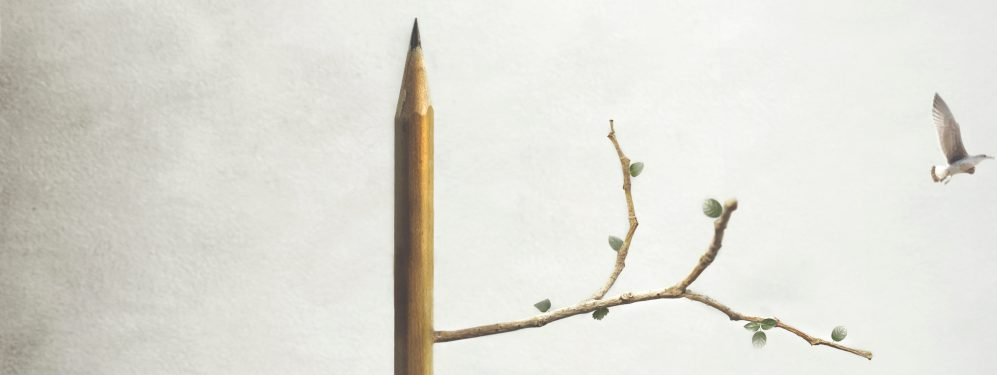


 Richard L. Fricks