I’m currently taking a writing, blogging, and coaching sabbatical due to family health issues. For now, I’ll repost selected articles from my Fiction Writing School.
Surely there was a time when you said, “I love writing!”
Most people feel that way when they start writing. But after years in the writing business, it’s possible for that feeling to fade.
If that’s happened to you, it’s natural for you to feel nervous. You may wonder if you’ve still “got it” when it comes to writing. You may be afraid that your best writing years are behind you.
Or maybe you wonder if you should be writing at all.
Never fear. If you loved writing once, you can love it again. All it takes is a little time and perhaps one of the following suggestions.
Love Writing Exercise 1: Re-Read Some of Your Old Work
It’s easy to fall out of love with your writing when you’re working on a long project.
You may have come up against obstacles that you had a hard time working through. Maybe you’ve been blocked on the story, or have been unable to finish it for one reason or another.
As weeks, months, or even years pass, the shine can easily wear off of a writing project. What seemed so exciting and full of possibility in the beginning may now seem dull and hopeless.
Try to re-ignite your love of writing by reading something else that you’ve written. Peruse your old files and check out some of your poems, short stories, children’s stories, or other novels.
You may see some passages that make you cringe (as you get better, it’s natural to judge your old works), but it’s also possible you’ll find something that will make you smile or laugh, or that will move you to tears.
When you read your past work, even if it’s not as good as you’d like it to be, it will remind you of your passion for writing. You’ll remember what you felt like when you wrote that piece, and how eager you were to improve your writing skills. That may be enough to turn your thoughts about your writing in a more positive direction.
It could also be that as you read your old stuff, you’ll realize how much better you’ve become! That too can encourage you to go back to your current project because hey, you didn’t see it before, but this is pretty good!
2. Focus on Your Passions
There’s a Willa Cather quote that goes: “A reporter can write equally well about everything that is presented to his view, but a creative writer can do his best only with what lies within the range and character of his deepest sympathies.”
I have found this to be true in my fiction writing. If the story isn’t tapping into something deep within me, I can’t stick with it. It gets boring.
If you’ve fallen out of love with your writing, it could be because you’re just not passionate about the story. Maybe the plot, characters, setting, or all of the above don’t resonate with you. You don’t care about it as much as you thought you would.
Consider too that you’re not writing about what you want to write about because it scares you. This is one of the most common reasons writers shy away from their “deepest sympathies.” If you suspect this may be the case, try tip #4 to see if that helps.
Either way, remember that when you’re writing, you need to write about what you’re passionate about. If you’re not doing that, the feeling is likely to be missing.
Love Writing Exercise 3: Plan a Retreat
Sometimes we fall out of love with writing simply because we’re burned out.
It happens a lot. Writers are frequently overworked and overwhelmed. With so much of the marketing and platform-building now on our shoulders, we can easily become over-booked and find ourselves running around like chickens with our heads cut off.
If, after a book launch, website revamp, series of interviews, or other similar situation, you feel like writing has become a chore instead of a pleasure, it’s time to plan a retreat. What you need is some time away from all the marketing and platform-building and all the rest to get back to what matters—the writing.
Even just four days in a different location (away from home) can be enough to jumpstart your creativity and get you excited about your story again.
4. Take 10 Minutes to Freewrite Something New
After writing steadily for a while, you may have inadvertently locked yourself into what you “should” write or what you think is your writing arena.
But life changes things. Maybe you started out writing fantasy, but a decade later, you find yourself bored with it. Or maybe horror was your thing, but now you’ve experienced a big life-changing event and you can’t muster the passion for horror that you used to have.
This is when you need to find out where you are as a writer now. The best way to do that is to put all your old projects away. Clear the deck. Then take a week or two to free-write every morning.
The time you spend is up to you. The important thing is to let your creative muse take you where it wants to. Instead of “writing,” try “listening.” Tune into your gut and your heart. Abandon your preconceived notions. Let your writing be like a meditation. Close your eyes and let your fingers fly.
Do this for a few days and see if something new emerges that excites you. If it does, follow where it leads.
Keep your expectations out of it! Don’t worry about whether it will become a publishable work or whether you’ll earn money with it. Forget all of that and just write for the joy of writing—and for the discovery you might make about yourself.
Love Writing Exercise 5: Focus on Educating Yourself
Let’s face it—sometimes we get frustrated with our writing because it’s simply not living up to our expectations for it.
This usually points to one solution—we need to become better writers. There are many ways to do that.
I always start with books. Find one that talks about the writing craft and read it. Consider how what’s suggested may apply to your story.
Other options include hiring an editor, signing on to a workshop, entering a contest (that provides feedback), or attending a conference.
Even if you’re feeling discouraged, you may be surprised at how quickly learning more about writing can turn things around for you. It can open up possibilities, and help you come up with ideas you never would have thought of before.
When you go back to try that new idea, it can spark new energy for your story so that soon, you find yourself loving it once again.
I’m currently taking a writing, blogging, and coaching sabbatical due to family health issues. For now, I’ll repost selected articles from my Fiction Writing School.
It’s difficult. Let me just say that at the beginning. Creativity can be a struggle even when you have equilibrium in your life. But when daily challenges disrupt your mental and emotional balance, finding time to write, paint, or play music feels impossibly difficult.
As I write this in San Francisco in September 2020, we are quite literally surrounded by wildfires. This morning the sky is red with smoke, the automatic street lights are still on at 11 a.m., and it’s raining ash. But we’re also in the midst of a society-defining pandemic, the most consequential American election in decades, and social upheaval to acknowledge that Black lives matter.
All of that is lurking outside our doors, in our homes, and taking up space in our minds. Inside, many of us are working from home while trying to keep our kids focused on academic achievement via Zoom. Some are keeping the medical, food, and safety systems running — you are heroes. Social gatherings are distant, muffled, and sweaty because of our masks. Even watching Disney’s “Mulan” is a political decision.
This is how you stay creative while all of that is swirling around you: remember that everything, difficult or easy, is a test of your determination and purpose. This is life during wartime, and you are a journalist at the event. Whether you are writing a newspaper article or a poem, your words and stories matter. They help you process the turbulence, make sense of the chaos, and bring order and deliberation to your days. You do all this by simply sitting down and saying to yourself, “Now I write.”
I’m attempting to create that order through my current science fiction project. Even though it’s a story set 450 years in the future, it is very much a product of the current moment. My main character is Black, in part because I want more diversity in science fiction (and I secretly imagined Chadwick Boseman playing him in the movie version, but that’s a different story.) This forces me to examine what life is like for Black men now, so I can extrapolate that into the future. Even though I wrote the outline for this story almost 20 years ago, writing it now has helped me focus on the social upheaval and growth that surrounds me. I’m no Shakespeare, who is reputed to have written “King Lear” under a stay-at-home order during a plague. But the words I write, and the stories I tell, are part of the zeitgeist of today.
Fully invest yourself in this moment and don’t shy away from the discomfort. Empathy can change your life. Ask yourself: Why are people protesting? Why is this election such a historical inflection point? What about people for whom this level of catastrophe is a daily experience? Write, and let that inform your writing. The world is always on fire somewhere. If it’s only now making you uncomfortable, then you get to examine your privilege and why you have been insulated from the worst of it.
Luckily, you’re an artist. You get to write about it, sketch it, sculpt it, create a dance that embodies the confusion and chaos. You get to be a historian for this moment, even if what you write is not directly related to current events. This is how you can focus yourself during all this disruption and distill the cacophony into some sort of order.
Is it more difficult to find a creative spark? Maybe. Is it more difficult to create the space to work? Absolutely, particularly if you live with family or roommates, and none of them ever leave the house! Is it more difficult to find the time? Yes. But it’s worth it. It might be challenging to give priority to your creative endeavors, but try to find time, even if it’s only five or 10 minutes a day.
You are tired. You are stressed. You are uncertain. But you can make time to create. Every 10 minutes you spend opening yourself to your story can be a healing experience, even if your art is only for you. We all yearn for respite, and the arts offer us the space to imagine a less chaotic, overwhelming world.
It’s life during wartime, the world is on fire, and we need to hear your story, to hear your song, to watch your dance, to hear you recite your poem, your voice cracking with anger, fear, and hope.
Write.
Dance.
Play.
Act.
Create.
Published by Rennie Saunders
Rennie founded Shut Up & Write! in 2007 following a desire to meet fellow writers while working on a series of science fiction novels. Rennie spends an inordinate amount of time reading Wikipedia and Discover Magazine articles as research for his science fiction writing, practices Indonesian martial arts and cooks wholesome dinners for his family. His novella, Pale Angel, is available on Amazon and The Proteus Knife, a novel, will be released in late 2019. View more posts
I’m currently taking a writing, blogging, and coaching sabbatical due to family health issues. For now, I’ll repost selected articles from my Fiction Writing School.
A hymn of rage, a hymn of redemption, and a timeless love letter to the possible.
BY MARIA POPOVA
“Day by day I am approaching the goal which I apprehend but cannot describe,” Ludwig van Beethoven (December 16, 1770–March 26, 1827) wrote to his boyhood friend, rallying his own resilience as he began losing his hearing. A year later, shortly after completing his Second Symphony, he sent his brothers a stunning letter about the joy of suffering overcome, in which he resolved:
Ah! how could I possibly quit the world before bringing forth all that I felt it was my vocation to produce?
That year, he began — though he did not yet know it, as we never do — the long gestation of what would become not only his greatest creative and spiritual triumph, not only a turning point in the history of music that revolutionized the symphony and planted the seed of the pop song, but an eternal masterwork of the supreme human art: making meaning out of chaos, beauty out of sorrow.
Across the epochs, “Ode to Joy” rises vast and eternal, transcending all of spacetime and at the same time compacting it into something so intimate, so immediate, that nothing seems to exist outside this singularity of all-pervading possibility. Inside its total drama, a total tranquility; inside its revolt, an oasis of refuge. The story of its making is as vitalizing as the masterpiece itself — or, rather, its story is the very reason for its vitality.
Beethoven by Josef Willibrord Mähler circa 1804-1805. (Available as a print.)
As a teenager, while auditing Kant’s lectures at the University of Bonn, Beethoven had fallen under the spell of transcendental idealism and the ideas of the Enlightenment — ideas permeating the poetry of Friedrich Schiller. A volume of it became the young Beethoven’s most cherished book and so began the dream of setting it to music. (There is singular magic in a timeless poem set to music.)
One particular poem especially entranced him: Written when Beethoven was fifteen and the electric spirit of revolution saturated Europe’s atmosphere, Schiller’s “Ode to Joy” was at heart an ode to freedom — a blazing manifesto for the Enlightenment ethos that if freedom, justice, and human happiness are placed at the center of life and made its primary devotion, politically and personally, then peace and kindness would envelop humankind as an inevitable consequence. A “kiss for the whole world,” Schiller had written, and the teenage Beethoven longed to be lips of the possible.
This Elysian dream ended not even a decade later as the Reign of Terror dropped the blade of the guillotine upon Marie Antoinette, then upon ten thousand other heads and the dreams they carried. Schiller died considering his “Ode to Joy” a failure — an idealist’s fantasy unmoored from reality, a work of art that might have been of service perhaps for him, perhaps for a handful of others, “but not for the world.”
The young Beethoven was among those few it touched, and this was enough, more than enough — he took Schiller’s bright beam of possibility and magnified it through the lens of his own genius to illuminate all of humanity for all of time. Epochs later, in the savage century of the World Wars and the Holocaust, Rebecca West — another uncommon visionary, who understood that “art is not a plaything, but a necessity” — would contemplate how those rare few help the rest of humanity endure, observing that “if during the next million generations there is but one human being born in every generation who will not cease to inquire into the nature of his fate, even while it strips and bludgeons him, some day we shall read the riddle of our universe.”
While Schiller’s poem was ripening in Beethoven’s imagination, the decade-long Napoleonic Wars stripped and bludgeoned Europe. When Napoleon’s armies invaded and occupied Vienna — where Beethoven had moved at twenty-one to study with his great musical hero, Haydn — most of the wealthy fled to the country. He took refuge with his brother, sister-in-law, and young nephew in the city. Thirty-nine and almost entirely deaf, Beethoven found himself “suffering misery in a most concentrated form” — misery that “affected both body and soul” so profoundly that he produced “very little coherent work.” From inside the vortex of uncertainty and suffering, he wrote:
The existence I had built up only a short time ago rests on shaky foundations. What a destructive, disorderly life I see and hear around me: nothing but drums, cannons, and human misery in every form.
That spring, Haydn’s death only deepened his despair at life. The next six years were an unremitting heartache. His love went unreturned. He grew estranged from one of his brothers, who married a woman Beethoven disliked. His other brother died. He entered an endless legal combat over guardianship of his young nephew. He spent a year bedridden with a mysterious illness he called “an inflammatory fever,” riddled with skull-splitting headaches. His hearing almost completely deteriorated. He grew repulsed by the trendy mysticism of new musical developments, which made no room for the raw human emotion that was to him both the truest material and truest product of art.
One of William Blake’s paintings for The Book of Job, 1806. (Available as a print.)
Somehow, he kept composing, the act itself becoming the fulcrum by which Beethoven lifted himself out of the black hole to perch on the event horizon of a new period of great creative fertility. While Blake — his twin in the tragic genius of outsiderdom — was painting the music of the heavens, Beethoven was grounding a possible heaven onto a disillusioned earth with music.
And then he ended up in jail.
One autumn day in 1822, the fifty-two-year-old composer put on his moth-eaten coat and set out for what he intended as a short morning walk in the city, his mind a tempest of ideas. Walking had always been his primary laboratory for creative problem-solving, so the morning stroll unspooled into a long half-conscious walk along the Danube. In a classic manifestation of the self-forgetting that marks the intense creative state now known as “flow,” Beethoven lost track of time, of distance, of the demands of his own body.
Beethoven by Julius Schmid
He walked and walked, hatless and absorbed, not realizing how famished and fatigued he was growing, until the afternoon found him wandering disheveled and disoriented in a river basin far into the countryside. There, he was arrested by local police for “behaving in a suspicious manner,” taken to jail as “a tramp” with no identity papers, and mocked for claiming that he was the great Beethoven — by then a national icon, with a corpus of celebrated concertos and sonatas to his name, and eight whole symphonies.
The tramp raged and raged, until eventually, close to midnight, the police dispatched a nervous officer to wake up a local musical director, who Beethoven demanded could identify him. Instant recognition. Righteous rage. Apologies. Immediate release. More rage. More apologies. Beethoven spent the night at his liberator’s house. In the morning, the town’s apologetic mayor collected him and drove him back to Vienna in the mayoral carriage.
What had so distracted Beethoven from space and time and self was that, twenty-seven years after falling under the spell of Schiller’s poem, he was at last ferocious with ideas for bringing it to life in music. He had been thinking about it incessantly for months. “Ode to Joy” would become the crowning achievement of his crowning achievement — the choral finale of his ninth and final symphony. It would distill the transcendent torment of his creative life: how to integrate rage and redemption, the solace of poetry with the drama of music; how to channel his own poetic fury as a force of beauty, of vitality, of meaning; how to turn the human darkness he had witnessed and suffered into something incandescent, something superhuman.One of Arthur Rackham’s rare 1917 illustrations for the fairy tales of the Brothers Grimm. (Available as a print.)
It had to be in a symphony, although he had not composed one in a decade and no composer — not Bach, not Mozart, not his hero Haydn — had ever woven words into a symphony before. It had to be the crowning choral finale of the symphony, although he had not written much choral music before. But the light of the idea beamed bright and irrefutable as spring. This was no time for old laurels, no time for catering to proven populisms — this was the time for creation. A decade earlier, Beethoven had written back to a young girl aspiring to become a great pianist, offering his advice on the central urgency of the creative calling:
The true artist is not proud… Though he may be admired by others, he is sad not to have reached that point to which his better genius only appears as a distant, guiding sun.
So often, in advising others, we are advising ourselves — the most innocent, vulnerable, and visionary parts of us, those parts from which the spontaneity and daring central to creative work spring. I wonder whether Beethoven remembered his own advice to Emilie as he faced the blank page that spring in 1822 when the first radiant contours of his “Ode to Joy” filled his mind and his footfall.
By summer, he was actively seeking out commissions to live on as he labored. He managed to procure a meager £50 from London’s Harmony Society, but that was enough subsistence and assurance to get to work. For more than a year, he labored unremittingly, stumbling over creative challenge after creative challenge — the price of making anything unexampled. His greatest puzzle was how to introduce the words into the final movement and how to choose the voices that would best carry them.
Meanwhile, word was spreading in Vienna that its most beloved composer was working on something wildly ambitious — his first symphony in a decade, and no ordinary symphony. But just as theater managers began vying for the premiere, Beethoven stunned everyone with the announcement that it was going to premiere in Berlin. He gave no reason. Viennese musicians took it as an affront — did he think they were too traditional to appreciate something so bold? He had been born in Germany, yes, but he had become himself in Austria. Surely, he owed the seedbed of his creative blossoming some measure of faith.
At the harsh peak of winter, Karoline Unger — the nineteen-year-old contralto Beethoven had already chosen to voice the deepest feeling-tones of his “Ode to Joy” — exhorted him to premiere his masterwork in Vienna. Writing in his Conversation Books — the notebooks through which the deaf composer communicated with the hearing world — she told him he had “too little self-confidence” in the Viennese public’s reception of his masterwork, urged him to go forward with the concert, then exclaimed: “O Obstinacy!”
Karolin Unger
Within a month, thirty of his most esteemed Austrian admirers — musicians and poets, composers and chamberlains — had co-written and signed an impassioned open letter to Beethoven, laced with patriotism and flattery, telling him that while his “name and creations belong to all contemporaneous humanity and every country which opens a susceptible bosom to art,” it is his artistic duty to complete the Austrian triad of Mozart and Haydn; imploring him not to entrust “the appreciation for the pure and eternally beautiful” to unworthy “foreign power” and to establish instead “a new sovereignty of the True and the Beautiful” in Vienna. The letter was hand-delivered to him by a court secretary who tutored the royal family.
Not even the most stubborn and single-minded artist is impervious to the sway of adulation. “It’s very beautiful, it makes me very happy!” The Viennese concert was on.
But Beethoven bent under the weight of his own expectations in a crippling combination of micro-managing and indecision. Eager to control every littlest detail to perfection, he committed to one theater, then changed his mind and committed to another, then it all became too much to bear — he cancelled the concert altogether.
After a monthlong tailspin, the finitude of time — concert season was almost over — pinned him to the still point of decision. He uncancelled the concert and, once again confounding everyone, signed with one of the underbidding imperial court theaters he had at first rejected.
The date was set for early May. He hand-picked the four soloists who would anchor the choir and assembled an orchestra dwarfing all convention: two dozen violins, two dozen wind instruments, a dozen cellos and basses, ten violas, and all that percussion.
It was to be not only a performance, not only a premiere, but something more — the emblem of a credo, musical and humanistic. The reception of the symphony would make or break the reception of the ideals behind it. Against this backdrop, it is slightly less shocking — but only slightly — that, in an astonishing final bid for total control of his creation, Beethoven demanded that he conduct the symphony himself.
Everyone knew he was deaf. Now they feared he was demented.
Beethoven by Joseph Karl Stieler
The theater, having won the coveted premiere, reluctantly conceded, fearing Beethoven might change his mind again if his demand went unmet, but persuaded him to have the original conductor onstage with him, with every assurance that he would only be there for backup. The conductor, meanwhile, instructed the choir and orchestra to follow only his motions and “pay no attention whatever to Beethoven’s beating of the time.” The best assurance even one of Beethoven’s closest friends — who later became his biographer — could muster was that the theater would be too dim for anyone to notice that Beethoven was conducting in his old green frock and not in the fashionable black coat a conductor was supposed to wear.
After two catastrophic rehearsals — the only two the enormous ensemble could manage in the brief time before the performance — the soloists railed that their parts were simply impossible to sing. Karoline Unger called him a “tyrant over all the vocal organs.” One of the two male soloists quit altogether and had to be replaced by a member of the choir who had memorized the part.
Somehow, the show went on.
On the early evening of May 7, 1824, the Viennese crowded into the concert hall — but they were not the usual patrons. Looking up to the royal box, Beethoven was crushed to see it empty. He had journeyed to the palace to personally invite the Emperor and Empress but, like most of the aristocracy, they had vanished into their country estate as soon as spring broke the harsh Austrian winter. He was going to be playing for the people. But it was the people, after all, that Schiller had yearned to vitalize with his poem.
Beethoven walked onto the grand stage, faced the orchestra, and raised his arms. Despite the natural imperfections of a performance built on such tensions, something shifted as soon as the music — exalted, sublime, total — rose above the individual lives and their individual strife, subsuming every body and every soul in a single harmonious transcendence.
After the final chord of “Ode to Joy” resounded, the gasping silence broke into a scream of applause. People leapt to their feet, waving their handkerchiefs and chanting his name. Beethoven, still facing the orchestra and still waving his arms to the delayed internal time of music only he could hear, noticed none of it, until Karoline Unger stood up, took his arm, and gently turned him around.
With the birth of photography still fifteen years of trial and triumph away, it is only in the mind’s eye that one can picture the cascade of confusion, disbelief, and elation that must have washed over Beethoven’s face in that sublime moment when his guiding sun seemed suddenly so proximate, almost blinding with triumph.
As soon as he faced the audience, the entire human mass erupted with not one, not two, not three, but four volcanic bursts of applause, until the Police Commissioner managed to yell “Silence!” over the fifth. These were still revolutionary times, after all, and art that roused so fierce a response in the human soul — even if that response was exultant joy — was dangerous art. Here, in the unassailable message of “Ode to Joy,” was a clarion call to humanity to discard all the false gods that had fueled a century of unremitting wars and millennia of inequality — the divisions of nation and rank, the oppressions of dogma and tradition — and band together in universal sympathy and solidarity.
Woodcut by Vanessa Bell from “A String Quartet” by Virginia Woolf, 1921. (Available as a print.)
The sound of Beethoven’s call resounded long after its creator was gone. Whitman celebrated it as the profoundest expression of nature and human nature. Helen Keller “heard” it with her hand pressed against the radio speaker and suddenly understood the meaning of music. Chilean protesters sang it as they took down the Pinochet dictatorship. Japanese musicians performed it after the Tōhoku earthquake and tsunami. Chinese students blasted it in Tiananmen Square. Leonard Bernstein, patron saint of music as an instrument of humanism, conducted a group of musicians who had lived on both sides of the Berlin Wall in a Christmas Day concert commemorating the twentieth anniversary of its fall. Ukrainian composer Victoria Poleva reimagined it for an international concert commemorating the fiftieth anniversary. A decade later, the National Symphony Orchestra of Ukraine performed her reimagining not long before a twenty-first century tyrant with a Napoleonic complex and a soul deaf to the music of life bludgeoned the small country with his lust for power.
But this, I suspect, was Beethoven’s stubborn, sacred point — the reason he never gave up on Schiller’s dream, even as he lived through nightmares: this unassailable insistence that although the Napoleons and Putins of the world will rise to power again and again over the centuries, they will also fall, because there is something in us more powerful as long as we continue placing freedom, justice, and universal happiness at the center of our commitment to life, even as we live through nightmares. Two centuries after Beethoven, Zadie Smith affirmed this elemental reality in her own life-honed conviction that “progress is never permanent, will always be threatened, must be redoubled, restated and reimagined if it is to survive.”
In the winter of my thirteenth year, two centuries after Beethoven’s day and a few fragile years after the fall of Bulgaria’s communist dictatorship, I stood in the holiday-bedazzled National Symphony Hall alongside a dozen classmates from the Sofia Mathematics Gymnasium, our choir about to perform Beethoven’s “Ode to Joy,” recently adopted as the anthem of Europe by the European Union, of which the newly liberated Bulgaria longed to be a part.
We sang the lyrics in Bulgarian, but “joy” has no direct translation. “Felicity” might come the closest, or “mirth” — those wing-clipped cousins of joy, bearing the same bright feeling-tone, but lacking its elation, its all-pervading exhale — a diminishment reflecting the spirit of a people just emerging from five centuries of Ottoman occupation closely followed by a half-century Communist dictatorship.
And yet we stood there in our best clothes, in the spring of life, singing together, our teenage minds abloom with quadratic equations and a lust for life, our teenage bodies reverberating with the redemptive dream of a visionary who had died epochs before any of our lives was but a glimmer in a great-great-grandparent’s eye, our teenage spirits longing to kiss the whole world with possibility.
Today, “Ode to Joy” — a recording by the Berlin Philharmonic from the year I was born — streams into my wireless headphones as I cross the Brooklyn Bridge on my bicycle, riding into a life undreamt in that teenage girl’s wildest dreams, into a world unimaginable to Beethoven, a world where suffering remains our constant companion but life is infinitely more possible for infinitely more people, and more kinds of people, than even the farthest seer of 1822 could have envisioned.
I ride into the spring night, singing. This, in the end, might be the truest translation of “joy” — this ecstatic fusion of presence and possibility.
donating = loving
Each month, I spend hundreds of hours and thousands of dollars keeping The Marginalian (formerly Brain Pickings) going. For fifteen years, it has remained free and ad-free and alive thanks to patronage from readers. I have no staff, no interns, not even an assistant — a thoroughly one-woman labor of love that is also my life and my livelihood. If this labor has made your own life more livable in the past year (or the past decade), please consider aiding its sustenance with a one-time or loyal donation. Your support makes all the difference.
Partial to Bitcoin? You can beam some bit-love my way: 197usDS6AsL9wDKxtGM6xaWjmR5ejgqem7
CANCEL MONTHLY SUPPORT
Need to cancel an existing donation? (It’s okay — life changes course. I treasure your kindness and appreciate your support for as long as it lasted.) You can do so on this page.
sunday newsletter
The Marginalian has a free Sunday digest of the week’s most mind-broadening and heart-lifting reflections spanning art, science, poetry, philosophy, and other tendrils of our search for truth, beauty, meaning, and creative vitality. Here’s an example. Like? Claim yours:
midweek newsletter
Also: Because The Marginalian is well into its second decade and because I write primarily about ideas of timeless nourishment, each Wednesday I dive into the archive and resurface from among the thousands of essays one worth resavoring. Subscribe to this free midweek pick-me-up for heart, mind, and spirit below — it is separate from the standard Sunday digest of new pieces:
I’m currently taking a writing, blogging, and coaching sabbatical due to family health issues. For now, I’ll repost selected articles from my Fiction Writing School.
While readers love to see larger-than-life characters with passion, take-charge attitudes, and heaps of boldness and daring, not every protagonist wears an extrovert skin. In fact, looking at real-life demographics for a second, I think there’s a lot more people on the quieter side than not. Some of us are introverted, others, on the shy side. People can also be deep thinkers or natural observers. And of course many struggle with doubt and insecurity, and extroverted or not, it’s enough to keep them from actively choosing the spotlight.
Whatever the reason is, it is worth remembering that if we’re to mirror the real world in our fiction, those loud, brash characters are the exception, not the rule. Besides, if all our story cast members have big, BIG personalities it will create a tug-of-war for the reader’s attention, and the story can suffer as a result. We need quieter characters, too…especially because quiet DOESN’T mean boring.
The trick with quieter characters is finding a way for them to stand out. If you have a shy woman or a calm and careful man, each will be naturally more reserved with their actions and choices. They likely think before they act, look both ways before crossing the street, that sort of thing. They may be predictable, and if we aren’t careful, they might become forgettable. This is death if your quieter character happens to be the protagonist, so let’s look at three ways to make sure they command the stage.
Use Contrast
Contrast is a great way to bring the spotlight back to your quiet character. Pair them against a flashy cast, like a friend who is bold yet arrogant, or a parent who is feisty and reckless. A teacher who abrasive and opportunistic, or an erratic, superstitious boss. When the people around your quiet hero are creating a lot of drama, then your protagonist can become an interesting and insightful counterweight.
To make this work, ensure that something about them (a trait, a talent, an interest or hobby, knowledge they have, or something else) is special and connected to the current problem or what’s at stake. For example, imagine half a dozen superficial, attention-jockeying teens on a school hiking trip who become separated from the larger group. Between blaming each other for getting lost and hysterics about starving or being mauled by a bear, no one in this group is capable of solving the problem at hand. But imagine that one of the kids assigned to this group is our protagonist, a logical thinker who spends his time Geo-caching for fun. Who is suddenly going to be the focus as he’s the best suited to navigating everyone back to the campsite?
Offer Readers Something Unexpected
People can be meek and mild, but in books, a too-quiet introvert will quickly bore the reader. Imagine a schoolgirl, her perfectly combed hair, her steps careful as she watches for cracks on the sidewalk. You can see her, can’t you, clutching books to her chest, unassuming, polite, so different from the hormonal teen freak show going on around her. She does her homework. Raises her hand enough to stay off the teacher’s radar. Her schoolmates don’t know her name and find her utterly forgettable…and readers will too if we leave her in this Plain Jane purgatory.
Yet, if we give her something unexpected, the very details that made her fade will bring her to life. Maybe we give her a secret, or allude to a desire of hers that is so much bigger than her blah exterior.
We could also reveal something about her that will make a reader’s breath catch.
What if those books she clutches are holding something in place…an injured bird found on the way to school? But she’s not holding it there to protect it. Instead, each twitch, jerk, and flutter floods her body with exhilaration, so much so that she squeezes harder, smothering away its cries as claws dig through her sweater, until finally, all movement stops.
Her carefully controlled demeanor takes on a whole new meaning, doesn’t it?
Create Reader Empathy Using Deep POV
When characters don’t have noticeably extroverted traits and behaviors, they don’t usually express themselves outwardly to the same degree as those that do. However, one thing every introvert has is big, deep thoughts. They might not be showing their emotion as actively as other characters do but you can bet they are thinking, reflecting, and FEELING.
Pulling the reader inside your quiet protagonist is a great way to show their raw emotions as a scene plays out. Deep POV means instead of watching everything from a distance, readers see through the eyes of the protagonist and experience the visceral quality of their emotions. (This in turn lends more weight to any outward expressions because their body language is layered with the context of their thoughts.)
Deep POV means what a character sees and senses becomes a shared emotional experience for the reader. And in heightened emotional moments, they often find themselves remembering their own life experiences when they themselves felt something similar to what the character is feeling. These echoes mean that deep POV is a powerful tool for creating closeness and that all-important empathy bond.Click here to download our One Stop for Writers checklist on Deep POV.
I’m currently taking a writing, blogging, and coaching sabbatical due to family health issues. For now, I’ll repost selected articles from my Fiction Writing School.
Time is all we have because time is what we are — which is why the undoing of time, of time’s promise of itself, is the undoing of our very selves.
In the dismorrowed undoing of 2020 — as Zadie Smith was calibrating the limitations of Stoic philosophy in a world suddenly time-warped by a global quarantine, suddenly sobered to the perennial uncertainty of the future — loss beyond the collective heartache besieged the miniature world of my sunny-spirited, largehearted friend and Caldecott-winning children’s book maker Sophie Blackall. She coped the way all artists cope, complained the way all makers complain: by making something of beauty and substance, something that begins as a quickening of self-salvation in one’s own heart and ripples out to touch, to salve, maybe even to save others — which might be both the broadest and the most precise definition of art.
One morning under the hot shower, Sophie began making a mental list of things to look forward to — a lovely gesture of taking tomorrow’s outstretched hand in that handshake of trust and resolve we call optimism.
№3: hot shower
As the list grew and she began drawing each item on it, she noticed how many were things that needn’t wait for some uncertain future — unfussy gladnesses readily available in the now, any now. A century after Hermann Hesse extolled “the little joys” as the most important habit for fully present living, Sophie’s list became not an emblem of expectancy but an invitation to presence — not a deferral of life but a celebration of it, of the myriad marvels that come alive as soon as we become just a little more attentive, a little more appreciative, a little more animated by our own elemental nature as “atoms with consciousness” and “matter with curiosity.”
№5: hugging a friend
Sophie began sharing the illustrated meditations on her Instagram (which is itself a rare island of unremitting delight and generosity amid the stream of hollow selfing we call social media) — each part record of personal gladness, part creative prompt. Delight begets delight — people began sending her their responses to these prompts: unbidden kindnesses done for neighbors, unexpected hobbies taken up, and oh so many sweet strange faces drawn on eggs.
You can relish a rainbow and a cup of tea, sunrise and a flock of birds, a cemetery walk and a friend’s newborn, the first blush of wildflowers in a patch of dirt and the looping rapture of an old favorite song. You can’t tidy up the White House, but you can tidy up that neglected messy corner of your home; you can’t mend a world, but you can mend the hole in the polka-dot pocket of your favorite coat. They are not the same thing, but they are part of the same thing, which is all there is — life living itself through us, moment by moment, one broken beautiful thing at a time.
№48: walking in cemeteries№22: weddings№10: first snow
Sophie writes in the preface:
I have always been a cheerful sort of person, able to find the silver lining in just about any cloud, but 2020 was a son-of-a-cumulonimbus. There was the pandemic, of course, which knocked us all sideways. Like most people, I tried to remain hopeful, counting my blessings, grateful to be alive when so many were dying. But also like most people, I was full of anxiety and fear and grief and uncertainty. My partner, Ed, and I worried about bills, fretted about my aging parents, and missed our kids, who were living away from home. Deciding to downsize, we moved out of the apartment we had happily rented for ten years with our blended family, the longest either of us had ever lived anywhere. We canceled our wedding, because we knew we couldn’t get married without our loved ones. Then in the fall, Nick, the dear, queer father of my children, died in an accident on the other side of the world. The thunderclouds really closed in then, and for a while I struggled to find any rays of hope. I almost lost sight of beauty and wonder and delight.
With an eye to the dangerous seductions of nostalgia — that longing not for a bygone time but for the bygone selves and certitudes that time contained — she adds:
I have often found myself romanticizing the Before Times, when we could travel the world and hug our friends and shake hands with strangers, but I have come to the conclusion that it’s better to look forward: to gather the things we’ve learned and use our patience and perseverance and courage and empathy to care for each other and to work toward a better future for all people. To look forward to things like long-term environmental protection and racial justice; equal rights and an inclusive society; free health care and equitable education; an end to poverty, hunger, and war. But we can also look forward to everyday things that will buoy our spirits and make us laugh and help us feel alive and that will bring others comfort and hope.
№27: collecting pebbles
Tucked between the quiet joys of painting on pebbles and rereading a favorite passage from a favorite book and enfolding a loved one in a simple hug is the unfailing consolation of the cosmic perspective and its simplest, most enchanting guise, which the visionary Margaret Fuller reverenced, a century and a half earlier amid a world torn by revolutions and economic collapse, as “that best fact, the Moon.”
№21: a full moon
In the twenty-first entry, devoted to the full Moon, Sophie writes:
Wherever we are in the world, we see the same moon. It’s the same moon earliest humans would have seen, waxing and waning, rising and setting. Depending on where we were thousands of years ago, we would look to a full moon to mark time, to tell us when to plant corn, when to lay the rice to dry, and when to expect the ducks back. Now we look to the moon and marvel that men have traveled there in unlikely contraptions and actually set foot on its surface. It is our stepping-stone to the vast universe, and looking at a full moon can make us feel very small and very young. But it can also remind us to make the most of our time here on earth, to pop corn and throw rice and watch for ducks.
№44: doing your taxes№8: applause№31: moving the furniture around№25: new glasses
What makes the book so wondrous is that each seemingly mundane thing on the list shimmers with an aspect of the miraculous, each fragment of the personal opens into the universal, each playful wink at life grows wide-eyed with poignancy.
In the thirtieth entry, titled “Clean Laundry” and illustrated with a stack of neatly folded grey T-shirts, Sophie writes:
I tend to put off washing clothes until the last possible day, when I’m reduced to leggings with holes and the mustard top that inspires people to ask if I’m feeling OK, but clean laundry means a whole closet of possibilities. I can dress like a nineteenth-century French farmer or an Edwardian ghost or a deckhand on a whaler off Nantucket. Actually, those are pretty much my three options, but there are many subtle variations.
My clothes are pre-owned, unruly, and difficult to fold, but my partner wears a uniform. Not the kind with epaulets or creased slacks or his name embroidered on his chest, but a deliberate, self-selected uniform. Ed is a playwright and a teacher, and he heeds the advice of Gustave Flaubert: “Be regular and orderly in your life, so that you may be violent and original in your work.”
Once a year, he purchases six gray T-shirts and a dozen pairs of black socks and multiples of carefully chosen, unremarkable shirts and pants. On laundry day, his neatly folded piles of clean clothes are so dear and familiar they put a lump in my throat.
Pulsating through the book, through the list, through the life is the one thing that saves us all: love — the love of partners and of friends, of children and of flowers, of books and music and list-making and this whole improbable living world. Indeed, the entire book is one extended love letter to life itself, composed of the miniature, infinite loves that animate any given life.
In entry №37, titled “Falling in Love,” Sophie writes:
I met my husband, Nick, when I was twenty-one, and we moved in together before the year was out. We got married when I was twenty-five, and I had my first child at twenty-six. But I didn’t fall in love, not properly, until I was thirty-six. And it wasn’t with my husband. It wasn’t that Nick and I didn’t love each other. We did. We were best friends. He could play “My Funny Valentine” on his teeth and make anything out of nothing: a 1930s-style playhouse, a shirt out of a vintage tablecloth, Halloween costumes that made the news. He had a blinding temper, but he was as funny as he was angry, so I laughed at least as much as I cried. When we met, he thought he was 5 percent gay. It turned out he was 5 percent straight. But that was enough to make two excellent children, and we thought we were happy.
Days with young children can pass by in a blur of drop-offs and pickups, bath time and bedtime, Hot Wheels and carrot sticks and Shrinky Dinks. If you’re in love with your partner I can imagine finding moments to notice each other, managing, even through the blur, to see one another clearly. But if you’re not sure, then you can become kind of blurry yourself.
Later, when I met Ed, the man I would fall in love with, I was still a bit blurry, but I saw him in distinct detail. I noticed everything: his beautiful profile, his generous ears, his kind eyes. The way he shoved his T-shirt sleeve up on his handsome shoulder as he talked. His heartbreakingly neat handwriting. The way he was always reading, even when he was walking down the street, underlining without breaking stride. The way he carried everything in a stack: book, extra book, notebook, pen, phone, as though he’d never heard of bags. The way he followed a recipe and put all the ingredients in little bowls. The way his tongue stuck out when he chopped onions or dribbled a basketball or tied a child’d shoe. The way he made all the babies laugh. The way he made me laugh. The way he made my hands tremble.
And I noticed the way he noticed me too. He saw me more clearly than anyone had, ever before.
And bit by bit, I realized that I’d previously had no idea, no idea on earth, what it was to be in love and to be loved in return. Those were heady days. Fourteen years later, they still are. The point is, of course, that you can look forward to falling in love with the love of your life, day after day. If you haven’t found love yet, or found it and lost it, then it can find you, perhaps when you least expect it.
№37: falling in love
Complement Things to Look Forward to, to which neither screen nor synthesis do service, with Sophie’s splendid animation of Edna St. Vincent Millay’s poem “Dirge Without Music” — a sort of mirror-image counterpart to this elemental awareness that our time, finite and savage with creative force, is all we have — then revisit her illustrated celebration of our shared world.
I’m currently taking a writing, blogging, and coaching sabbatical due to family health issues. For now, I’ll repost selected articles from my Fiction Writing School.
The other day I was talking to another writer about the young adult time travel story I’m writing. Her first question was, “Do you have the book English Through the Ages?” I didn’t, but at her encouragement I got one immediately. The minute I opened the book it was my favorite writing tool, and I knew I had to tell you about it. Then I got to thinking about all the great writing tools on my bookshelves (both physical and digital), and I thought you might enjoy hearing about those, too. So today I’m sharing with you my favorite books that help me write books, beginning with my newest, English Through the Ages by William Brohaugh.
If you write contemporary or speculative fiction, you might not have a need for English Through the Ages. But if you want to know which came first, the chicken or the egg, stick around because this book has the answer and I’m going to share it. Plus I’ll tell you about other cool tools you might be interested in.
English Through the Ages is a hefty tome that’s kind of like a historical dictionary. It begins with Old English words that were in use in 1150, and then adds words decade by decade as they came into use through 1990. The words in each section are divided into categories like “Technology,” “Fashion,” and “Everyday Life” for easy reference. Plus a full third of the book is an alphabetical index so you can quickly find a particular word you’re curious about.
I use the book in a number of ways to make sure the language I’m using in my story is appropriate to the time period. The chapters I’m writing now take place in the U.S. in the early 1900s. I have one of the characters saying the word “quibble,” but I wasn’t certain if that word was in use then, so I looked it up in the index. Turns out the word has been in use—with the same meaning—since the 1650s, so I’m set! I can use the word with confidence.
Another way I use the book is to browse the decade following the one I’m writing about—these words should NOT be used in my story because they weren’t in common use yet. Example: the word “brassiere” wasn’t commonly used until 1915, and “bra” not until 1935. This could be important to a modern-day girl who finds herself in 1900 (my protagonist), so I did some further research and learned that bras themselves were in use in 1900 but just not called bras. Fascinating and useful, too—it gave me an idea for a scene where my character’s modern bra threatens to give her away as someone who doesn’t belong there…err, then. (Time travel is hard!)
Note that English Through the Ages is out of print and there is no e-book version available. However there are plenty of used copies floating around. Check your local library, used bookstore, or online bookseller. You’re sure to find a copy, and inexpensively to boot. (“To boot” has been in use since 1150.)
Another writing book that’s recently become one of my favorites is Save the Cat: The Last Book on Screenwriting You’ll Ever Need by Blake Snyder. I’m not a screenwriter, but after one look at this resource I understood why so many novelists swear by it: the information is awesome (a word that’s been in wide use in this context since the 1980s) and easily applicable to novel writing. For me, the gem in this book is Snyder’s “beat sheet” – a 15-point list of the critical elements that comprise a story’s structure. Not only does the book tell you what elements to include in what order, it specifies where in the story they should occur for maximum impact. When I used the beat sheet to lay out the plot of my current work-in-progress, I discovered a couple of “holes” I needed to fill, plus some areas where I might want to tighten the timing between plot points. As a bonus, if I get stuck while writing the story, I can simply refer to my beat sheet to get back on track. I’ve found this method of story planning to be so helpful, I expect to use it on every novel I write from here on out.
Before I discovered Save the Cat, Christopher Vogler’s The Writer’s Journey was my constant companion when story planning and plotting. This book takes the groundbreaking work of Joseph Campbell’s “the hero’s journey” and puts it into an accessible, digestible form for writers. Like Blake Snyder, Vogler’s roots are in film, and he draws on his experiences working on The Lion King and Star Wars to provide examples that are both illuminating and relatable. Also like Snyder, Vogler lays out story elements in clear terms, providing guidelines and milestones for great storytelling. I still refer to this book and the “hero’s journey” when story planning (“plan” was a latecomer to the English party, not appearing until the mid- to late-1900s), and I find The Writer’s Journey to be particularly helpful when I’m determining exactly where I should begin my hero’s journey.
My reference shelf holds a number of books I consult when creating characters. My favorite for building a protagonist is The Complete Writer’s Guide to Heroes and Heroines:Sixteen Master Archetypesby Tami D. Cowden, Caro LaFever, Sue Viders. Archetypes (in use since 1545) provide powerful templates from which to craft characters, and Heroes and Heroines serves them up on a platter for writers’ use. For building villains (in use to mean “antagonist” since 1830), my go-to reference is Bullies, Bastards And Bitches: How To Write The Bad Guys Of Fiction by Jessica Morrell. This book covers all kinds of bad guys—not just bullies, bastards, and bitches but anti-heroes, monsters, and sociopaths, too. It’s a must-have for any writer who wants to graduate from mustache-twirling one-note villains to multi-dimensional antagonists who torment your other characters deliciously and believably.
I recently celebrated a milestone birthday, and as a gift to myself I bought a book I’d been hearing about frequently from other novelists: The Emotion Thesaurus: A Writer’s Guide to Character Expressionby Becca Puglisi and Angela Ackerman. Thesauri (or thesauruses—equally acceptable) have been around a long time. In fact, the word “thesaurus” entered the lexicon in about 1600. But this thesaurus is different. The Emotion Thesaurus doesn’t provide synonyms for emotions, but rather gives writers an abundance of sources to draw from when s/he wants to depict or describe an emotion. Each entry includes lists of physical signals, internal sensations, mental responses, and cues that indicate different aspects of that emotion. To indicate dread, for instance, it offers options like giving my character a hunched posture and a drooping head (physical signal), a sluggish heartbeat (internal sensation), and/or an inability to see a positive outcome (mental response). If I want to show cues of suppressed dread, I can have her attempt to escape her problems using distractions, like TV or music. Or to indicate acute or long-term dread, I can have her jump at sudden sounds or seek any excuse to avoid what is to come. For further exploration of this emotion, it’s suggested that acute dread may escalate to anguish or terror, both of which have their own entries in the thesaurus. This book is def (1985) a serious (1985) writing tool, and that’s no spin (1985).
If I had to pick just one writing book that has helped me the most in my career, hands-down (in use since 1870) it would be GMC: Goal, Motivation, & Conflictby Debra Dixon. This book is an all-purpose tool—it works on character, plot, conflict, you-name-it—which is why I refer to it as the “Swiss Army knife of writing tools” in this previous blog that discusses GMC. Once I discovered this powerful tool, it was like the clouds parted and a ray of insight shone down upon my writing. Before I was introduced to Dixon’s book I’d never thought much about what my characters wanted or why they wanted it; this book showed me how to look at my characters in that light, as well as how to create conflict by putting formidable obstacles in my characters’ way. It allowed me understand my protagonists better, build stronger villains, raise the stakes, and increase tension. In short, I’m a better novelist because of this book.
Photo by Stephen W, courtesy of Creative Commons
Okay, here’s what you’ve been waiting for:
Chicken came first. Or at least the word did. According to English Through the Ages, historical records indicate that “chicken” entered in Old English sometime before the year 950. “Egg” doesn’t appear until the early 1300s.
Now you know.
Whatever it is you need to know, remember that books can be our best tools for writing books. I’ve told you my faves (in use since the 1940s). What are yours?
I’m currently taking a writing, blogging, and coaching sabbatical due to family health issues. For now, I’ll repost selected articles from my Fiction Writing School.
Have you ever been flipping through a magazine and found an excerpt from a book, maybe one you’d never read? And did reading that short passage make you want to read more, prompting you to go looking for the book? This is why a lot of authors and publicists publish book excerpts: to generate interest in their story. Erik Klass from Submitit is here to discuss why this might be a good idea for you, too.
A few years ago I read Elizabeth Gilbert’s “The Signature of All Things” in the journal One Story, and was blown away. When the eponymous book came out a short time later, I bought it. For readers like me, who skipped Eat, Pray, Love, getting a taste of Gilbert’s fiction was important. We can understand why the author (and probably her publishers) went to the trouble of getting an excerpt published.
But a more important reason to excerpt a novel, I believe, is that, with a few publishing credits in the quiver, an (otherwise) unpublished writer might have an easier time finding an agent and eventually a publisher for his or her first novel. It is a great separator, a free pass to the top of a (towering) pile of queries.
But, you say, your novel is structured with care. It is complete. It adheres to a particular emotional arc. It is the sum of its parts—or, correction, is greater than these parts. A completed puzzle. But a chapter, no mirror or fractal of its larger whole, may not have an arc of any kind.
And I rejoin: If a novel is a love affair, a short story is a one-night stand. It’s quick. Sometimes a little dirty. Strangers remain strangers. In many of my favorite short stories, very little actually happens. Not much time passes (it may stand still). They are all mood and indigo. A thought. A gesture. A crack in a bathroom mirror opens up a violence. The silhouette of a child’s kite against a setting sun brings back a memory. Let’s go into the woods and follow a stream and spot a deer beneath a blood-red sky. There can be great profundity in the small.
I’m currently working on a novel about a man wandering the streets of Łódź, Poland, contemplating the loss of love. In one chapter, about halfway through, the narrator sits in a small square in the city and remembers an afternoon at his ex-lover’s apartment. A moment in time echoing a moment in time. That’s it. No real narrative arc—maybe this is another word for plot—no arc at all. And yet, there are colors and sounds and smells. There’s that inescapable feeling of loss. The haunting fleetingness of memory. I’d like to believe it will work as a publishable excerpt.
Yes, short stories are often subtle. This, I think, is good news for your excerpt. You don’t need to connect all the dots. I recommend you don’t. Hint. Sprinkle breadcrumbs. Those gaps? Leave them. Have you ever stood close to a painting—let us say, Van Gogh’s Roses(1890)—and studied just one small section—perhaps a single white fallen petal in the canvas’s bottom corner, painted, it seems, with the tip of a finger? It is easy to miss, white against nearly white. It is a beautiful thing. This may be your excerpt.
But not all chapters are ready to reveal themselves, to throw off their novel (in both senses) clothes. An excerpt may require some work.
Let’s say your excerpt requires a little background. Try this: summarize your novel (up to the chapter) in a sentence or two. It’s a surprisingly easy—and startlingly effective—way to start a story. I just came up with this: My wife would be meeting her lover at 4 in the afternoon (Ulysses).
I think I’d keep reading.
And endings: Unlike most novels, your excerpt doesn’t need tidy resolution. In fact many short stories leave things vague. But you probably need a hint of resolution. Perhaps there is a catalyst, a spark, and we’re left to imagine the oncoming conflagration. (This might be how you’re ending your chapters already. It’s what we do, we novelists.) But if you need to tie things up ever so slightly, tie away.
The chapter I mentioned above ends with my narrator eventually rising from where he sits in the little Polish square and continuing his journey through the city. No resolution. (It’s a sad chapter.) But I didn’t want to end this excerpt like this. So in the last couple paragraphs I created a new character (yes: deus ex machina), a girl with long legs and violet-blue eyes. Not a word is spoken, but there’s that hint. It’s enough.
What I’m trying to say is that we may change our chapters. They are malleable, these precious things of ours. They are made not of stone, but of clay. We may even tear them, sometimes to shreds. For this novel—this interminable novel of mine—I wrote a chapter about eight Polish poets preparing for Vladimir Mayakovsky’s famous visit to Warsaw in May 1927. I get into their minds, explore their loves. With just a bit of work, I was able to pull short excerpts from this chapter and submit these new “flash” stories to a handful of journals; all but a few were accepted. (Here’s one, if you have half an interest.)
Most chapters, I believe, hold this potential. Consider it an exercise. Free of the pulling weight, the magnificent magnitude, of the rest of your novel, you may enter into your story’s story, use the tip of your finest brush (or finger), and paint anew.
Finally, there’s a whole art to submitting your—I must call it now—story. There’s much to submitting, but I’ll leave you with one piece of advice: read. There are literally hundreds of journals (I have over 400 on my list), and they vary widely. Many writers use Duotrope to search for journals—it’s a great place to start. (And if you want to make it really easy, I run a company that can help.) Read these things. It is pleasant homework.
I hope the above inspires you to submit excerpts from your novel. And I wish you success.
Erik Harper Klass is the founder of a full-service submissions company called Submitit. He has published stories in a variety of journals, including New England Review, Summerset Review, Maryland Literary Review, and Open: Journal of Arts and Letters, and he has been nominated for multiple Pushcart Prizes. He writes in Los Angeles, CA.
I’m currently taking a writing, blogging, and coaching sabbatical due to family health issues. For now, I’ll repost selected articles from my Fiction Writing School.
One of the greatest challenges of writing better stories is knowing exactly which scenes to write. The best scenes focus on the core elements of conflict — which means before you can write amazing scenes, you have to find the central conflict in a story.
Pin
You may have a great story idea in your head. But the specifics of it — which moments to capture — are unclear. The result is often writer’s block, or a story that feels “off,” meaning it isn’t focused on the right stuff.
That’s where Conflict Mapping can make your writing even better!
Strong scenes come from strong plans. And visualizing the types of conflict between your characters is a great way to do just that.
To give zest to your plot and move it forward, you need to integrate a type of conflict in every scene.
This can be seen as a moral conflict that sparks an internal struggle, or a force of external conflicts that threaten a character in a physical or other way.
Rarely does a story’s conflict magically appear in our minds. That’s because inspiration frequently comes from other sources: beauty, music, or situations. Rarely are we inspired by a focused sequence of events built around pursuing a goal (which is what a story is), because this tends to happen too quickly to note.
So when we sit down to write, we’re really just translating the image or idea we had into a word-picture.
Except those aren’t major conflicts.
I experienced this in 2012 when I decided to write a murder mystery about a family in New Orleans. My wife and I even went on vacation there, staying just outside the French Quarter.
And while we saw a lot of beautiful things, heard some amazing music, and came up with many interesting situations, strong story conflict did not come to us as we sweated our way through the city.
“
The beauty, music, and situations that inspire you to write are wonderful—but these alone are not the core conflicts of your story.
How can we translate inspiration and ideas into clear conflict in a story?
Simple: Start by drawing two circles.
Conflict Map: Drawing a Relationship
To begin your Conflict Map, draw two empty circles. Then, connect them with arcing arrows, like this:
Pin
Now, decide which two people are in a relationship in your story. You don’t need names. Just people. Mom and daughter? Boyfriend and girlfriend? Owner and dog? You decide. Just put something in there.
The point is that you are intentionally developing multiple characters in a a story, which gives you an opportunity to create conflict between people, particularly between one character and your protagonist.
Once you’ve done this, on the arrow extending from a character’s bubble, write what they want from the other character. It can be physical (preferable) or non-physical (okay — but add something physical to go with it, like “affection = hug”).
Then, consider what the other character might want from the first. Write it on their arrow.
As you do this, consider traits that might be essential to each character. Jot them in the circles. This is the time to create without any fear or reservations.
And to keep it fear-free, do it in pencil so you can erase and alter to your heart’s delight!
Create 4 Relationships
According to Robert McKee, there are four character types that nearly every protagonist has a relationship with in most stories. Whenever I’m building a new story in a new world, I find this to be a fantastic starting place, and it’s what I did as I built the world of my New Orleans play.
The four character types to fill first, as you plan, are:
Friend: What one might want from a friend? What does the exchange of goals look like in friendship?
Authority: How does this relationship create benevolent and/or negative energy?
Love: How does the protagonist think of, and possibly plan to, pursue their love interest?
Enemy: Who opposes the protagonist? Is it direct opposition (contradicting the protagonist’s goal), or competitive (pursing the same or a similar goal)?
Once you’ve established what the protagonist wants from each of these characters, draw arrows connecting the characters to each other. What might the Authority want from the Friend? The Friend from the Love? And so on.
Not only does this give you more characters to work with, but it plants the seeds for plenty of conflict that will blossom into strong scenes. When characters are engaged in authentic relationships, the conflict between them occurs more naturally. It doesn’t feel unclear, nor does it come out of nowhere.
So plan out two (or more) characters who want things from one another that cannot easily be given.
“
When you have characters in conflict, you have the makings of a strong story.
You can see my protagonist, Isabel’s, relationship with two of these characters below: the Friend (her adopted brother) and her Authority (her mother, Natasha). Note that I hadn’t figured out Andre’s goal, yet. This truly is a way to discover your protagonist’s “world!”
Pin
Add Goals and Go
When I was done with my Conflict Map, it was so big that my play couldn’t possibly contain all the characters and relationships. So I cut five of them!
Yet the map was invaluable for planning the relationships and conflict I would need to make the story work. It gave me the seeds of great, dramatic scenes.
And the result was a fun, thrilling play that surprised everyone with its authentic conflict.
There is one thing I didn’t do, though, that I highly recommend you do: Add action verbs to each character’s goal. There’s a big difference between an Enemy who chooses to “annihilate” to get their goal, versus one who “humiliates.”
My protagonist, a bride-to-be, chose to “soothe” her overbearing mother in order to get her goal of “genuine love and approval. The play would have been much different if she chose to blame, lie, or ignore. Verbs matter, and they can help you as you craft these crucial scenes.
Conflict is crucial in a plot and between characters and other forces, like the environment, that challenge the protagonist.
To help you come up with conflict, turn to your planning process. Remember, this is supposed to be messy, not a perfect, finished product. A well-executed plan can lead to a wonderful final product.
Whether or not the main conflict in your scene is internal conflict or minor characters blocking your protagonist and their pursuit of their scene goals, or other external obstacles standing in their way, engaging conflicts will advance a plot and keep your readers engaged.
To plan and implement conflict into your story, give Character Mapping a try. And watch as your story get stronger right away!
I’m currently taking a writing, blogging, and coaching sabbatical due to family health issues. For now, I’ll repost selected articles from my Fiction Writing School.
By Angela Ackerman, @AngelaAckerman Part of the How They Do It Series
JH: It’s a special treat today! Angela Ackerman takes the podium to share thoughts on the emotional wound and how it benefits our characters–and our stories.
Angela Ackerman is a writing coach, international speaker, and co-author of the bestselling book, The Emotion Thesaurus, as well as five others (including The Emotional Wound Thesaurus). Her books are available in six languages, are sourced by US universities, and are used by novelists, screenwriters, editors, and psychologists around the world. Angela is also the co-founder of the popular site Writers Helping Writers, as well as One Stop for Writers, an powerful online library built to help writers elevate their storytelling.
Take it away Angela… In fiction, a single piece of information usually drives the action, whether writers realize it or not: the protagonist’s emotional wound. Wounds are painful events that lurk in your character’s backstory, and in some way they changed how he or she views the world and themselves…in a very unhealthy way.
A wound might be a single event (like a terrible car accident or the death of a child), repeated episodes (such as domestic violence or a string of toxic relationships) or an ongoing detrimental situation (perhaps living in poverty, or suffering neglect at the hands of addicted parents).
Regardless of it’s shape,this shattering event leaves behind fear, pain, and destruction in its wake. Your character will adopt biases, negative attitudes, personality flaws, and other dysfunctional behaviors as emotional shielding to prevent more hurtful events from happening. While this shielding does help create a “buffer” around the character, it comes at a cost: fracturing his relationships, preventing self-growth, sabotaging his ability to achieve meaningful goals, and ensuring fear is ever-present in his life, steering his actions and choices. This is a recipe for unhappiness and unfulfillment…unless it can be reversed. If this sounds like character arc territory, you are correct. The character must learn to let go of the past and move forward differently if he is to achieve his story goal.
Because wounds are invasive, shaking even the strongest character’s foundation, choosing the right one is no small (or easy) task. While some authors prefer to let a protagonist’s fears and wounds emerge as they write, spending time up front to dig around in his or her backstory can save countless hours of revision.
There are a variety of ways to unearth what particular past event (and the fear it generates) is steering your character’s actions within the story. Here are a few areas to brainstorm which may help lead you straight to that painful past wound.
Past Influencers
It’s unfortunately true that those closest to us are in a position to inflict the most pain. In this way, the people our characters interacted with prior to the start of the story are often tied to their wounding events. Caregivers top the list, with their maltreatment birthing deep fears, generating irrational beliefs or biases, creating a legacy of abuse, or even causing unintentional parental failings to be passed through the generations.
For example, imagine a girl who helplessly watched her four-year-old sibling choke and die. She, in turn, could become a controlling mother, her fear causing her to hover over her own child to keep him safe. She may choose his friends and make most of his decisions for him because she believes she knows what’s best. And her son, growing up in this tightly monitored environment, will likely have lower self-esteem because he doesn’t trust his ability to make good decisions. Place this young man into your story as the main character and you have someone who struggles to be independent, obsesses about what others think, is hypersensitive to criticism, and avoids responsibility because he thinks he’ll screw up.
The ability to inflict pain is not just reserved for family, so think about people who left a negative mark on your character, perhaps restricting her growth, sabotaging her self-worth, inflicting a humiliation, or undermining her self-confidence. Mentors, past lovers, ex-friends, and people in positions of power may have imparted negative life lessons. Try asking this question: Whom from your character’s past would she never want to run into again and why?
Unpleasant Memories
Wounds hide within negative past experiences, such as a particular time of hardship, an event that cannot be forgotten, or a moment your character wishes she could utterly erase. Don’t be afraid to interview her about difficult situations she’s endured. Every person’s past is littered with mistakes, failures, disappointments, feelings of inferiority, and fear, so try your best to learn about these painful memories.
Personality Flaws
For some, personality is the first thing to emerge when brainstorming a new character. Maybe she has an amazing sense of humor, loves to learn, and is the most unmaterialistic person you might meet. But along with these qualities, she’s incredibly temperamental, going from hot to cold in a flash and taking offense when none was meant. Do some digging to uncover the why behind this flaw. What causes that reactiveness and hypersensitivity? Why is she so quick to see enemies where none exist? Identifying the situations that lead to this knee-jerk response will help you spot the emotions the character doesn’t want to feel, which will help you brainstorm the wounds that could be the cause of her emotional armor.
Fears
Fear is something most people are reluctant to experience, because while it can push us to strive harder for what we want, it also comes with a host of uncomfortable emotions. Clearly, your character will have a deep fear sitting at the heart of the defining wound that must be faced, but other fears and worries can also be markers of a wounding event. If you realize that your protagonist is afraid of water, why is this? If her heart rate picks up when her sister calls, delve into that response for more information. Fears don’t manifest by themselves, so search for their underlying reasons.
Secrets
One thing experience teaches us is that everyone keeps secrets. It’s second nature to hide the things that embarrass us, cause shame and guilt, or leave us feeling exposed and vulnerable. Ask yourself what your character is hiding. What information does she guard closely and would never want others to discover? This most likely touches on a shard of emotional trauma that she wishes to keep buried in the past.
Insecurities
Self-doubt is, to some degree, a problem for everyone. Worrying about not measuring up, making a mistake that impacts others, and disappointing loved ones can eat away at our self-worth. If your character is insecure about fitting in and being accepted, why is that? In which situations is she reluctant to make decisions or take risks? Thinking about her doubts and worries will create a starting point for brainstorming the negative experiences and influencers who left her feeling this way.
If you need more ideas on how to root around in your character’s history to find the defining wound, leaf through your Emotional Wound Thesaurus book, or browse the huge list of emotional wounds at our website, One Stop for Writers.
Readers connect to characters with depth, ones who have experienced life’s ups and downs. To deliver key players that are both realistic and compelling, writers must know them intimately—not only who they are in the present story, but also what made them that way. Of all the formative experiences in a character’s past, none are more destructive than emotional wounds. The aftershocks of trauma can change who they are, alter what they believe, and sabotage their ability to achieve meaningful goals, all of which will affect the trajectory of your story.
Identifying the backstory wound is crucial to understanding how it will shape your character’s behavior, and The Emotional Wound Thesaurus can help. Inside, you’ll find:
A database of traumatic situations common to the human experience
An in-depth study on a wound’s impact, including the fears, lies, personality shifts, and dysfunctional behaviors that can arise from different painful events
An extensive analysis of character arc and how the wound and any resulting unmet needs fit into it
Techniques on how to show the past experience to readers in a way that is both engaging and revelatory while avoiding the pitfalls of info dumps and telling
A showcase of popular characters and how their traumatic experiences reshaped them, leading to very specific story goals
A Backstory Wound Profile tool that will enable you to document your characters’ negative past experiences and the aftereffects
Root your characters in reality by giving them an authentic wound that causes difficulties and prompts them to strive for inner growth to overcome it. With its easy-to-read format and over 100 entries packed with information, The Emotional Wound Thesaurus is a crash course in psychology for creating characters that feel incredibly real to readers.
I’m currently taking a writing, blogging, and coaching sabbatical due to family health issues. For now, I’ll repost selected articles from my Fiction Writing School.
There are two definitions of story beat. Both of them refer to a change.
One use of the term beat refers to the subtle change in the dynamic of a relationship that a line of dialogue brings about in a scene. There are usually several beats within a scene, each a marker for pushing the scene forwards dramatically.
The other meaning of the word beat in storytelling applies to changes in the plot brought about by scenes. A plot is a succession of events linked causally, a narrative chain of cause and effect. One event effects a change, determining what happens in subsequent scenes. Writers might arrange these events on a board or “beat sheet” during the planning phase.
One of the most popular exponents of planning a plot according to beats was Blake Snyder. In his how-to book Save The Cat! The Last Book On Screenwriting That You’ll Ever Need, he presents fifteen scenes a Hollywood movie requires, starting with the Opening Image and ending with the Final Image. During story development, these scenes are arranged on a board containing exactly 40 index cards divided into four segments. The other 25 scenes connect the fifteen important ones.
While the emphasis in Save The Cat! is on commercial or popular storytelling á la Hollywood blockbusters, there are many aspects of Snyder’s approach that encourage the author to think about the audience’ emotional reaction to scenes. The Save The Cat moment of the title, for example, is a key scene placed early in narratives in which heroes do something selfless, such as rescuing a feline, thus establishing a core of goodness in their character so that the audience cares about them and will root for them when they later face dangers.
To read more of Beemgee’s writing craft articles click here








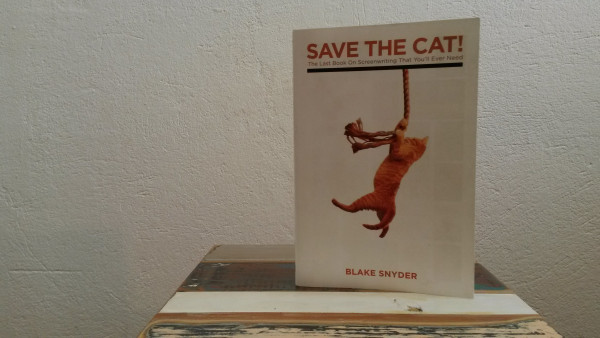
 Richard L. Fricks

