Internal Problem

I’m currently taking a writing and blogging sabbatical due to family health issues. For now, I’ll repost selected articles from my Fiction Writing School.

Here is the link to this article.

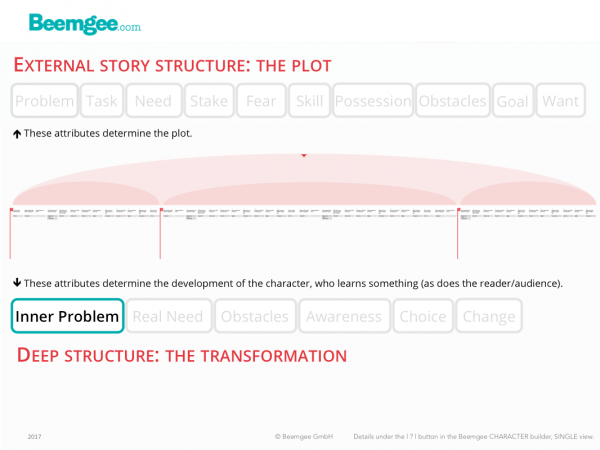
The internal problem is a character’s psychological or emotional flaw, weakness or shortcoming – and is often what makes the character interesting. So the internal problem is usually a negative and harmful character trait, possibly one that led to terrible mistake the character has made in the past. Watching the character resolve this inner issue by causing a change is what the story is really about, on a deeper level than the surface structure of the plot. So the author and the readers/audience need to know what the internal problem is – although the character may not. At least not until the middle or near the end of the narrative, when the realisation of this internal problem (gaining awareness) marks the beginning of its being (re)solved. What is this character’s issue?

An inner or internal problem is the chance for change.

While the external problem shows the audience the character’s motivation to act (he or she wants to solve the problem), it is the internal problem that gives the character depth.

In storytelling, the internal problem is a character’s weakness, flaw, lack, shortcoming, failure, dysfunction, error, miscalculation, or mistake. It is often manifested to the audience through a negative character trait. Classically, this flaw may be one of excess, such as too much pride. Almost always, the internal problem involves egoism. By overcoming it, the character will be wiser at the end of the story than at the beginning. Thus the character must learn cooperative behaviour in order to be a mature, socially functioning person.
Internal_1_Beemgee_InnerProblem

The inner problem is the pre-condition for the character’s transformation. It is the flaw, weakness, mistake, error, or deficit that needs to be fixed. In other words, it shows what the character needs to learn.

Internal problems may be character traits that cause harm or hurt to others. They cause anti-social behaviour. And internal problems can also harm the character. They can be detrimental to his or her solving the external problem.

From Lack of Awareness to Revelation

While the external problem provides a character’s want, i.e. motivation, the internal problem provides the need.

The audience sees the flaw before the character does. The character is blinkered, has a blind spot. She first has to learn to see what the audience already knows. At the beginning of the story the internal problem is a hindrance to the character’s emotional growth and even causes the character to hurt others. But eventually it may give rise to awareness or self-revelation. The character will recognise the internal problem and understand that it is harmful to him or herself or to others, and really needs to be solved.


The Internal Problem of a character is revealed to the audience in scenes that show the symptoms of the flaw for the character and her environment. It results in internal obstacles, specific instances of the character’s flaw which prevent her from progressing directly towards her goal. Furthermore, the antagonism in the story may well be a sort of symbolic manifestation of the protagonist’s internal problem.


So a character may initially not be aware of his or her internal problem. A character trait, after all, is something that has been in a character for a long time – since before the beginning of the story. In real life, the origin of behaviour patterns is seldom so singular and specific, but for authors of stories it helps to have scenes in mind for:

  • a scene early in the narrative that shows the audience the character’s flaw,
  • a “confirmation bias” moment, the outcome of which is that the character’s flawed belief or worldview is reinforced,
  • another incident that “touches the nerve” of our flawed character in such a way as to lead them to arduously defend themselves and their flaw, revealing the extent of their internal problem to the audience,
  • a scene which shows the character recognising the first cracks in the flawed world view, an initial revelation – often in the middle of the narrative,
  • a particular instance that is the origin or root cause of the character flaw,
  • the scene which demonstrates whether the character has fully recognised the problem and has learnt to act in such a way that the audience may now consider it solved.

The scenes don’t necessarily appear to the audience in that order. Since the inner problem was caused long before the story starts, all this seems to invite backstory scenes to explain its origin. But beware, there is a subtle writer trap here. More about that below.

The Problem Gives Rise to A Need

So: A character wants a certain state of being, a particular situation such as wealth, power, happiness, being in a relationship, owning a desired object. The character may believe this will be attained upon achieving a particular goal, the apparent manifestation of the solution to the external problem. However, once the character has reached the goal, it may transpire that the goal is not at all what the character needs in order to achieve the want. The full extent of the real need was perhaps suppressed by the character up to now, because it requires a change in character, which is to say a change of the negative character trait to a positive one.

In other words, growth. The character will grow by solving the internal problem. The internal problem is an emotional immaturity in the character. The real need the internal problem spawns is for emotional growth. This growth will turn the character into a person whose actions are no longer detrimental to the self, and who acts well towards others, i.e. with social responsibility.

That all sounds moralistic, which is a writer trap.

Writer Traps

We all know stories in which characters learn something and become better people by overcoming negative character traits. Very direct examples are the ones where a young protagonist helps a grumpy old person to redeem him or herself, such as True Grit or Scent Of A Woman. The idea of a main character having to learn something is so fundamental that its effects are visible in virtually all stories, especially – but not only – in ones from Hollywood.

Yes, the audience or reader should become aware of the internal problem of the character. And here’s how to avoid the morality trap: The internal problem should not be presented as something unforgivably reprehensible, but as a trait which the audience or reader recognises in themselves – to an extent at least. The more obviously anti-social the effects of the internal problem, the more the story turns into a morality piece. Generally speaking, the audience is more likely to have an emotional response to the story when the story does not transport a moral or the author’s intended meaning too explicitly. The audience is happier feeling it for themselves rather than having it spelled out to them.

And as for the backstory trap, this one is a doozy.

These days, for the last hundred years or so, we have a tendency to look for the origin of negative character traits in our own histories, often in the form of more or less powerful traumas suffered in our childhoods. Sigmund Freud has influenced storytelling here. Many modern stories provide explanations of the internal problem of a character by presenting a traumatic event which occurred in that character’s past. The film director Sidney Lumet mocks the “rubber-ducky” explanation scene: “Someone once took his rubber ducky away from him, and that’s why he’s a deranged killer.” A topos that has become a particular cliché in modern storytelling is child abuse. The protagonist was molested as a child; that explains the anti-social behaviour; confronting the trauma leads to its healing. Such simplistic explanations are writer traps.

It is quite possible to use a specific event in a character’s past as the cause of the internal problem without it turning into cliché. Speaking from a purely dramaturgical perspective, in terms of story structure there are alternatives to trauma. The ancient classics did not use traumatic events to provide an internal problem for a character to solve. Most older stories don’t try to find such psychological explanations – they are often less about trauma and more about errors of judgment. About mistakes.

Everyone makes mistakes. Everyone makes bad decisions sometimes. A bad call does not mean there needs to be a trauma. A bad call is usually simply the result of emotional immaturity.

So, the event that led to the internal problem does not have to bear Freud’s influence. The event could be a simple mistake a character made once upon a time, which comes back much, much later to haunt that character. An example from the ancient classics would be Sophocles’ Oedipus Rex.

Classically then, the internal problem is the cause of the external problem. Even stories that don’t manage to achieve this level of neatness will try to establish some connection between the external and the internal problems. In stories where the protagonist is her or his own worst enemy, such as Leaving Las Vegas, the internal problem becomes the antagonistic force.

To read more of Beemgee’s writing craft articles click here

The Most & Least Popular Genres of Mystery and Suspense

I’m currently taking a writing and blogging sabbatical due to family health issues. For now, I’ll repost selected articles from my Fiction Writing School.

Here is the link to this article.

By Emily Martin

MostLeastPopularGenreMysterySuspense_NovelSuspects

Mystery and suspense novels are some of the best-selling fiction genres, and have been for quite some time. But what kind of mystery and suspense novels are the most popular? Here is a list of mystery and suspense genres, ranked from most popular to least popular. This list was compiled by examining the amount of new works that were published in each genre in 2020 and how well these book sold. This is how “popular” was defined for this particular list.

It should also be noted that many books can be categorized into more than one mystery and/or suspense subgenre. Also, while some of these genres might not have been popular in the last year, these things are constantly changing. Like anything else, genres go through trends, and a lot of the subgenres within the mystery and suspense genres that were once very popular have fallen out of favor in recent years. Likewise, some old genres are regaining popularity, and new favorites have popped up as well. Enjoy this list for what it is: a snapshot of the mystery, suspense, crime fiction, and detective genres as they are at this point in time.

Psychological Thrillers

While psychological thrillers have always been a popular subgenre, we can trace the recent boom of psychological thriller novels to Gillian Flynn’s 2012 super hit novel Gone Girl. Psychological thrillers typically deal with characters who are dealing with psychological distress, usually because of some harrowing mystery or other suspenseful situation. A more recent example of a psychological thriller would be In the Clearing by J.P. Pomare.

Cozy Mystery

A cozy mystery has all of the thrills of a good mystery novel without all the blood and gore and gritty details. So it makes sense that this genre is so popular and has remained popular for decades. These novels often feature amateur detectives whom the reader can follow and root for. Many cozy mysteries are also serialized, which means when you get into a particular character or story, you can invest in those people and that story for many, many books. One example of a series with many books you can sink into: M.C. Beaton’s Agatha Raisin series. The most recent one, Hot to Trot came out in 2020.

Historical Mystery

Mystery genres quite frequently end up being crossed over with other genres, and one of the most popular of these crossovers is the historical mystery. This genre places detectives investigating crimes into different times in history. For instance, the novel Curious Toys by Elizabeth Hand is set in 1915 with the backdrop of a carnival.

Romantic Suspense

There is no denying the popularity of the romantic suspense genre. Though some titles lean more toward romance than suspense, we don’t imagine the popularity of romantic suspense books diminishing any time soon. If you like a little swoon with your action, we recommend this genre with titles like A Lady’s Guide to Mischief and Mayhem by Manda Collins.

Spy Thrillers

Who doesn’t love crime fiction and thrillers that feature spies? Charming spy characters like James Bond have long been a favorite in both novels and films. And while many of your older spy thrillers and espionage novels center around men as the protagonists, contemporary entries into the genre are becoming more diverse. Just look at American Spy by Lauren Wilkinson, which follows the story of an African American woman spy named Marie Mitchell.

Police Procedurals

Sure, it’s fun to see amateur detectives put clues together to solve a crime, but sometimes you just want to read a crime novel about a professional at work. Which is why police procedurals remain a pretty popular subgenre of mystery/thriller novels. As the name suggests, police procedural novels follow a police detective or a team of detectives hunting down a killer. Sometimes these novels switch back and forth between the detective’s perspective and the criminal’s perspective. One recent must-read example of police procedural fiction? If you’re a fan of the genre, you won’t want to miss James Patterson and J.D. Barker’s The Coast-to-Coast Murders.

Private Detective

On the flip side of the coin of police procedurals are private detective novels, coming in right after police procedurals in terms of popularity in recent years. Private detective novels focus on a private detective (obviously) and his or her journey to gather clues and ultimately solve a crime. There have been many famous private detective characters over the years, such as Sherlock Holmes and Hercule Poirot. A recent one you’ll love is Sherry Thomas’s Charlotte Holmes. The most recent book in her Lady Sherlock series is Murder on Cold Street.

Legal Thriller

For readers who are more interested in the justice side of crime fiction rather than the police or detectives, legal thrillers are the answer. Legal thrillers usually star a lawyer or some other court official who is working hard to get to the truth behind the crime when law officials seem to be on the wrong track. The Last Trial by Scott Turlow is an excellent new legal thriller you’ll want to read if you’re a fan of this subgenre.

Heist

More interested in the criminals and the thrilling act of the crime? Heist fiction takes you there. These stories focus on criminals as our antiheroes as we watch them perform nearly impossible thefts, usually of heavily guarded and highly prized items. While heist fiction is not as popular as other thriller subgenres, this genre still contains some popular favorites. Looking for a new, exciting heist story? Try Sandra Brown’s Thick as Thieves.

Locked Room

Locked room mysteries are fun because it adds a sense of urgency to solving the crime. Why? Locked room mysteries revolve around a seemingly unsolvable crime. How did the perpetrator get in? Get out? Because this is such a specific subgenre, not as many books are published that fit within this genre. But when locked room mysteries come out, they’re usually very much enjoyed by mystery fans. One recent locked-room mystery that was loved by many: The Woman in Cabin 10 by Ruth Ware.

Noir

Noir or hardboiled detective fiction is a genre that reached its height of popularity in the early-to-mid-20th century. These crime novels feature weathered and cynical private detectives who see the dark, edgy side of the city in which they live. As you can imagine, these stories are dark and often violent. While there have been more recent entries to the genre, this is one that has fallen out of favor in contemporary mystery fiction. Perhaps it’s because when a genre is so oversaturated, the tropes of the genre begin to feel cliché. Of course, mystery and thriller novels across genres still borrow conventions and are inspired by noir fiction. And as with any trend, we’ll likely see a resurgence at some point.

Supernatural Thriller

Why do supernatural thrillers have such a niche readership? Is it because people prefer concrete answers to their mystery stories? Is it easier to swallow a mystery if we know, at the end of the day, a butler did it and not some ghost that can’t be thrown in jail? Whatever the case may be, while supernatural thrillers continued to be published and read, the subgenre is not nearly as popular as others; however, there are gems like Imaginary Friend by Stephen Chbosky thats popularity reinvigorates this sub-genre.

Secrets

I’m currently taking a writing and blogging sabbatical due to family health issues. For now, I’ll repost selected articles from my Fiction Writing School.

Here is the link to this article.

Sometimes a character has a secret that provides a hidden motivation to that character’s actions. Does another character know of this secret? Does the audience? When is it revealed, and what happens as a consequence?

Character Secrets

What a character might know that others don’t – including the audience

When character's keep a secret or hide a truth

Some characters have secrets. We are not talking here about their internal problem or the need that arises out of it (they may be aware of such a problem or not.) We are talking about information that makes a difference to the story once it is shared.

Character secrets are intimately bound to the scene type called a reveal (which does not necessarily have to entail a revelation).

In terms of story (or rather the dramaturgy of the story), if a character has a secret that is never revealed, the secret is irrelevant. Only if the secret is made known at some point in the narrative does it really exist as a component of the plot.

For authors, the main aspects of character secrets to control are:

  • What plot event brings the secret about (this may be a backstory event)?
  • How does the secret alter or determine the character’s decisions or behaviour?
  • Does the character share the secret with another character at any point, and if so when (in which scene)?
  • At what point in the narrative (in which scene) does the audience receive knowledge of this secret?

Who are you, really?

If it is so important the character has a secret, then, often, the secret becomes part of who this character is. Their role in the story, their identity within the story, is determined by their secret. So secrets are dramaturgically important. 

Let’s take the fairy tale topos of the girl who pretends to be a boy in order to be allowed (by the patriarchal system) on some sort of quest. Typically in such a story there will be a scene early in the narrative in which the girl makes the choice to hide her real identity. Later there may be a scene in which she reveals her secret to an ally, the prince or love interest. The audience, however, knows about this secret all along. It is probably the whole point of the story, part of its premise.

An alternative scenario may be the (somewhat clichéd) idea of a character interacting with others throughout the bulk of narrative, and at a key point in the second half of the story the identity of this character being revealed as the long-lost son, heir to and saviour of the family fortune, for instance. In such a story, the audience is surprised by the reveal just as much as the other characters.

More sophisticated versions of the idea of character identity being part of a big secret keep the audience guessing about who the character really is. For example, many dramatized versions of the story of Martin Guerre, the French peasant who returned to his wife and family many years after having left to go to war, play with the doubt about the returnee’s real identity, thus creating tension. Similarly, in Homeland the audience wonders whether Brody has been ‘turned’ or not (and [caution: spoiler alert] some of CIA officer Carrie’s erratic behaviour is later explained when the secret is revealed that she has a bipolar disorder).

Secrets can create and maintain the audience’ curiosity and ongoing interest. Throughout thousands of pages, Dumbledore keeps (an implausible amount) of secrets from Harry Potter and thereby from the audience. The gradual unveiling of the truths behind the foregrounded plot are part of J.K. Rowlings overall design of the entire series. In Harry Potter the point of view character is Harry, and we know more or less what he knows. But with a different story design, tension may also be created by trying to keep track of who is in on the secret and who is not, that is, who is fooling who. Take for instance The Talented Mr. Ripley, who lies to many characters but cannot conceal everything from everyone, and the fun for the audience is waiting for him to get caught out.

The protagonist in Sixth Sense has a secret and doesn’t know it [caution: spoiler alert]. This secret is effectively lifted in a big reveal at the end of the movie, when the audience discovers the hero died in an early scene and for the greater part of the narrative has actually been a ghost. This forces the audience to reconsider all the previous scenes in the light of the new information. By comparison, much of the enduring appeal of Blade Runner resides in the (even more effective) doubt around the main character Deckard’s identity – is he a (non-human) replicant or isn’t he? By not answering the question and maintaining the secret, the movie allows fans to discuss the various clues for years, and the film may be considered more of a classic than Sixth Sense.

Summing up the secret

In terms of narrative structure, the reveal of a major secret should best be placed at a key point in the plot, possibly at the midpoint, or the second pinch point or second plot point. Since many stories lead to a revelation scene (for instance in a crime story when the true identity of the murderer is revealed), it may be tempting to treat the reveal of a great secret as the great story revelation. One should consider, however, that the most effective revelations concern a sort of meta-level understanding of the story that creates a change in the audience’ understanding of the world or themselves, i.e. that they have learnt something through experiencing this story. The reveal of a character secret can rarely carry quite so much weight.

Concerning character secrets, it is crucial is that the author always remain aware of the state of knowledge each character has at every stage of the plot, so that each character can act and react according to the state of his or her knowledge at that particular moment. It may be quite different from what the audience knows, or other characters, creating effects of dramatic irony.

Conversely, if a character knows more than the audience and solves problems with the benefit of knowledge or objects that the audience is unaware of or did not know the character has, then the audience feels cheated at the reveal. In some stories, usually not the great ones, you see a hero at a crucial moment whip out some object or other that the audience had thought lost, and you gasp, “oh, he does still have the thing”. The idea is that we think the hero clever for slyly putting the thing in his pocket back when we thought it got lost. But let’s face it, this is a cheap trick.

To read more of Beemgee’s writing craft articles click here

The Seven Deadly Sins of Novel Writing

I’m currently taking a writing and blogging sabbatical due to family health issues. For now, I’ll repost selected articles from my Fiction Writing School.

Here is the link to this article.

December 14, 2009 by ANGELA ACKERMAN

devil

In my mind, there are seven big things that can undermine a novel. I want to address them all, but to avoid having a post 8 miles long, I’ll break them up so they each have their own real estate. Today let’s look at the first sin on the list!

Sin#1: Low Stakes

Stakes are paramount in a novel–they force your character to act. High personal stakes create strong conflict because each choice or action will carry a hefty price. Low stakes lead to mediocre conflict and a risk that the reader will not care about the outcome.

Often low stakes can be attributed to two things:

–the storyline lacks adequate conflict

Conflict is the key to holding the reader’s attention and the driving force behind forward story movement and character investment. Pushing your character to clash with the forces against him or her is what gets the blood pumping–this is conflict! By infusing your story with scenes where characters experience heightened emotion and face powerful obstacles you not only create high stakes in your novel, you also raise them for the reader. Pages turn because your audience is drawn into the action, compelled to find out what happens next.

–The writer doesn’t push the characters hard enough

Sometimes the stakes are high, the consequences dire, the action bursting off the page…and the character does not rise to the challenge. While indecision is often a large part of any thought process when facing difficult choices, it cannot overrun the character’s actions. At some point, the character MUST COMMIT to a chosen course and put their all into it.

Other times, the writer sabotages the story because they care too much about a character to shove them in harm’s way or force them to do the dirty work. If circumstances or another character always swoop in and save the day, the stakes flatline. CHARACTERS ARE NOT OUR CHILDREN. Never hesitate to throw them into the path of a bus. Only then can we really see what they are made of.

Can you think of other ways low stakes ruin a novel? Have you ever cared about a character so much you struggled to force them to face their fears?

Sin # 2 Counterfeit Characters

Sin # 3 Missing the Mark on Voice & POV

Sin # 4 Plot Snafus

Sin # 5 Flat WordSmithing

Sin # 6 Dialogue Disaster

Sin # 7 TMI (Too Much Information)

BONUS SIN  Disappointing the Reader

External Obstacles

I’m currently taking a writing and blogging sabbatical due to family health issues. For now, I’ll repost selected articles from my Fiction Writing School.

Here is the link to this article.

External obstacles tend to be hindrances formed by the realities of the story world, such as geographical or topographical characteristics. At their best, external obstacles are inbuilt parts of the world the characters occupy, so that they are logical consequences of the setting of the story. They are in the way of the character achieving the goal, and must be overcome. However, if such things from outside the character’s sphere of influence make his or her life difficult, there is a danger of such external obstacles appearing random to the audience or reader. In the world of this story, what’s in this character’s way?

In essence, there are three kinds of opposition a character in a work of fiction may have to deal with:

  1. Character vs. character
  2. Character vs. nature
  3. Character vs. society

However, this way of categorising types of opposition is not equivalent to internal, external and antagonistic obstacles. Any of the three kinds of opposition listed above may be internal, external, or antagonistic. It depends on the story structure.

External opposition

In any story, the cast of characters will likely be diverse in such a way as to highlight the differences and conflicts of interests between the individuals. In some cases, certain roles may be expected or necessary parts of the surroundings, i.e. of the story world. In the story of a prisoner, it is implicit that there will be jailors or wardens, whose interest it will be to keep the prisoner in prison, which is in opposition or conflict with the prisoner’s desire for freedom. In a jungle story, one may expect wild animals or other natural forces to hinder and obstruct the character in her or his story journey, i.e. in the way towards the goal this character has set. In both cases, in terms of dramatic structure, the obstacles are external to the character.

However, when the force of opposition becomes concentrated and specifically in opposition to the plan and goal of the protagonist(s), then it manifests itself as antagonism. Warden Samuel Norton in The Shawshank Redemption is not incidental or external, but is the main antagonist. In Deliverance, the river down which the characters canoe is not simply part of the story world, but is the representation of antagonism. Similarly, in The Revenant, nature as a force is antagonistic when it is working in opposition to what the character played by Leonardo DiCaprio wants (survival, for a start). Kafka in The Trial or in The Castle set up whole societies which for the characters stuck in them are antagonistic.

So, external obstacles arise out of the story world, not out of the character’s emotional makeup or dramatic function. Internal obstacles on the other hand are inherent in the character. Antagonistic obstacles at their best are aspects of the character’s dark shadow or polar opposite.

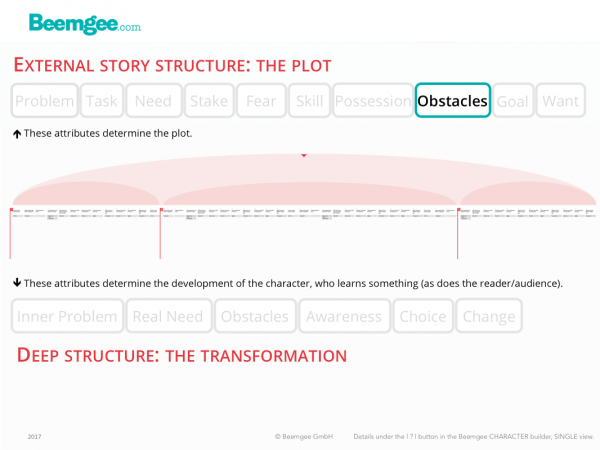
Beemgee_ExternalObstacles

External Obstacles are generally part of the story world, not of the character.

External obstacles are more important to the plot than to the inner transformation of the character. Stories that rely heavily upon external factors to provide opposition do their best to load these obstacles with significance within the story world. In Lord Of The Rings, the heroes must overcome several topographical elements, such as mountains and marshes. J.R.R. Tolkien provides all sorts of hints and information about these features of the landscape long before the characters reach them, setting them up as forces of opposition to such an extent that they almost become antagonistic in themselves.

Ultimately, the boundaries between the kinds of obstacles are fuzzy – and in fact it is not so very important to be able to categorize them neatly. What is important is that the obstacles do provide real opposition to the character’s plan. Moreover, by overcoming an obstacle – or indeed by failing to –, the character must be a step further along her or his path of development.

Characters dealing with obstacles and opposition is what makes up the bulk of any story. In a narrative, each obstacle – whether it be external, internal or antagonistic – must be greater in intensity than the last. Ideally, the character will learn through having to deal with each one, and be better equipped to deal with the final great confrontation towards the end of the story. It is unlikely that this great final obstacle that marks what is often called the crisis will be an external obstacle. It is far more likely to be antagonistic, and at best may involve elements of external and internal opposition, uniting all the kinds of opposition in one great climax.

A potential writer’s trap in the external problem is what is sometimes referred to – in a considerable extension of John Ruskin’s original sense of the phrase – as the pathetic fallacy. Sometimes external forces are used in stories to highlight particularly dramatic moments or conflicts. The classic example is a thunderstorm that happens to occur at a moment of great emotional intensity. This sort of convergence of obstacles or forces of opposition runs the risk of turning into cliché.

To read more of Beemgee’s writing craft articles click here

Antagonistic Obstacles

I’m currently taking a writing and blogging sabbatical due to family health issues. For now, I’ll repost selected articles from my Fiction Writing School.

Here is the link to articles on the Beemgee blog about developing fictional characters..

Hindrances to characters’ attaining what they want are either consequences of the character’s personality (internal obstacles), of the world in which the character is struggling (external obstacles), or of the antagonistic forces pitched against the character (antagonistic obstacles). An antagonist is another character’s opponent or competitor. Antagonistic obstacles are the ones that the antagonist deliberately places in front of this character in order to foil his or her attempt at reaching the goal. In other words, the central opposition to what the protagonist of a story wants is the antagonism of the story, which manifests itself in antagonistic obstacles.

To read more of Beemgee’s writing craft articles click here.

The 10 Things Every Action Story Needs

I’m currently taking a writing and blogging sabbatical due to family health issues. For now, I’ll repost selected articles from my Fiction Writing School.

Here is the link to this article.

The 10 Things Every Action Story Needs

Genre 4 Comments

In today’s post, I’m going to walk you through the ten action genre conventions. So, these are the character roles, settings, and events that need to be present in an action story in order for it to work and to satisfy fans of the genre. 

I’m also going to show you how these action genre conventions show up in the movie The Hunger Games.

Why movies? Why not books?

Well, the simple answer is that movies require less time investment than books. And I’m hoping that if you haven’t seen The Hunger Games movie, then you’ll at least watch it after reading this post to help cement these conventions in your mind.

But before we dive in, let’s quickly talk about what makes an action story or what makes the action genre unique.

What Makes an Action Story?

Action stories are about life and death and good versus evil. They’re about a character who has to rise up, overcome great obstacles, defeat forces of evil, and maybe even save the world.

But that being said, these stories aren’t always about superheroes. In fact, the protagonist in an action story is usually someone who is like us, but different.

They’re special or unique in some way–and because of that, they’re often misunderstood by the rest of society. And that is what makes this genre so relatable.

Because even if we don’t have magical powers, special abilities, or an unwavering faith in a certain mission or destiny, we’ve all experienced the curse of feeling different or being misunderstood. And this is where action stories come in. 

They show us how we can not only embrace the things that make us different but how we can use those things to fight against the evil forces in our lives. They show us how we have the power to be the hero of our own story and make a difference in the world, too.

Beyond that, action stories can have any tone or style, be set in any place or time, and have various levels of romance, mystery, adventure, or magic. They can include different subplots as long as the protagonist’s fight for survival (against the antagonist) remains the focus of the story.

Why do people read action stories?

People choose to read action stories to experience the excitement of the life and death stakes and situations that the protagonist is presented with.

But it’s not just about that — like I said earlier, we choose these stories because they inspire us to become the best versions of ourselves, too.

These stories show us that even a character destined for greatness has problems — and that their problems aren’t too different from our own. I mean, how many of us have had fantasies about being special or about rising up and proving that we’re better than our peers or better than those who try to keep us down? I know I have — and I’m sure you have, too.

So, it’s that plus the good versus evil dichotomy that reassures us that if we keep at it, if we embrace our unique gifts or talents, we know that good will eventually prevail.

And like all genre fiction, you have to deliver the emotional experience readers are looking for in order for your story to work. To deliver this emotional experience, you need to include the obligatory scenes and conventions of your genre in your novel.

What are obligatory scenes and conventions?

Conventions are a reasonably well-defined set of roles, settings, events, and values that are specific to a genre. They’re the things that readers intuitively expect to be present in a work of genre fiction whether they consciously realize it or not.

Obligatory scenes are the key events, decisions, and discoveries that move the protagonist along on his or her journey. They’re what help us write a story that works and when coupled with your genre’s conventions, help us evoke emotional reactions in our readers. 

Long story short, if you don’t deliver the obligatory scenes and conventions of your genre, your story just won’t work. So, what are the action genre conventions? Let’s take a look (warning–spoilers ahead):

Action Genre Conventions:

#1. The protagonist has a special talent or gift and the potential for heroism. 

This gift can be something like the ability to wield magic, a mission to do good, a strong resolve, an impenetrable faith, loyalty to friends, etc. This special talent or gift is how the reader gets to feel special by proxy because your protagonist will essentially become your readers’ avatar for experiencing the story.

And although this gift or talent or gift seems fun at first, there’s a flip side that the antagonist might try to exploit. It’s also how writers can create conflict and make our protagonists more relatable. 

For example, the antagonist might capture or harm the protagonist’s love interest or best friend. Or the antagonist might somehow use their magic against them or find a way to dampen their magic. Superman has Kryptonite, Tony Stark has a battery-powered chest. 

Either way, all action protagonists have something in common—the potential for heroism and the courage to sacrifice for others.

Case Study:

In The Hunger GamesKatniss is an excellent shot with a bow and arrows. She also has a strong desire to protect other people who aren’t as strong or skilled. Both of these things help her in the arena, but they also work to her disadvantage sometimes. If she loses the bow and arrows, what other skills would compensate? And when the game makers blast sounds of Prim screaming for Katniss or when Rue dies, we see Katniss’s resolve and ability to focus slip. All that being said, Katniss definitely has the potential for heroism (she volunteers to be a tribute in Prim’s place!) and has been sacrificing for others ever since her father died.

#2. The protagonist’s goal is to stop the antagonist and save victims.

Although the protagonist will face danger, be put in extreme situations, and be forced to take risks, they cannot stand by and let the antagonist get away with harming others.

The antagonist has created conflict by endangering the victim/s, which causes a new goal to arise within the protagonist. Their new goal is to stop the antagonist and save the victim/s.

In most cases, the protagonist’s journey to stop the antagonist and save the victim/s will take them from their familiar, everyday surroundings to a new, unfamiliar environment—whether your story takes place in real-life or in a made-up world.

Being in a strange land or a new and unknown environment will create more significant risks and challenges for the protagonist to face, increasing the tension and helping them grow.

Case Study:

In The Hunger GamesKatniss leaves the impoverished District 12 and ventures into the affluent and colorful Capital. Katniss not only has to navigate a new environment (the Capital) but a new set of politics and an arena where eleven other people are trying to kill her, too.

#3. There are multiple lives at stake (including the protagonist’s).

There must be more than one life at stake in an action story, including your protagonist’s life. Whatever they’re trying to do or accomplish forces them to make decisions that put their lives or the lives of others at risk. As the protagonist gets closer to confronting the antagonist, the threat to their life must escalate in severity. 

Case Study:

In The Hunger GamesKatniss’s life and safety are threatened when she volunteers as tribute. This escalates in severity once she gets into the arena and as more and more tributes are picked off. She also knows that to survive, she’s going to have to kill other tributes.

#4. The antagonist is stronger and/or more powerful than the protagonist. 

The action antagonist is very smart, strong, and/or powerful. Much more so than the protagonist. And whatever ordinary measures the protagonist would take to solve their problems will not work against the antagonist. They have to learn, grow, or change to become someone capable of surviving a confrontation with the antagonist. 

Case Study:

In The Hunger GamesKatniss comes from the weakest, most impoverished district possible. Not only that, but she’s just an average civilian, and President Snow is… the President. Once she gets to the Capital, she learns that some of the tributes have been training their whole lives to fight in the arena, so she’s at a disadvantage there, too. And finally, when she gets in the actual arena, the odds are definitely not in her favor.

#5. The protagonist has a moral compass that the antagonist does not.

The action antagonist can usually embrace evil, and therefore feels no shame and has no boundaries when it comes to pursuing their goals. They go about their business without noticing the harm they’re inflicting on others. Sometimes, the antagonist is so corrupt that they believe they’re doing the right thing or that the ends justify the means.

In contrast, the action protagonist is willing to sacrifice themselves for the good of others. This conflict and the protagonist’s willingness to sacrifice for others help readers relate to what’s happening in the story. They, too, want to stand up to evil and see “good” win.

Leaning into this moral code is also how the protagonist transforms from an ordinary person into a hero (and the only one who will stand up to the antagonist). 

Case Study:

In The Hunger Gamesit’s pretty obvious that Katniss disagrees with what President Snow and the game makers are doing—making kids fight in an arena and televising it as prime entertainment. And as readers, we can’t help but empathize with Katniss and root for her because we understand how terrible President Snow and the game makers actually are! It’s so unfair, and it’s so evil, that she cannot just stand by and watch it happen.

#6. There’s a speech in praise of the antagonist. 

This is when a character talks about how brilliant, strong, and powerful the antagonist is. Sometimes this is shown via a conversation between two characters, through letters or a newspaper article, or on TV during a news broadcast. Something like that.

This could also happen in the form of a revelation where the protagonist pieces together bits of information that show just how smart, strong, or powerful this antagonist is.

Case Study:

In The Hunger Gamesbefore the District 12 tributes are picked, we see the Capital’s “hype real” that talks about how wonderful everything is now that there is order amongst the districts and how thankful everyone should be to President Snow. Later, we hear President Snow tell Seneca Crane about why they allow a winner in the Hunger Games at all–he uses hope as a tool to help him control the people throughout each of the districts. We also hear Haymitch (and Katniss’s other mentors) talk about the other tributes and their unique talents and abilities too.

#7. There’s a MacGuffin (or a very specific thing the antagonist wants).

A MacGuffin is the specific thing that the antagonist is trying to get, accomplish, or achieve throughout the story. And there needs to be a plausible reason for why they want this specific thing, too. Whatever happens during the story’s inciting incident usually contains a clue about the antagonist’s MacGuffin.

Case Study:

In The Hunger GamesPresident Snow wants power and control. He wants to keep the people throughout the districts submissive. And part of the way he maintains this is through the Hunger Games each year. This year, for the 74th annual Hunger Games, his specific goal is to put on a good show! In doing so, he’ll also keep the districts in check too.

#8. There are sidekicks who help the protagonist save the victim/s.

The action protagonist can have one or multiple sidekicks—and they’re usually part of a friendship or romantic subplot.

They often act as confidants and can sometimes create conflict by opposing the protagonist’s decisions or by becoming victims themselves. They can be heralds who remind the protagonist what’s at stake and how dangerous everything is.

Sidekicks can also provide interpersonal conflict when the protagonist is not actively engaged in opposing the antagonist as well.

Case Study:

In The Hunger GamesKatniss’s two main sidekicks are Peeta and Rue. Peeta also serves as Katniss’s maybe-love interest. And Rue also serves as an almost-younger sister/friend.

#9. There’s at least one mentor figure who gives the protagonist guidance.

A mentor is someone who gives the protagonist advice, help, guidance, tools, weapons, insight, or all of the above. They help motivate the protagonist and encourage them to take the next steps forward (for better or for worse).

Sometimes, the mentor has gone through something similar to the protagonist, or they may have a history with the antagonist. Multiple characters can act as mentors, too.

Case Study:

In The Hunger GamesKatniss has Haymitch, Effie, and Seneca Crane to help her prepare for and survive the Hunger Games. 

#10. There’s a ticking clock that puts pressure on the protagonist. 

There’s a ticking clock or deadline by which the protagonist must stop the antagonist so that they can save the victim/s. The deadline (and the stakes) must be crystal clear to the protagonist and to readers. Ticking clocks usually kick into gear at the Midpoint.

Case Study:

In The Hunger Gamesthe ticking clock starts when Katniss enters the arena. Technically, there’s no time limit on the actual games, but it’s only a matter of time before she has to kill or be killed. Every other tribute is trying to be the last one standing.

Final Thoughts

You’re probably thinking, “This is so obvious! Tell me something I don’t know!” But seriously, you’d be surprised how many first drafts I see that are missing these conventions.

These are the character roles, settings, and micro-events that readers come to action stories for—they love them!

Everyone wants to see the protagonist learn to embrace their special skill or talent (or even the thing they previously perceived as a flaw!) in order to overcome the antagonist at the end, right? Can you imagine an action story without that element? 

So, long story short, don’t leave these conventions out. Find a way to give the reader what they want, in new and unexpected ways, and you’ll gain fans for life. 

Many great action stories stick with us because they include these conventions in a new or innovative way. And you can do this, too!

Prized possession

I’m currently taking a writing and blogging sabbatical due to family health issues. For now, I’ll repost selected articles from my Fiction Writing School.

The following was copied from beemgee.com .

“A prized possession is something (or even someone) the character cherishes. The loss of a prized possession may set off the character’s story by establishing the goal: to get it back. Structurally, the prized possession may be another character, for instance if your character is a parent, then the child may function as prized possession. Looked at like this, a prized possession may be seen as a McGuffin. Or merely the threat of the loss of the possession may create tension by providing what is at stake. As with special abilities, if the prized possession has no function in the story, or if its actual or threatened loss plays no role, then the prized possession is redundant and should probably be scrapped.”

To read more of Beemgee’s writing craft articles click here.

When Loved Ones Don’t Support Your Writing

I’m currently taking a writing and blogging sabbatical due to family health issues. For now, I’ll repost selected articles from my Fiction Writing School.

Here is the link to this article.

When Loved Ones Don’t Support Your Writing

Writing AdviceEncouragementRamblings

Aug 2 

Written By Shayla Raquel

This entire article was almost erased before I even started it. Each time I write, I tell myself, Be honest. Be honest. Be honest. I didn’t want to tell this story, but my hope is that it’ll encourage you.

I’ve been fortunate enough to have many people in my life who have supported my writing. They have cheered me on, purchased signed copies, and introduced me to new people with “SHE’S AN AUTHOR!” It is the best.

But, like you I’m sure, I used to have someone in my life who never supported my writing. Never “understood” it, so to speak. Just didn’t “get it.” I would make jokes about her apathy and say things like, “Ah, I’ll just give you the CliffsNotes.”

It was to lessen the pain of her not reading a single thing I had ever written.

It still hurt, though. I could make as many jokes as I wanted to lighten the mood, but the truth was: I wanted her to support my writing and cheer me on and want my books in her house. I didn’t ever experience that, though.

I’m sure you’ve experienced this hurt too. For my clients and friends, they’ve been told:

“If you talk bad about Mom in your memoir, I’m never talking to you again.”

“I think it’s nice that you’re following your dreams, but you also need to pay bills and have a fall-back plan in case this whole writing thing fails.”

“If you never finished college, then how can you get a good job as a writer? I heard they don’t pay much.”

“What are people going to think if they read that?”

“Hasn’t that been written about, like, a hundred times?”

What’s sad is that . . . I almost wish she had said something like the above. Just words in general, good or bad, about my writing. But you see, sometimes silence is worse than words.

Do you have people in your life who are silent about your writing?

Maybe you tell them about finishing your first draft or hiring a book coach or ordering your first proof copy in hardcover, and you hear . . . nothing. Maybe there’s a nod. A curt smile. Maybe there’s a “Cooooool.” Or my personal favorite: a thumbs-up emoji via text.

Silence like that, to me, hurts deeper than words. I know that’s not so for everyone. But I know you all have experienced this before. If you haven’t, consider yourself very lucky. Because when someone you love falls silent about the thing you love, it pierces your soul. Rather than listening to all the praise and excitement and encouragement from everyone else, you zero in on what that one person said (or didn’t say) about your life as a writer.

That becomes the whole narrative. So you take the silence, or you take the rejection, and you create a whole new story:

“I’m a bad daughter if I tell the true stories about life with my mom in my memoir.”

“I’m irresponsible if I try to focus on writing my book right now because it’s not stable enough and my dreams need to just wait.”

“I should’ve finished college. Now no one will want me for the writing jobs I’m seeking.”

“I have to use a different word and rewrite this scene in case someone from my church reads this.”

“I need to scrap this because it’s been written about already. A lot.”

We let other people dictate what we should do with our words. We let people we love and admire pooh-pooh all over our writing, sometimes before the ink even dries. We watch loved ones ignore our books.

As I look back on how I reacted to when a loved one did that to me each time I wrote a book, I realize I wasted a lot of energy. I had alllllll these other people excited about my books and congratulating me, but I spent time and energy wondering why my loved one wouldn’t support me.

If you’re struggling with something like this, here’s what I recommend:

1. Be honest and tell your loved one that it hurts you when they don’t acknowledge your dream or when they put a damper on it. Have an adult conversation and be kind. It’s okay to tell someone when you’ve been hurt.

2. If that doesn’t work, then accept that your loved one just doesn’t get it and that’s that. Move on. Don’t try to force someone to support your writing when you have tons of other people out there cheering you on. It’s a waste of time and energy. Give attention to those who are already supporting you.

3. Write them into your novel and have, like, a bear eat them or something.

4. Find an author support group online or in your community. That, to me, is one of the biggest reasons I have succeeded in my career. You need like-minded people rooting for you. Make this a priority!

5. Go be a light to someone else who is experiencing the same thing as you, which . . . well, is probably every writer you know. To me, that’s the most important step in all of this—besides the bear thing. Think of your writer friends and ask yourself, “If I knew that Jane was struggling with having a loved one support her, just like I struggle with, what would I want someone to do for me?” Then go do that. I can be a text message saying, “Can I read some more of your stories? They’re so good!” Just be a light.

If I had it to do all over again . . . you know, I think for every single time my loved one ignored my writing or didn’t celebrate with me when a book was published, I would go find three people to message and cheer them on and tell them how proud I was of them. Can you imagine all the positivity that would’ve brought?

Well, there’s no time like the present.

An expert editor, best-selling author, and book marketer, Shayla Raquel works one-on-one with writers every day. A lifelong lover of books, she has been in the publishing industry for ten years and specializes in self-publishing.

Her award-winning blog teaches new and established authors how to write, publish, and market their books.

She is the author of the Pre-Publishing Checklist, “The Rotting” (in Shivers in the Night), The Suicide Tree, #1 bestseller The 10 Commandments of Author Branding, and her book of poetry, All the Things I Should’ve Told You. In her not-so-free time, she acts as organizer for the Yukon Writers’ Society, studies all things true crime, and obsesses over squirrels. She lives in Oklahoma with her dogs, Chanel, Wednesday, and Baker.

self-publishing lingowhat to do when people don’t like your writingwhat to do when family doesn’t like your writingwhat to do when friends don’t like your writingwriter’s doubtself-doubt writersunsupportive family as a writerhow to deal with unsupportive family members as a writerwhat to do when your family and friends aren’t supportive of your writing

Shayla Raquel

Self-Publishing Mentor. Author. Speaker. Editor. Book Marketer.

http://www.shaylaraquel.com

How to Test an Idea Before Writing the First Draft

I’m currently taking a writing and blogging sabbatical due to family health issues. For now, I’ll repost selected articles from my Fiction Writing School.

Here is the link to this article.

How do you know if the idea you have is strong enough to support a full-length novel?

Is there a way to know the difference between a good idea and one that’s better left in your idea folder? 

If so, can you do this before spending all that time writing the first draft?

The answer is YES!

For most of us, there’s nothing worse than the thought of wasting a bunch time and energy on a story that’s going nowhere. 

But luckily, there IS a way to “test” out a story idea before writing the first draft. And in today’s post, I’ve got two different exercises that will help do just that.

So, get out your notebook and let’s dive in!

https://www.buzzsprout.com/791087/9872071-how-to-test-your-story-idea-before-writing?client_source=small_player&iframe=true&referrer=https://www.buzzsprout.com/791087/9872071-how-to-test-your-story-idea-before-writing.js?container_id=buzzsprout-player-9872071&player=small

Exercise #1: Write your storyline.

A storyline is a short summary that gives the gist of your book in 1-2 sentences.

It tells the reader who the main character is, what the conflict is, and what the stakes are. Basically, it’s the WHO, WHERE, WHAT, and WHY of your story, but not the HOW.

Before you write your storyline, let’s take a look at some examples.

Examples:

  • STAR WARS: A NEW HOPE  Luke Skywalker, a spirited farm boy, joins rebel forces to save Princess Leia from the evil Darth Vader, and the galaxy from the Empire’s planet-destroying Death Star.
  • JAWS – A police chief, with a phobia for open water, battles a gigantic shark with an appetite for swimmers and boat captains, in spite of a greedy town council who demands that the beach stay open.
  • RAIDERS OF THE LOST ARC – In 1936, archaeologist and adventurer Indiana Jones is hired by the US government to locate the ancient Ark of the Covenant before the Nazis, and stop them from becoming the most powerful army the world has ever known.
  • JURASSIC PARK – During a preview tour, a theme park suffers a major power breakdown that allows its cloned dinosaur exhibits to run amok.
  • SILENCE OF THE LAMBS – A young F.B.I. cadet must confide in an incarcerated and manipulative killer to receive his help on catching another serial killer who skins his victims.


Take Action:

Write a 1-2 sentence storyline for your book. When you’re done, ask yourself and others – does this story sound interesting to me? Is it something I’d want to read?

If the answer is yes, move onto the next exercise. But if the answer is no, you either need to re-write your logline to focus on the most interesting parts of your story or pick a different idea to work with.

Exercise #2: Write your story’s elevator pitch.

An elevator pitch is a longer summary of your story—usually, around 250 words—that does not give away the ending of the story but does cover the main conflict and stakes. It’s the summary that sometimes appears on the back cover of a book. Or it could be the summary that you’d include in your query letter if you’re planning to submit your work to agents in the future. 

When composing your elevator pitch, you want to answer these questions: WHO is this story about? WHAT is the situation? WHERE does the story take place? WHY does it matter?

  • The protagonist: WHO is your main character? What makes this character unique? What does this character want at the beginning of the story?
  • The conflict: WHAT is the situation? Who or what is standing in the way of your protagonist achieving his or her goal?
  • The stakes: WHY does it matter? What’s at risk if your protagonist doesn’t achieve their goals? What is the worst thing that will happen? What will their success or failure mean to your protagonist?
  • The setting: WHERE does the story take place? 


Examples:

THE HUNGER GAMES by Suzanne Collins
In the ruins of a place once known as North America lies the nation of Panem, a shining Capitol surrounded by twelve outlying districts. The Capitol is harsh and cruel and keeps the districts in line by forcing them all to send one boy and one girl between the ages of twelve and eighteen to participate in the annual Hunger Games, a fight to the death on live TV.

Sixteen-year-old Katniss Everdeen regards it as a death sentence when she steps forward to take her sister’s place in the Games. But Katniss has been close to dead before-and survival, for her, is second nature. Without really meaning to, she becomes a contender. But if she is to win, she will have to start making choices that weigh survival against humanity and life against love. (134 words)

THE WAY OF KINGS by Brandon Sanderson
Roshar is a world of stone and storms. Uncanny tempests of incredible power sweep across the rocky terrain so frequently that they have shaped ecology and civilization alike. Animals hide in shells, trees pull in branches, and grass retracts into the soilless ground. Cities are built only where the topography offers shelter.

It has been centuries since the fall of the ten consecrated orders known as the Knights Radiant, but their Shardblades and Shardplate remain: mystical swords and suits of armor that transform ordinary men into near-invincible warriors. Men trade kingdoms for Shardblades. Wars were fought for them, and won by them.

One such war rages on a ruined landscape called the Shattered Plains. There, Kaladin, who traded his medical apprenticeship for a spear to protect his little brother, has been reduced to slavery. In a war that makes no sense, where ten armies fight separately against a single foe, he struggles to save his men and to fathom the leaders who consider them expendable.

Brightlord Dalinar Kholin commands one of those other armies. Like his brother, the late king, he is fascinated by an ancient text called The Way of Kings. Troubled by over-powering visions of ancient times and the Knights Radiant, he has begun to doubt his own sanity.

Across the ocean, an untried young woman named Shallan seeks to train under an eminent scholar and notorious heretic, Dalinar’s niece, Jasnah. Though she genuinely loves learning, Shallan’s motives are less than pure. As she plans a daring theft, her research for Jasnah hints at secrets of the Knights Radiant and the true cause of the war. (268 words)

HARRY POTTER & THE ORDER OF THE PHOENIX by J.K. Rowling
There is a door at the end of a silent corridor. And it’s haunting Harry Potter’s dreams. Why else would he be waking in the middle of the night, screaming in terror?

Harry has a lot on his mind for this, his fifth year at Hogwarts: a Defense Against the Dark Arts teacher with a personality like poisoned honey; a big surprise on the Gryffindor Quidditch team; and the looming terror of the Ordinary Wizarding Level exams. But all these things pale next to the growing threat of He-Who-Must-Not-Be-Named—a threat that neither the magical government nor the authorities at Hogwarts can stop.

As the grasp of darkness tightens, Harry must discover the true depth and strength of his friends, the importance of boundless loyalty, and the shocking price of unbearable sacrifice.

His fate depends on them all. (138 words)

Take Action:

Write a 250-word summary for your story. When you’re done, ask yourself and others – does this story sound interesting to me? Is it something I’d want to read?

If the answer is yes, then you’re probably ready to start writing the first draft!

But if the answer is no, you’ll need to re-write your elevator pitch focusing on the most important parts of your story. Make sure you’re focusing on the storyline of your global genre. For example, in a romance, the focal storyline would be the romantic relationship between the two characters. 

Final Thoughts

Writers who don’t take the time to flesh out their ideas are the ones who get stuck in the middle of a draft or who never finish the stories they start.

Hopefully, these exercises have helped you test out your story idea so that you can write forward with confidence. But if these exercises were difficult for you, don’t give up!

Check out the descriptions of movies on imdb.com (the internet movie database). There are hundreds of examples that will show you how a 2-hour movie in your genre can be summarized in one or two sentences. 

You can also browse the descriptions of your favorite books on amazon.com. Once you’ve read through a dozen or so examples, you’ll start to see patterns and understand how to apply those patterns to your own story. 

Doing this kind of work upfront is the first step toward writing a story that works. If you need help, don’t be afraid to reach out to your fellow writers or to enlist the help of a professional book coach. You don’t have to write alone!