Write to Life blog

Novel Excerpts–The Boaz Schoolteacher, Chapter 31

The primary aim of the "Novel Excerpts" blog category is to showcase my creative writing, specifically from the novels I've written. Hopefully, these posts will provide a glimpse into my storytelling style, themes, and narrative skills. It's an opportunity to share my artistic expressions and the worlds I've created through my novels.
The Boaz Schoolteacher, written in 2018, is my fifth novel. I'll post a chapter a day over the next few weeks.
Book Blurb
In the summer of 2017, Katie Sims and her daughter Cullie, moved from New York City to Katie’s hometown of Boaz, Alabama for her to teach English and for Cullie to attend Boaz High School . Fifteen years earlier, during the Christmas holidays, five men from prominent local families sexually assaulted Katie. Nine months later, Katie’s only daughter was born.
Almost from the beginning of the new school year, as Katie and fellow-teacher Cindy Barker shared English, Literature, and Creative Writing duties for more than 300 students, they became lifelong friends.
For weeks, Katie and Cindy endured the almost constant sexual harassment at the hands of the assistant principal. In mid-October, after Cindy suffered an attack similar to Katie’s from fifteen years earlier, the two teachers designed a unique method to teach the six predators a lesson they would never forget. Katie and Cindy dubbed their plan, Six Red Apples.
Read this mystery-thriller to experience the dilemma the two teachers created for themselves, and to learn the true meaning of real justice. And, eternal friendship.
Chapter 31
I had never missed an entire week of school. I had also never missed a week of writing, at least since I began, in earnest, after taking my first teaching job in Los Angeles. This wet and foggy Monday morning my classroom looked like it had been frozen in time since I was last here Friday afternoon over a week ago. I placed the bologna sandwich that Cindy had made me in my refrigerator and walked to my little office and sat down. I reviewed my To-Do list, now quite stale, and noticed the third item from the bottom.
It read, “take Nanny to the Fall Festival.” The tears came unannounced. I wasn’t one to cry so easily. For over two weeks before her death, Nanny kept reminding me she wanted to go to this once per year celebration of sorts. It was Liberty Baptist Church’s long-standing event to praise God for an abundant harvest. It was rooted in long-ago times where farming was most everyone’s livelihood. The church, Papa and Nanny’s church since they married, felt obligated to continue this tradition. Nanny had missed last year’s event because of a bout with the shingles, and I was determined to take her this year. What was making me so sad was how I had contemplated asking Sammie to take her. What a selfish woman I was. Now, I would never have the chance to see the joy spread across Nanny’s face. She was dead, and she had died a most horrible death, and in a sense, it was all my fault. If I had only handled things differently. If I hadn’t been such a smart ass and practically told Pastor Warren I had the videotape, Nanny might still be alive. Furthermore, I’m now positive, the Faking Five found out about my visit with Ralph Williams.
“You in there?” I heard Cindy’s voice blaring.
“Back here.” I wiped my eyes and opened my literature teacher’s guide.
“Sorry, I missed you this morning. You must have left early. Cullie’s in my classroom with Alysa.” Since I hadn’t written this morning, nor for the previous eight days, I had gotten dressed early and driven out to the home place on Bruce Road. I hadn’t been but once since the fire over a week ago. I think my need to see the past before engaging the future was why I went. As a writer, transitions were important. It was like I was both writing a story and living as the main character.
“Thanks for bringing her to school. I didn’t want her with me as I strolled around a war zone.” Even though the house was destroyed, it had maintained a semblance of its former glory. All the outer walls on the first floor were still standing. I should thank the Boaz and Sardis City fire departments for all their valiant efforts. Even though the upper floor had fallen in, I sensed the surviving walls were a testimony to Nanny and her resilience over the years. It was like they were pointing upwards praising God in the bad times just as they had done during the many good and bad times for going on seventy years.
“I just wanted to see you for just a minute before our first classes and wish you godspeed.”
“Thanks Cindy, you are the best. I hope you know how much I love you and how much I’m grateful for all you, Steve, and your family have done for Cullie and me, especially since the fire.” I said trying to remember when I had told another teacher that I loved her. I hadn’t even told Ellen Fink that.
“I love you too. And, I hope you know you do not have to move out. Why don’t you stay a while longer? I’m still a little uneasy about you moving in with Sheriff Waldrup.”
“That’s not happening. I told you he is going to be staying in his little cabin on the back side of his property.” I said, recalling mine and Cullie’s visit yesterday afternoon and how we both fell in love with his home, a ranch nearly as large as Steve and Cindy’s.
“Why do I sense a little romance in your future. Wayne, you’ll need to call him Wayne, is a mighty handsome man. Even if he is ten years older than you. That’s what you said, right?”
“He is but at best all I’m interested in is a platonic relationship.”
“Oh, so you are thinking about a relationship. Good. You silly teacher, don’t you know that all romances start out being platonic?” I didn’t know why on earth Cindy was being so humorous. Maybe she thought I needed it. My eyes were probably red from crying.
“Get out of here. I have things to do.”
“So, hurry up. I’ll be back at 10:30, if that’s okay. I’ve got an idea.” Cindy said walking out and not even asking me permission to crash my planning period.
Over the next thirty minutes I realized that my week off had been productive. At least from the standpoint of the Real Justice novel writing project. All during the week I had received multiple emails from each of the five Creative Writing teams. Everyone had shared their condolences and asked how I was doing. They even told me how much they missed me. I was proud of how hard they were working, and I was impressed with their almost-completed character sketches and with their first chapter drafts. Who says high school students don’t have initiative?
After scanning the wave of emails from yesterday and Saturday, I noticed that the five teams were coalescing around the story’s inciting incident and key event. Every novel, the experts say, needs to follow a structure. All of them contend writers should follow a three-act structure, and in act one, two things need to occur. The first thing is the inciting incident. This is a plot point that begins a story’s problem. The key event is the time when the main character, the protagonist, becomes connected or engaged by the inciting incident. I like the example that expert K.M. Weiland (her name is Katie!) uses to illustrate these two terms: “In most detective stories, the inciting event (the crime) takes place apart from the main character, who doesn’t become involved with it until the key event, when he takes on the case.” I wish I was half as smart as this Katie. She is a master at word pictures: “the key event is the glue that sticks the character to the impetus of the inciting event.”
I shouldn’t have been so surprised that my five Real Justice teams had decided that our five antagonists (Mason Campbell, Noah Fletcher, Aiden Walker, Jackson Burke, and Daniel Taylor) were all part of a secret club that thrived off sinister games, including sexual exploitation and murder. The five teams were a little vague in their email description, I think intentionally, but I gathered that the five antagonists were involved with the disappearance of a high school girl whose father is an outspoken blogger. Stella received an anonymous tip that triggered her interest and investigation. Thus, the tip is the glue that stuck Stella to the inciting event, what appeared to be an abduction of a teenage girl by a club known as Jaybird. The only meaning I could ascribe to the club’s name was ‘naked as a jaybird.’ I think the phrase had originated nearly a century ago. At the time it was simply ‘J-bird,’ and meant jailbird. It referred to prisoners brought in from a bus and after taking a shower they had to walk naked from one end of the prison to the other. As I walked to the auditorium and my first period class, all I could think about was how the Faking Five still imagined me ‘naked as a jaybird.’ No doubt, I was still in prison.
My first three classes were easy. I didn’t resist letting each class talk. The first two had been as active as my official Real Justice students although these outliers were contemplating the five Ellijay antagonists individually preying on Stella Gibson. She became glued to the story’s problem because she herself was the independent focus, for sexual gratification I might add, of the Mayor, the Bank President, the Pastor, the business owner, and the Judge.
The third class, my senior English class, was content discussing Ernest Hemmingway’s Hills Like White Elephants, a story about the end of a relationship. The class discussion quickly moved from one of the story’s main themes, the difficulty of dealing with an unplanned pregnancy, and onto abortion. It was clear most of the guys were for it and the girls were not, at least if it didn’t concern them.
Cindy was sitting in my room when I returned at 10:30. Sometimes, I almost wished we hadn’t exchanged classroom keys. At least she had waited until I arrived to enter my private little office behind my classroom.
“You look tired. Difficult classes? Here, I brought you a Red Bull.” I took the can, thanked her, and walked into my office. Cindy was right on my heels and her voice, both high pitch and rapid, revealed she may have been literally full of Bull. “Let’s start with Pastor Warren. He seems to be closer friends with Wilkins than the other four members of your Faking Five.”
“Start with? Explain.” I almost regretted having shared with Cindy my anger and my comparing myself to a Mama Bear protecting her cubs.
“Burn their asses.” Cindy said sitting across from me.
“Wow, I’m beginning to think you were in the Navy. Lately, you’ve been cussing like a sailor.
“Who says revenge is Victorian?” Cindy said, no doubt referring to Victorian England when women were thought to be shy and virtually perfect in dress, manner, and especially speech.
“I’m listening.” I may not have said it so bluntly as Cindy did but I hadn’t changed my mind. I was ready to teach six men a lesson. I was ready for Six Red Apples. Although, I hadn’t thought about burning them at the stake.
“If Pastor Warren and criminal asshole Wilkins are as good friends as we think they are, then they do things together; they spend time talking. Maybe they play golf every Thursday afternoon. I don’t know but we must find out. Once we learn their routine we can begin planning how to burn their asses.”
“You’re liking that phrase. I can tell.”
The remainder of my planning period, until 11:25, Cindy described how she had already been conducting a little surveillance on Danny Ericson and Fulton Billingsley. She wanted to stay on during my lunch period, but I persuaded her I had a ton of work I needed to do since being away for over a week.
After school, Cullie and I ran by Walmart to buy a few groceries, mainly cold items. Yesterday afternoon Wayne had suggested this since the only thing in his refrigerator was a half-empty gallon of three-day expired milk, a large bag of wilted salad mix, and the remainder of a green bean casserole that his sister had left last Tuesday. What he lacked in the refrigerator he made up for in his pantry. It was stocked with every imaginable type of canned soup and vegetables, and at least four kinds of cereals. I was thankful Cullie and I had spent Saturday shopping for clothes. I was content with Walmart selections but, not wanting to drive to Gadsden, Cullie had been surprisingly pleased with what she had found at Goodies and Factory Connections. I was also thankful we had left all our furniture in storage after moving to Boaz from New York City. Although we didn’t need furniture now that we were at Wayne’s, we would in a few months after we built a house at Nanny’s.
A little before 7:30 p.m., right after I had cleaned off mine and Cullie’s soup bowls from the table in the breakfast nook, I heard a knock at the back door. I looked and saw Wayne. I hadn’t closed the blinds on the door. He had his hands around a large cardboard box. I walked over and opened the door.
“Hi Katie. I promise I’m not going to be a pest but I need to apologize.” I motioned him in and noticed the box contained several Walmart shopping bags.
“Why do you need to apologize?” I said, not having a clue what he was talking about.
“I invite you to stay here and don’t even give you a house-warming gift. Here’s a few things I hope you and Cullie enjoy.” He set the box on a kitchen counter and started pulling out packs of steak, pork chops, and chicken.
“You didn’t need to do this. Letting us stay here is gift enough. By the way, I’m going to pay you rent, no matter what you’ve said.”
“Oh no. Forget that. Again, I’m sorry I didn’t clean out the refrigerator.”
Cullie had walked in from the den where she was watching TV. After she smiled at Wayne and inventoried all the good meats he had brought, she thanked him and returned to the opposite side of the great room and kitchen combination. “I suspect you are tired and wanting to go home. Sorry, you are home. I meant your new home.” I said.
“But, you would like to know if I have learned anything new?” I guess Wayne was a mind-reader or I had a big question mark carved into my forehead.
“Yes, do you mind?”
“Not at all. That’s another reason I came by. Late this afternoon I received word from Montgomery that Nathan Johnson’s DNA was on the Lone Star Candy Bar wrapper you gave me from Ralph’s.”
“How did they match it? How did they have Johnson’s DNA?” I said.
“I thought I had told you. When Cliff Thomas, Johnson’s lawyer from Texas, arrived a week ago, he gave us permission to swab his client’s mouth. That was before he knew we had any tangible evidence other than the gun. I guess he already knew from talking with his client that Nathan’s fingerprints would have to be on the 22-pistol since we had him on camera at Joe’s Pawn Shop trying to hock it. Again, we kind of conned him by not disclosing the candy bar wrapper.”
“So, that shows Johnson was at the murder scene?” I asked.
For a minute, Wayne didn’t responsd. He rolled his head around like he was unsure what to say. “Probably, but not definitively. The DNA match proves Nathan had handled the candy bar wrapper. Mr. Thomas might argue that his client had left the wrapper in Danny Ericson’s truck but was not with him that morning at Ralph Williams’ place. But, with what Ralph told you about the passenger he saw in Ericson’s truck, it seems likely that Johnson was there.”
“What about Ralph being dead? Obviously, he cannot testify. Isn’t my word hearsay?”
“You’re correct. I’m sorry the law and criminal cases can be so complicated.”
“I already knew that. I’ve watched enough Law and Order and CSI and those type shows to realize Darla’s case wasn’t going to be easy to resolve.”
Wayne looked at his watch. I was still amazed by people who still wore watches. Now that smartphones hang on nearly every belt. “I’ve got a few calls to make so I must go. Do you need any help putting up these groceries?”
“No. I think I can handle that.” I said looking up at the tall and handsome Wayne Waldrup. His blue eyes met mine and lingered about two seconds longer than he probably meant to. He smiled and said, “Remember, you promised me you would tell me if I became a bother.”
“I promised that. Yes. I will honor that promise. You better believe.”
“Let me know if you need anything. Oh, one other thing. I nearly forgot. The gas cans seized at the fire. The perpetrators either wiped them clean or they used gloves. There were no fingerprints on them.”
“I’m sorry to hear that. I was hoping we might get a break.”
“The closest to that right now is that all six of the cans were the same brand. Locally sold only by Walmart and Radford Hardware and Building Supply.”
“If they were new cans couldn’t we, you, investigate the sales at both locations?” I said feeling like I wanted to write a detective series.
“Already on it. It’s a long shot but at least it’s a lead of sorts. I’ll keep you posted. Sorry, I’m running late but I have to go.”
“When do you ever rest? I’m sure you have more than the fire and Darla’s cases to deal with.” I said, feeling sorry for him.
“I rest all the time. I’ve been here, what fifteen minutes? It has been like an afternoon at DeSoto Falls, just talking with you. Sorry, that didn’t come out just right. What I meant is I find it peaceful and satisfying talking with you. You are so kind and respectful.”
“I take that as an extreme compliment. Thanks. I enjoy you too. Talking with you. I appreciate all your help. I’m sorry we had to meet under these circumstances but I’m still enjoying getting to know you.”
“Take care Katie and get some rest yourself. You’ve been through a lot. Tell Cullie goodnight.”
“I will.” He left, and I watched him open the door of an older looking Ford Bronco. It didn’t have a Sheriff Department insignia on it. I figured it was a personal vehicle. I smiled as I thought Wayne Waldrup was a spitting image of Walt Longmire, the only man I had let into my heart since that horrible night in 2002.
The Marginalian: The Pleasure of Being Left Alone
Here’s the link to this article.
BY MARIA POPOVA

There is a form of being together that feels as easy and spacious as being alone, when your experience is not crowded out or eclipsed by the presence of the other but deepened and magnified. Such companionship is extremely rare and extremely precious. All other company, no matter how dear, inevitably reaches a saturation point and begins to suffocate. If one is an introvert, that point comes sooner and more violently. A return to solitude then becomes nothing less than a rapture.
Rose Macaulay (August 1, 1881–October 30, 1958) channels this ecstatic relief with great charm and poetic passion in a piece from Personal Pleasures: Essays on Enjoying Life (public library) — her 1935 collection of reflections kindred to, and a century ahead of, poet Ross Gay’s wonderful Book of Delights.

Despite publishing twenty-two books in twenty years, alongside numerous essays, poems, and newspaper columns — prolificacy only possible through the deepest and most undistracted solitude, haunted by Susan Sontag’s lament that “one can never be alone enough to write” — Macaulay was no hermit. She gave talks, attended events, threw parties, and appeared frequently on public radio to offer incisive commentary on the state of the world. During WWI, she worked as a nurse and a civil servant. During WWII, like Marie Curie a war earlier, she became a volunteer ambulance driver at the age of sixty. She regularly wrote to the editors of the Oxford English Dictionary — her favorite book — with suggestions, corrections, and improvements. (“To amend so great a work gives me pleasure,” she writes in one of these essays on life’s littlest and deepest joys.) When her flat was demolished in the Blitz, all her books destroyed, it was the dictionary volumes she most mourned. When she rebuilt her home, she continued hosting friends for salons and soirees.
But despite her surface sociality, Macaulay embodied the true test of an introvert — not whether one engages in social activity, but whether one is charged or drained by it. In an essay titled “Departure of Visitors,” she exults in the pleasure of being at last left alone:
An exquisite peace obtains: a drowsy, golden peace, flowing honey-sweet over my dwelling, soaking it, dripping like music from the walls, strowing the floors like trodden herbs. A peace for gods; a divine emptiness.
[…]
The easy chair spreads wide arms of welcome; the sofa stretches, guest-free; the books gleam, brown and golden, buff and blue and maroon, from their shelves; they may strew the floor, the chairs, the couch, once more, lying ready to the hand… The echo of the foolish words lingers on the air, is brushed away, dies forgotten, the air closes behind it. A heavy volume is heaved from its shelf on to the sofa. Silence drops like falling blossoms over the recovered kingdom from which pretenders have taken their leave.
What to do with all this luscious peace? It is a gift, a miracle, a golden jewel, a fragment of some gracious heavenly order, dropped to earth like some incredible strayed star. One’s life to oneself again. Dear visitors, what largesse have you given, not only in departing, but in coming, that we might learn to prize your absence, wallow the more exquisitely in the leisure of your not-being.

Paradoxically, even Macaulay’s muse was a visitor from whom she eventually needed a break. In another essay, she offers a strikingly similar inner response to finishing a book — that moment when, upon setting down the last word on the last page, the mind becomes uncrowded again. She writes:
Leisure spreads before my dazzled eyes, a halcyon sea, too soon to be cumbered with the flotsam and jetsam of purposes long neglected, which will, I know it, drift quickly into view again once I am embarked upon that treacherous, enticing ocean. Leisure now is but a brief business, and past return are the days when it seemed to stretch, blue and unencumbered, between one occupation and the next. There are always arrears, always things undone, doubtless never to be done, putting up teasing, reproachful heads, so that, although I slug, I slug among the wretched souls whom care doth seek to kill. But now, just emerged as I am from the tangled and laborious thicket which has so long embosked me, I will contemplate a sweet and unencumbered slugging, a leisure and a liberty as of lotus eaters or gods.
Couple with May Sarton’s stunning ode to the art of being alone from the era of Macaulay’s Personal Pleasures, then revisit Olivia Laing on the modern art of being alone amid the crowd and Stephen Batchelor’s field guide to glad solitude.
Defend Democracy: MAGA dumbfucks are so fucking dumb, they have no idea that the pro-slavery Confederates were the bad guys
Here’s the link to this article.
Republicans = Confederates = KKK = MAGA = NAZIS. Different labels, but it’s always the same group of hateful racists.

JUN 18, 2024

Recently I wrote an article about how spectacularly stupid MAGA dumbfucks are. Turns out, they’re even dumber than I thought.
I’ve encountered hundreds of MAGA dumbfucks on social media over the years, and I’m no longer surprised that most of them have no clue that the German Nazis were far-right Christian conservative nationalists, and that MAGA Nazis and German Nazis are ideological twins.

I’m also no longer shocked that MAGA dumbfucks are so uneducated, most of them have no idea that the German Nazis were not left-wing socialists. They were right-wing capitalists, who are world famous for slaughtering anyone who supports socialism:
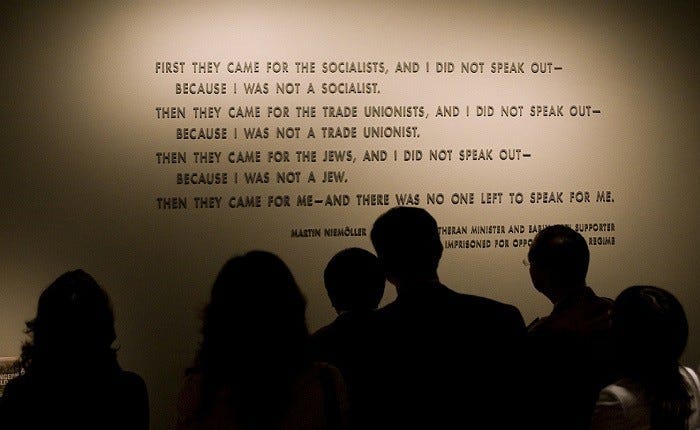
WERE THE NAZIS SOCIALISTS? NO.
“Hitler allied himself with leaders of German conservative and nationalist movements, and in January 1933 German President Paul von Hindenburg appointed him chancellor. Hitler’s Third Reich had been born, and it was entirely fascist in character. Within two months Hitler achieved full dictatorial power through the Enabling Act.
In April 1933 communists, socialists, democrats, and Jews were purged from the German civil service, and trade unions were outlawed the following month. That July Hitler banned all political parties other than his own, and prominent members of the German Communist Party and the Social Democratic Party were arrested and imprisoned in concentration camps.“
NAZI CONCENTRATION CAMPS
“In 1933–1939, before the onset of war, most prisoners consisted of German Communists, Socialists, Social Democrats, Roma, Jehovah’s Witnesses, homosexuals, and persons accused of ‘asocial’ or socially ‘deviant’ behavior by the Germans.”
I figure MAGA dumbfucks can be forgiven for not knowing this stuff, because corrupt Republican politicians have been underfunding schools to create a legion of braindead pinheads. So I don’t really expect them to know anything about European history, or even to be able to find Europe on a map.
But since many Americans are obsessed with the Civil War, as if it’s the only thing that ever happened in history, you’d think even MAGA dumbfucks know at least the basics. Like which side supported slavery, and who the good guys and the bad guys were.
Nope. Most of them don’t even know that.
They don’t even know what the Civil War was about:
Lots of Americans don’t think slavery caused the civil war
Nikki Haley declines to say slavery was cause of US civil war
Students aren’t learning about slavery: A new report from the Southern Poverty Law Center finds that students in the U.S. simply aren’t learning much about the country’s history of slavery.
U.S. students’ disturbing lack of knowledge about slavery: Only 8 percent of U.S. high school seniors can identify slavery as the central cause of the Civil War.
National Education Association
“About 92 percent of students did not know that slavery was the war’s central cause, according to the survey.”
There really are millions of MAGA dumbfucks who have no fucking clue that the Confederates were the bad guys who supported slavery, and the Union were the good guys who wanted to abolish slavery.
And they don’t even know that the pro-slavery Confederates started the KKK.
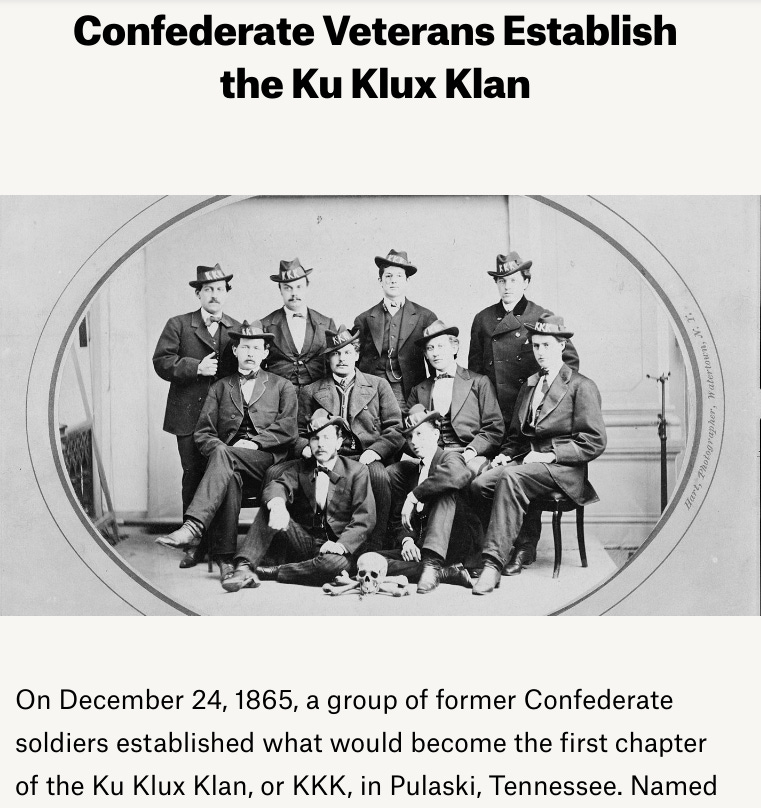
South Carolina approves KKK’s pro-Confederate flag rally at capitol
‘Still a racist nation’: American bigotry on full display at KKK rally in South Carolina

Pro-slavery Confederates = KKK = MAGA = Republicans
The reason why MAGA dumbfucks don’t know this is simple: Fox News lies to them all day every day, about everything. And they’re too dumb to know that they’re being lied to.
Fox News and corrupt Republican politicians like to confuse dumb Republican voters by pretending the KKK was founded by today’s progressive Democrats. Of course that’s complete bullshit, but MAGA dumbfucks are too dumb to see through the lies.
So let me explain it in a way even a child can understand. With simple words, short sentences, and lots of pictures:

The KKK was started by pro-slavery Confederate soldiers. Today they call themselves Republicans, not Democrats.
Fact check: Democratic Party did not found the KKK, did not start the Civil War
No, the Democratic Party didn’t create the Ku Klux Klan
Who’s waving pro-slavery Confederate flags today? Republicans.
Who gets upset when pro-slavery Confederate monuments get torn down by Democrats? Republicans.
Yes, it’s true, pro-slavery Confederates used to call themselves Democrats for a while, until they got upset because the Democratic party supported equality for black people.
That’s when the pro-slavery Confederates started to call themselves Republicans.
Princeton’s Ilyana Kuziemko and Yale’s Ebonya Washington use this data to argue that nearly all of the Democratic Party’s losses in the South from 1958-1980 can be explained by white voters’ racially conservative views.
‘Racially conservative’ attitudes led white Southerners to leave Democratic Party
Racial attitudes were the primary reason white Southerners abandoned the Democratic Party after party leaders began to advocate for civil rights legislation during the last half of the 20th century, a new study finds.
That’s why racist MAGA dumbfucks still run around with pro-slavery Confederate flags.
Conservatives want to hold on to the old ways, like slavery and white supremacy.
Progressives strive to make progress, by finding new, better ways of making everyone’s life better. For example by getting rid of old traditions like slavery and promoting new ideas like racial equality.
Sometimes words and their meanings change. Over time, people use different labels to describe themselves or others.
Remember when the word “gay” used to mean happy, and not homosexual?
The meaning of the words Republican and Democrat also changed over time.
A long time ago, progressives used to call themselves Republicans. Today progressives call themselves Democrats.
Lincoln was anti-slavery because he was a progressive. He didn’t like the old ways, like slavery.
If Lincoln were alive, he’d be a Democrat
Lincoln would be a Democrat today, say Doris Kearns Goodwin and Tony Kushner: The Pulitzer Prize winners behind the new biopic say that the 16th president’s political beliefs would see him in a different party in 2012.
When did Democrats and Republicans switch platforms, changing their political stances — and why?
Donald Trump’s Republican Party is not the party of Lincoln: Republicans have embraced all that Lincoln loathed.
MAGA are the descendants of the same “conservative” Confederate traitors who killed Lincoln, and who were pro-slavery and started the KKK.

KKK leader David Duke tweets ‘Thank God for Trump! That’s why we love him!’
Ku Klux Klan newspaper declares support for Trump
Former KKK leader endorses Trump for president again – and Tucker Carlson for Vice President
Here’s a little video that explains why Southern Baptists aka Evangelicals were pro-slavery during the Civil War, and why they’re still bat-shit crazy:
Dear MAGA dumbfucks: You are the bad guys.
You are the pro-slavery Confederates.
You are the racist KKK.
You are the racist white-supremacy pro-slavery party.
You are ideological twins of the Nazis.

Flash Fiction: Bitter Boundaries

In the suburban quiet of Maplewood, the neat hedges and well-kept lawns belied the growing tension between John Green and his neighbor, Rick Dale. John, an avid gardener, cherished the tranquility of his garden, while Rick, indifferent to neighborhood aesthetics, owned a large, unruly Rottweiler named Max. This discord simmered unnoticed until the day Max tore through a weak spot in the shared fence and viciously attacked John’s gentle Beagle, Toby.
The attack left Toby gravely injured, and though he survived, the trauma was evident in his every timid step and fearful whimper. John, seething with anger, confronted Rick, demanding not just a fence repair but justice for Toby’s suffering. Rick’s dismissive response, attributing the incident to mere animal instinct, fueled John’s wrath further. He warned Rick of consequences, but his threats were met with scoffs and indifference.
John’s days and nights morphed into a timeline of plotting revenge. His initial plans of calling authorities or seeking legal recourse gave way to darker strategies as he watched Rick negligently patch the fence, leaving gaps wide enough for Max to menace through. The sight of Toby flinching at the mere sound of Max’s bark pushed John past the brink of tolerance.
One late evening, under the cover of darkness, John executed his plan. He stealthily opened a section of the weak fence, placed a trail of meat leading from Rick’s yard to the busy street nearby, and waited. Like clockwork, Max took the bait, escaping into the night. The next morning brought news of chaos: Max, found miles away, had caused an accident on a busy road, resulting in injuries and Max being captured by animal control.
Rick was distraught and furious upon discovering Max’s fate and immediately suspected John’s hand in it. Confronting John yielded a cold admission and a chilling reminder of Toby’s undeserved pain. “You never cared to secure him, so I did what I had to do,” John declared with icy finality.
This bitter exchange severed what little civility had existed between them. Rick faced hefty fines and legal trouble over the accident caused by Max, while John was left with a silent neighborhood devoid of Max’s barks but filled with the hollow victory of his revenge. Neither man spoke to the other again, each day widening the chasm of animosity between their homes.
Toby, though recovering physically, remained a shadow of his former self, forever altered by the attack. John, while satisfied with his retaliation, found no real peace in his victory. The garden he once tended with love now stood as a stark reminder of the cost of vengeance. As the seasons changed, the fence remained firmly in place, a boundary stronger and more impenetrable than ever, not just between properties, but between hearts irrevocably turned cold.
Novel Excerpts–The Boaz Schoolteacher, Chapter 30
The primary aim of the "Novel Excerpts" blog category is to showcase my creative writing, specifically from the novels I've written. Hopefully, these posts will provide a glimpse into my storytelling style, themes, and narrative skills. It's an opportunity to share my artistic expressions and the worlds I've created through my novels.
The Boaz Schoolteacher, written in 2018, is my fifth novel. I'll post a chapter a day over the next few weeks.
Book Blurb
In the summer of 2017, Katie Sims and her daughter Cullie, moved from New York City to Katie’s hometown of Boaz, Alabama for her to teach English and for Cullie to attend Boaz High School . Fifteen years earlier, during the Christmas holidays, five men from prominent local families sexually assaulted Katie. Nine months later, Katie’s only daughter was born.
Almost from the beginning of the new school year, as Katie and fellow-teacher Cindy Barker shared English, Literature, and Creative Writing duties for more than 300 students, they became lifelong friends.
For weeks, Katie and Cindy endured the almost constant sexual harassment at the hands of the assistant principal. In mid-October, after Cindy suffered an attack similar to Katie’s from fifteen years earlier, the two teachers designed a unique method to teach the six predators a lesson they would never forget. Katie and Cindy dubbed their plan, Six Red Apples.
Read this mystery-thriller to experience the dilemma the two teachers created for themselves, and to learn the true meaning of real justice. And, eternal friendship.
Chapter 30
I may have slept for a week but for Cindy. At first, I thought I was dreaming. I kept hearing, “oh Father, touch her, oh Father, show her your mighty power, oh Father, give her your peace, the peace that surpasses all understanding. Oh Father, let her know we love her and that she can stay here but give her just the right home whereever that is.” What scared me was the part where I was falling down an elevator shaft, the elevator was speeding just ahead of me and it was on fire. The red flames were licking my face but not burning me. A soft and gentle hand reached up and touched my face. I awoke to Cindy’s flaming red hair and her adorable smile. Our eyes met just as she completed her prayer. I felt, or believed I felt, an electricity rush through my body. Had God been so quick to answer Cindy’s prayer?
“I’m sorry to wake you but I was getting worried. You’ve been asleep nearly twelve hours. It’s six o’clock and I have supper ready.” Cindy said, standing and pulling back a heavy quilt and blanket leaving me covered with only a sheet. “Steve is an enigma. He’s hot natured and can swim in the pool with snow on the ground but can’t go to sleep without a pile of covers.”
It was then I realized I must be in her and Steve’s bed. Yet, the bed seemed small. “I pictured you having a giant king-sized bed.” I said.
“We used to until his mother gave him this bed. He grew up sleeping in this oak oasis as he calls it. I’ve gotten used to it and to sleeping in his arms. He’s one who loves cuddling. At first it wasn’t easy, I’m such a light sleeper. The Ambien helps.”
I laughed to myself. “You’re one lucky woman. He worships you.” For the first time in nearly fifteen years I wanted a man, not just any man, but one who would love me like Steve loved Cindy. After the rape, I couldn’t stand the thoughts of being touched. This revulsion had destroyed mine and Colton’s relationship. We had remained friends, but no couple can survive without intimacy.
“Katie, I know you know this, but I have to say it. I am so sorry for what happened. I know how much you loved Nanny, and Sammie for that matter. I can’t imagine what you are going through.”
“Actually, I haven’t been feeling much of anything. Did you say I’ve been here for twelve hours?”
“Yes, no doubt it was the Valium.”
“What? Valium? You drugged me?” I asked.
“No. Dr. Landers did. Don’t you remember going to the Sand Mountain Clinic?”
“No.”
“He is one of Steve’s fishing buddies. On our drive back from your house, after the fire, Steve called and asked him if he would see you and Cullie. Both of you were in shock or something like it. Dr. Landers met us and examined both of you. He said ya’ll needed to sleep so he prescribed one Valium each. Yours worked better than Cullie’s. She’s been up since noon.”
“How is she?” I couldn’t believe I had lain in Cindy’s bed for half-a-day and not been taking care of Cullie. She had just lost her great-grandmother and no doubt had to be reeling.
“She’s thankful to be alive. She told us about Midnight.”
“Oh my gosh. Midnight. Did he make it out of the house?” I hadn’t even thought about the beautiful black-as-night kitten that had touched Cullie so much she was dreaming about starting an animal shelter.
“No. I’m sorry. I guess we could say he sacrificed his life so you two could live.”
“I’m not following you.”
“Don’t you know? Cullie said if it hadn’t been for Midnight she would have never woken up. And, you probably wouldn’t be here right now. Another few minutes and you two would have been overcome by the smoke.”
“Life sure is held together by a slender thread. A stray kitten is adopted by a teenage girl who happened to stop at one of a dozen gas stations. The kitten goes on to save its new owner and her mother from a raging fire.”
“A fire that was intentionally set.” Cindy said, giving me a look that was at least a cousin to the one when confronted by Wilkins in his office. “Katie, my dearest friend in the whole world. Early this morning, someone tried to kill you and Cullie. They succeeded in killing Nanny and Sammie. And, Midnight. How does that make you feel? Or, are you still in so much shock you can’t feel anything?”
“My feelings are a jumbled mess right now, but my mind just woke up. I know, and you know who did this. There is no doubt in my mind it was the Faking Five. They are the only ones who have any motive. This changes everything. I can take a lot of abuse, but they stepped across the last line when they attacked my family. The idiots, they should know you don’t go fucking around with a mother bear when her cubs are around.”
“This is really not the time to ask but I know our friendship is strong. Do you think you are ready for Six Red Apples?” Cindy asked, pouring her green eyes into me, not cracking a smile.
“Hell yes. Mama Bear is angry.”
Cullie and I stayed a week with Cindy and Steve and their family. They helped us more than we could ever repay. I think Cullie would have stayed forever. She witnessed what a real father was all about. Steve loved his wife and his three children. He worked hard all day at his job but when he was off he invested full time talking, walking, playing, and fishing with the Barker tribe as he called them.
Wednesday, after Nanny’s memorial service, Steve took Alysa and Cullie fishing in Guntersville. I liked how he was a take-charge guy. He had seen how distraught Cullie was at the funeral home. It was something about not being able to see Nanny in her casket that had shaken Cullie to her core. I think it was the fact that the State hadn’t been able to perform an autopsy. She had overheard me talking on the phone with Dr. Vincent. I had made the mistake of having him on speaker, not realizing that Cullie was listening from the hallway outside Steve and Cindy’s bedroom. Dr. Vincent had said, “her body was too badly burned for us to conduct an autopsy.” After the service, Steve had held her in his arms, told her he loved her, and said, “you need a change of scenery. Alysa and I know just the spot.” I will forever be grateful for the miracle he performed that afternoon.
Saturday night, almost a week after the fire, I sat out back on Steve and Cindy’s patio. They had tried to get me to go with them to the Gadsden Mall, something to do I suppose to get out of the house that was growing smaller by the day, even though it was a sprawling ranch, with four bedrooms and a giant great-room/kitchen combination. Cullie loved the idea and tried to persuade me to join them. I couldn’t. That place was too tied to the horrible memories of the worst night of my life. I knew if I went all I would think would be, “I’m watching American Assassin and in six hours I will be nearly burning alive.”
After twenty minutes or so of wondering how, when, and where I would ever get back to writing, my iPhone vibrated in my pocket. It was Sheriff Waldrup. After his wife had given me his cell number I had entered it into my Contacts.
“Hello Sheriff.”
“Katie, can we talk?” It was the second time I had talked to him since the fire. Cindy had said that he had called Sunday afternoon, but she had told him I was in another world and needed to stay there. Monday morning, after breakfast, he had called just to check on me and Cullie and to tell me how sorry he was for our loss. That call had lasted just a couple of minutes.
“Yes.”
“Have you and Cullie made any plans about where you will be living?”
“We’ve been talking about it. Cullie wants to stay here with Alysa. Cindy and Steve are wonderful and said we could stay as long as we wanted but I can’t do that to them. They have a large family and need their space. I’m afraid of how us staying could eventually affect mine and Cindy’s relationship.”
“I have an idea, and please don’t think ill of me.”
“I doubt that will happen.” I said, always thinking of Sheriff Walt Longmire every time I talked with Sheriff Waldrup.
“I have a place you can live until you decide what to do. It’s in Smith’s Institute, right past Sardis City.”
“That’s very generous of you but we couldn’t do that to you and your wife.” I said almost shocked that Walt, Wayne, would be so caring and generous to someone he barely knew.
“Uh, I’m not married.”
“That’s odd. I talked to your wife last Friday night. She told me you were in Atlanta. She also gave me your cell number and said it had been hacked or something.”
“That was my sister. She always comes and babysits my house when I’m out of town. She lives in Rainbow City.”
“Oh, I’m sorry. I just figured the very nice lady had to be your wife.”
“She is nice. As was my dear wife. Karen died five years ago. Breast cancer.”
“I’m so sorry. Sheriff, I do appreciate your offer but, quite frankly, it doesn’t seem right.” I couldn’t quite figure out what to say or how to say it. I couldn’t move in with a man, even a very nice man. I had never even met him in person. It would not be what Cullie needed.
“It would seem wrong? Is that what you’re trying to say?”
“Yes.”
“Let me see if I can be clearer. You and Cullie could live in my house. I wouldn’t be living there. My two boys, both grown and gone, built a log cabin on the back side of our property when they were in high school. It became their hangout. It’s about a half-mile from mine and Karen’s house. Way past the pond. Quite frankly, I’d love living there for a while. I’m rarely home and don’t need all this room.”
“We’ll take it. Your house. Under one condition.” I said, not believing I had made such a big decision so quickly but feeling like Cullie and I had squatted at Cindy’s exactly the right amount of time.
“Okay, let me hear it.”
“You promise you will be honest with me, completely honest, and tell me if things are not working out. Cullie and I do need a place to live for a few months. We have pretty much decided to rebuild. I simply cannot see buying or building anywhere else.”
“I promise to be completely honest. Now, when do you want to see my place. Don’t commit fully until you come to kick the tires. You may not like it. Please know you are not under any obligation to take it.”
“I expect it will be just fine. For some reason, I have a feeling that you’re not a slob.”
“Thanks for the compliment but if it weren’t for my sister you might change your mind. Ever since Karen died in 2012, my one and only sister has come to check on me at least once per week. She is a perfectionist when it comes to housekeeping.”
“I promise to take care of your house. Your sister can maintain your cabin.”
“Her name is Rhea. Rhea Armstrong. You remind me of her.”
“How old is she. Forty-six. She’s ten years younger than me.”
“Thanks again for the offer Wayne, Sheriff.” I said embarrassed that I had called him by his first name.
“Call me Wayne. Now, when do you want to take a tour?”
“How about tomorrow afternoon after church, say 2:00 o’clock?”
“Sounds good. If something comes up, I’ll call you. The address is 8853 Sardis Road. If you come to Leeth Gap Road you’ve come too far. My place is the last one on the left before Leeth Gap. It’s a one-story ranch with a red windmill in the pasture in front of the house. You can’t miss it.”
“Cullie and I will see you at 2:00. Thanks so much.”
“Sounds great. Bye.”
I walked around Cindy and Steve’s swimming pool three times after my call ended with Wayne. All I could think of was Cindy’s prayer late Sunday afternoon. She had asked God to give me, Cullie and me, just the right home. Now, here I was with an offer of a place to live, a totally unsuspected offer. Was it God’s will? Had He answered Cindy’s prayer? It sure looked like God was at work. What else could it be?
The God Illusion: Megachurch Pastor Robert Morris accused of sexually abusing 12-year-old girl
Here’s the link to this article by Hemant Mehta.
JUN 16, 2024
Morris, a Donald Trump ally, admitted to “inappropriate sexual behavior” with a “young lady”
Robert Morris, a megachurch pastor who used his reputation to help Donald Trump get elected, admitted to sexually abusing a child for a “few years” beginning when she was only 12. He was in his twenties at the time of the attacks. Morris is now downplaying the severity of what he did by referring to it merely as “inappropriate sexual behavior with a young lady.”
Before going into the details of the allegations, it’s important to understand Morris’ standing in the evangelical world.
When Trump was trying to convince conservative Christians to support him in the summer of 2016, he released a list of his “evangelical executive advisory board,” a collection of mostly white, mostly male Christians who would be guiding him in the months ahead. That list included the likes of James Dobson, Jerry Falwell, Jr., and Ralph Reed.
It also included Robert Morris, the senior pastor of Gateway Church in Dallas, Texas.

Morris is the sort of person who claims his prayers can cure women’s infertility and that it’s “scientifically impossible to be an atheist.” He even prayed over Trump in the White House in 2019.
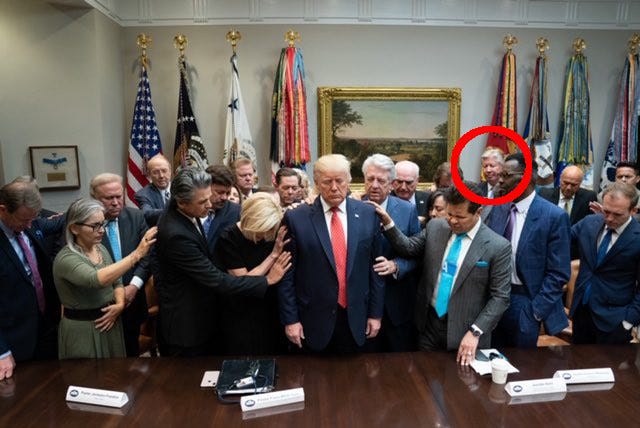
In 2020, Trump visited Gateway Church for an event on race relations and the economy. During the event, he thanked Morris and other church leaders by saying they were “Great people with a great reputation.”
The reason Morris amassed the sort of power that allowed him to be that close to the president is because he was able to hide his own actions for decades.
According to the Wartburg Watch, which first broke this story, Morris was a traveling evangelist in 1981 when he visited Tulsa, Oklahoma and met a family with an 11-year-old daughter named Cindy Clemishire. (Because she’s gone public with her story, I’m naming her here.)
Morris, along with his wife and son, stayed with Cindy’s family frequently. They all became very close.
On Christmas Day, 1982, he allegedly invited Cindy to come to his bedroom where he proceeded to touch her beneath her clothing. He then told her, “Never tell anyone about this because it will ruin everything.”
As a little girl, she didn’t know any better.
Part of the reason Morris was able to get away with it, and the way he was able to get so much alone time with the child, was by telling his wife he was “counseling” the little girl.
This sort of behavior continued for years, through 1987.
At one point, Cindy told a friend what had happened and the news came back to her own father, who “demanded that Morris get out of ministry.” Morris stepped down for two years. When he finally returned to preaching, he began the church that would later become Gateway Church.
It wasn’t until Cindy was much older that she realized the extent to which she had been abused and just how inappropriate (and criminal) it was.
In 2005, she obtained an attorney to file a civil lawsuit. Robert Morris’s attorney responded by implying that they believed it was her fault because she was “flirtatious.” She asked for $50,000 (which was not much in my estimation.) They responded that they would give her $25,000 if she signed an NDA. She refused, so she can now tell her side of the story.
If that story is true, it’s appalling (but not surprising) that the attorney blamed the child for what Morris did to her. No 12-year-old girl can legally consent to sex with an adult. She was not flirting with him.
(Interestingly enough, in one of Morris’ books, he writes about how he stepped down from ministry in his mid-20s—a time period that coincides with when Cindy’s father demanded he get out. The book, however, says God told Morris to take time away from the pulpit to deal with his “pride.”)
When reporter Leonardo Blair of the Christian Post asked Morris for comment about these allegations, the church responded with a confession of sorts. But they’re all acting like it’s not that big of a deal.
“When I was in my early twenties, I was involved in inappropriate sexual behavior with a young lady in a home where I was staying. It was kissing and petting and not intercourse, but it was wrong. This behavior happened on several occasions over the next few years,” Morris said in a statement to The Christian Post after Gateway Church was asked about the allegations.
“In March of 1987, this situation was brought to light, and it was confessed and repented of. I submitted myself to the Elders of Shady Grove Church and the young lady’s father. They asked me to step out of ministry and receive counseling and freedom ministry, which I did. Since that time, I have walked in purity and accountability in this area,” Morris added.
He explained that he returned to ministry in March of 1989, two years after his abuse was exposed with the blessing of the survivor’s father and the elders of his church. He further noted that he and his wife met with the survivor and her family in October 1989.
“I asked their forgiveness, and they graciously forgave me,” Morris said.
She was not a “young lady.” She was a 12-year-old girl.
It wasn’t merely “inappropriate.” It was criminal.
It wasn’t just “kissing and petting.” According to Cindy, Morris “touch[ed] every part of my body and inserted his fingers into me.”
And Cindy’s father did not give Morris his blessings.
“My father never ever gave his blessing on Robert returning to ministry! My father told him he’s lucky he didn’t kill him. I am mortified that he is telling the world my dad gave his blessing! Of course, we forgive because we are called to biblically forgive those who sin against us. But that does not mean he is supposed to go on without repercussions,” she said.
The statement from Gateway Church also included comment from the church’s elders, but it’s no better than anything Morris said.
“Pastor Robert has been open and forthright about a moral failure he had over 35 years ago when he was in his twenties and prior to him starting Gateway Church. He has shared publicly from the pulpit the proper biblical steps he took in his lengthy restoration process,” they said.
“The two-year restoration process was closely administered by the Elders at Shady Grove Church and included him stepping out of the ministry during that period while receiving professional counseling and freedom ministry counseling,” they said. “Since the resolution of this 35-year-old matter, there have been no other moral failures. Pastor Robert has walked in purity, and he has placed accountability measures and people in his life. The matter has been properly disclosed to church leadership.”
It wasn’t a “moral failure.” It was criminal sexual assault.
He didn’t share publicly from the pulpit why he needed any kind of “restoration.”
The fact that it happened 35 years ago is irrelevant largely because this was never made public until the survivor told her side of the story. (The Catholic Church learned the hard way that people won’t forgive them for clergy abuse that occurred decades ago.)
And no one should simply accept that Morris has had “no other moral failures” since that time because we already have evidence of this particular crime being covered up.
If “church leadership” knew all about what he did, what does it say about them that the congregation was never told Morris was a child sex predator? (In an internal Slack channel for Gateway, church staffers were given the same statement with no further details about how Morris sexually assaulted a child for many years.)
There’s simply no accountability of any kind happening here.
Morris is still, as of this writing, the senior pastor of Gateway. He’s not facing any punishments from his church, much less criminal charges. Hell, there’s a good chance he’ll downplay this story whenever he talks about it and receive a warm embrace from the people in the pews who he’s been lying to for all these years.
That’s what conservative Christians have a habit of doing whenever their pastors are forced to admit an incident of sexual assault that they thought they had swept under the rug. They do it so often that pastors have developed a playbook for these things. All they have to do is say they did something immoral, but it happened in the past, and they prayed on it, and God forgave them, and they’ve been doing great ever since. Rinse, lather, repeat.
There’s never any mention of all the people they hurt. There are never any details offered about the exact nature of their “immorality.” There are never any serious consequences for their actions.
The Dallas Morning News says that Morris wasn’t around on Saturday as this story began to spread:
Morris did not preach at the Southlake campus’ Saturday afternoon service, and the allegations were not addressed by pastors during the service. Several attendees either declined to comment or said they were unaware of the allegations.
It’s unclear if he’ll be in the pulpit today.
Morris has spent years preaching about sexual ethics and sin and consequences for one’s actions. During that time, he promoted a presidential candidate (and later president) who did all the things Morris urged people not to do because Christians like him love hypocrisy.
And all those years, he’s been hiding his own troubling secret. If the church’s initial response is any indication, they’re all still trying to bury the story.
Novel Excerpts–The Boaz Schoolteacher, Chapter 29
The primary aim of the "Novel Excerpts" blog category is to showcase my creative writing, specifically from the novels I've written. Hopefully, these posts will provide a glimpse into my storytelling style, themes, and narrative skills. It's an opportunity to share my artistic expressions and the worlds I've created through my novels.
The Boaz Schoolteacher, written in 2018, is my fifth novel. I'll post a chapter a day over the next few weeks.
Book Blurb
In the summer of 2017, Katie Sims and her daughter Cullie, moved from New York City to Katie’s hometown of Boaz, Alabama for her to teach English and for Cullie to attend Boaz High School . Fifteen years earlier, during the Christmas holidays, five men from prominent local families sexually assaulted Katie. Nine months later, Katie’s only daughter was born.
Almost from the beginning of the new school year, as Katie and fellow-teacher Cindy Barker shared English, Literature, and Creative Writing duties for more than 300 students, they became lifelong friends.
For weeks, Katie and Cindy endured the almost constant sexual harassment at the hands of the assistant principal. In mid-October, after Cindy suffered an attack similar to Katie’s from fifteen years earlier, the two teachers designed a unique method to teach the six predators a lesson they would never forget. Katie and Cindy dubbed their plan, Six Red Apples.
Read this mystery-thriller to experience the dilemma the two teachers created for themselves, and to learn the true meaning of real justice. And, eternal friendship.
Chapter 29
Saturday, I stayed in the basement until early afternoon, coming upstairs only one time for Sammie’s glorious pancakes at 8:00 a.m. I was thankful Papa had included a small bathroom downstairs. I recall Nanny saying more than once during one of her regular strolls down memory lane that she had told him it was his bathroom and he had to keep it clean since he was the only one who needed a complete floor to house his hobby. As far as I knew, other than my writing, the basement had never been used for anything other than storing junk.
I binge-wrote about once every six months. I loved it and I hated it. When I walked down the stairs a little after 4:30 this morning I hadn’t intended on staying more than a couple of hours, which was at least thirty minutes longer than I ever did during the school week. It was something about the look on Cindy’s face when Wilkins caught her in his office. He may not have noticed it, but I had. For a split second, even from where I stood, I could see the animal that lies buried deep inside every human. Technically, we are animals, just like chimpanzees and kittens. Fortunately, millions of years of evolution has allowed us to realize survival depends on playing well together. The old fight or flight gene lies dormant deep inside our psyche. It stays that way until its owner’s back is against the wall. It was something about Cindy’s stance and the look in her eye, for that split second, that I thought Wilkins was about to lose his own eyes. For whatever reason, just as I suppose she acted when he had raped her, she had chosen to suppress the violence that is endemic in every human, given the right conditions. That split-second visual had prompted me to delve deeper into my own protagonist’s willingness to confront her rapist with fire and venom.
By 3:30 p.m., Cindy and I were watching another movie at the Premiere Cinema 16 in the Gadsden Mall. Cullie and Alysa were shopping. I had wanted to see “Wilde Wedding,” but I was outvoted or overpowered by the cunning Cindy. She kept repeating American Assassin’s tagline, ‘Assassins aren’t born, they’re made.’ The thriller starred Michael Keaton, and Dylan O’Brien as Mitch Rapp, a young CIA black ops recruit. His job was to assist a Cold War veteran in stopping the detonation of a rogue nuclear weapon. I thought the plot was rather mundane, clichéd, and missed several great opportunities to provide the audience with a few thrills, but it intrigued me enough to purchase novelist Vince Flynn’s book of the same name. I had heard of this best-selling author but had never read a single book in his Mitch Rapp counter-terrorism thriller series. Towards the end of the movie and after at least the tenth time Cindy had whispered ‘Assassins aren’t born, they’re made,’ she added, “you know Vince Flynn died of prostate cancer at the age of 47?” Off and on for the rest of the movie and during our time eating and shopping at the Mall, all I could think was, ‘in two years I will be 47.’
After Cindy dropped Cullie and me off at home, she spent an hour modeling her new clothes for Nanny and Sammie. I was surprised that Nanny had allowed Sammie to pause The Walton’s. Last month’s Saturday shopping adventure in Gadsden had spawned an exciting and engaging look in Nanny’s eyes. She had stood and talked with Cullie as she modeled jeans, blouses, tee-shirts, and boots. I was surprised tonight that Cullie felt comfortable and confident enough to undress down to her bra and panties right in the den. This thrilled Nanny and made Sammie fetch a few things from her bedroom that the two of them had purchased at Walmart a week ago today. I don’t think I have ever laughed so much as Nanny and Cullie, pant-less and both with pink blouses strolled around the den. Sammie whispered to me, “Nanny is reliving her youth. This is the happiest I think I have ever seen her.”
At midnight I had to make Cullie pick up her scattered clothes and go to her bedroom. I knew this adventure would turn into an all-nighter for Nanny who needed to stay on a strict schedule. Midnight was already two hours past her routine bedtime. Ten minutes after Cullie went upstairs and Sammie and I had restored the den from a modeling studio I visited Cullie as I often did, always hoping for a goodnight hug, maybe even a quick kiss. “I want to do this every week, even if I don’t have new clothes. I had no idea Nanny was so much fun.” I went to bed thankful that Cullie was connecting with the woman I knew as a teenager and who had inspired me to reach for the stars. I hated clichés but sometimes they were perfect.
At 2:45 a.m., I awoke to pounding on my bedroom door and a feeling I was suffocating. I opened my eyes and could see my room was filled with smoke. It was like a heavy fog had enveloped my room as I looked across to a bright light streaming in along the edge of my closed blinds. “Mother, mother, get up, open the door, the house is on fire.” Cullie screamed over and over. At first, I thought I was dreaming, then the choking began. I stood up and gasped. I got down on the floor and crawled to the door. I don’t know why it was locked. I opened the door and Cullie was squatted down with a cloth over her mouth. Here, she handed me a wet bath cloth. “We have to get to Nanny and Sammie.” I said.
“We’ll have to crawl to the top of the stairs.” Cullie said. I could barely see her but caught a glimpse of her hand motioning me to follow. It seemed we were crawling on a reverse escalator. The further we crawled the faster it seemed to slide us back in the opposite direction. Finally, at the top of the stairs, we turned around and went down feet first with each of us using one hand to hold onto the hand-rail. Cullie was the first one to the bottom. I was still halfway up the stairs when she yelled. “Hurry, we have to get outside, the kitchen is an inferno.”
Then, it hit me. We are going to die. If by some miracle Nanny and Sammie weren’t already outside there was no way to get to them. Their suite was at the back of the house, down a long hallway from the kitchen, and there is no other route. In the few seconds it took to reach the first floor, I also realized that something else was going on. Just after Cullie and I had moved in at the end of July, I had bought six smoke detectors and installed two on each floor including the basement. I had instructed Sammie to test them at least once per week. As I turned towards the back of the house I didn’t hear the shrill sound of a single detector, but only the creaking, groaning, and popping of an old house that was being consumed by flames. As Cullie was tugging on me and telling me we had to go out the front door, my attention was drawn to a single light coming from the door right outside the kitchen less than twenty feet away. I started to crawl towards it and halfway there I was met with two things I will never forget. The heat from the fire was what one feels when she’s stood too long in front of a fireplace and has almost caught her jeans on fire, and the second was the faint outline of a hand around the light-end of the flashlight. It was either Sammie or Nanny, more likely Sammie. She had tried to get out, tried to get help. The kitchen was as far as she had gotten. Then she collapsed. The heat stopped me, and I retreated. Cullie was already outside having had no choice but to exit the house.
It took the firetruck another twenty minutes to reach us. By that time the house had been completely engulfed in flames for nearly as long, ever since Cullie and I had escaped and retreated halfway to Bruce Road avoiding the heat. It was the most helpless I had ever felt. While waiting, Cullie and I had walked around the house, staying at least a hundred feet from the raging flames. There had been no way to get to Nanny and Sammie, no door availed us. Every entrance spewed fire like a dragon.
By daylight the firemen had the fire extinguished, neighbors had brought Cullie and me a set of clothes to cover our smoky and singed nightgowns, and I had given a statement to Troy Logan, the Boaz fire chief. His final statement before Cindy and Steve took us home with them was, “I’ll be calling the District Attorney when I return to the Station, this appears to be arson. We found empty gas cans throughout the first floor.”
I was glad our neighbor, Charles Fordham, had let me borrow his cell phone. I had called Cindy and told her about half of what had happened, just enough for her to realize I was distraught. I rarely cry but this morning I did. It was so bad I couldn’t finish our conversation. Within fifteen minutes her and Steve showed up. They stayed with Cullie and me until the firemen recovered the bodies of the two dearest women I had ever known. After the ambulance left and with the firemen promising to stay all day if it took it to ‘cold the fire’ as they put it, Cullie and I held hands in the back seat of Cindy’s Nissan Altima, with her crying and repeatedly asking me, “What are we going to do? Where are we going to live?” In between my times of trying to reassure her that we would be okay, maybe even rebuild, the only non-suffocating thought I could muster was a feeling of satisfaction for having rented a safety deposit box at Wells Fargo Bank the Friday before Labor Day and storing one horrible videotape and one copy of Darla’s two diaries that I still had not finished reading.
Sam Harris: The Anatomy of Embarrassment

Here’s the link to this article.
Poker anyone?


Nature seems to have given us six primary emotions—happiness, sadness, fear, anger, surprise, and disgust. A glance at those cards suggests that the deck may be stacked against us. Only happiness seems worth wanting for its own sake. The rest, even the ambiguously valanced surprise, are generally unwelcome. Most of us regularly enjoy happiness, of course, and amusement, contentment, delight—even ecstasy—are among its many facets. But we must overcome countless forms of irritation and anguish to do so.
Layered on top of the primary emotions, we find moral ones like pride, guilt, shame, empathy, gratitude, and outrage. Once again, it seems that anyone who simply wants to be happy in this world will find themselves at a disadvantage. If pride is good, it is so only for children. And, as Paul Bloom has noted, even empathy (in the emotional, rather than cognitive, sense) is overrated.
We begin to experience these moral emotions as toddlers, and their emergence very likely coincides with our ability to distinguish ourselves from others—not merely as separate bodies in space, but as independent beings capable of distinct states of mind. Leaving moral outrage aside, to feel pride, guilt, shame, empathy, or gratitude is to intuit, if only unconsciously, that other people have points of view, and that one’s own person is among the many things they might harbor views about. Each of us thereafter, as Sartre famously put it, becomes an object in the world for others.
Somewhere in the vicinity of guilt and shame we find further sources of comedy and tragedy—in particular, the acutely self-conscious states of embarrassment and humiliation. Telling these sisters apart is more art than science. Some use the terms interchangeably, or merely consider humiliation to be an extreme form of embarrassment. Both types of assault upon our self-esteem require the gaze of others—by whose light we see ourselves to have lost status in a social hierarchy. However, the experiences differ in at least one respect. As William Ian Miller observed in his book, Humiliation, we are often eager to describe our past embarrassments, as other people tend to find these stories quite funny. Not so with our genuine humiliations.
Let us now consider the happier sister—embarrassment:
The Oxford English Dictionary indicates that the term “embarrassment” was in use for nearly a century before it acquired its current, most common meaning:
Intense emotional or social discomfort caused by an awkward situation or by an awareness that one’s own or another’s words or actions are inappropriate or compromising, or that they reveal inadequacy or foolishness; awkwardness, self-consciousness… Typically distinguished from shame in being caused by something that is socially awkward or inappropriate rather than morally wrong or debasing.
It’s first known usage in this sense seems to have occurred in the year 1751:
She pretended to be with child by him… She brought a man whom she called uncle, to add weight to her threats; and these violent proceedings threw Mr. Baker under great embarrassment. He always was extreamly tender of his reputation with the world. (London Magazine April 198/2)
One wants to know more about this “uncle.” In any case, there is a Mr. Baker in each of us—running a frenzied circuit between the medial prefrontal cortex (self-reflection and self-evaluation), the anterior cingulate (error detection, emotional regulation, and awareness of physical and social pain), the insula (the perception of emotion and other internal states of the body), the amygdala (emotional salience and threat detection), and the temporal-parietal junction (understanding the mental states of others).
However, we live not merely in our brains, but in the world.
Imagine you’re at a party. Though you happen to be in an expansive mood and have met many interesting people, all your interactions have felt slightly off-kilter. Most conversations have terminated abruptly—as though your company was best appreciated in the act of leaving of it. After more than an hour of pointlessly caroming off strangers in this way, you go to the restroom to freshen up, only to discover a 5-carat booger prominently displayed in one of your nostrils.
Of course, the change in you is instantaneous—and yet your inner mixologist has been working for nearly a million years in evolutionary time to produce the precise cocktail of destructive emotions that you are now obliged to drink.
Though I am no psychologist, the resulting state of mind strikes me as right on the boundary between embarrassment and humiliation. Everything depends on whether you are viewed, by yourself and others, as an object of comedy or contempt—both in the moment and, most important, in the final analysis. It is the presence (or painful absence) of good-natured laughter—once you exit the bathroom, having restored a semblance of bodily integrity—that will determine on which side of this invisible frontier you will live out your days.
Think of the most embarrassing moment in your life. Surely a few stand out. Pick one, and bring this experience to mind as vividly as you can. I’m asking you to recall, not an experience that left you traumatized and pining for the scaffold, but one about which you can now laugh, no matter how complete a loss of face it entailed at the time. Think of the most embarrassing story you would be willing to tell another human being.
Ok, now that you’ve prepared, let’s play a game of poker. I believe that I hold the higher cards.
Want to bet?
It begins, as most great stories do, with a prostate exam…
I was nearly forty and decided that it was time for a checkup. My primary physician had recently retired, and so without giving the matter much thought, I scheduled an appointment with the doctor who had inherited his practice.
When booking this appointment, however, I learned that this new doctor was a woman. There was nothing surprising about this, of course. I’d seen several female doctors over the years for specialized concerns—dermatology, tropical medicine, ophthalmology. But I’d never had one as my primary physician.
When I told a friend about this impending encounter, I detected an unflattering gleam in his eye.
“So a woman is going to give you a prostate exam?” He said.
I admit that the prospect suddenly struck me as somehow uncanny. Pressing further, my friend suggested that it would stand to reason that having a prostate gland of one’s own might better qualify a person to perform this intimate procedure. I asked him how often he felt his own prostate and what exactly these adventures in proctology had qualified him for.
The appointed hour came soon enough, and I found myself standing face-to-face with my new physician. After a period of perfectly rational discussion and a few lesser intrusions—blood taken, reflexes checked, breathing analyzed—the moment foretold finally arrived:
“Ok, so now I need to check your prostate.” Her tone was matter-of-fact, but she might as well have added, “and you and I both know that you’ve thought about nothing else since you set foot in my office.”
The exam itself went without incident, and at no point did I have occasion to regret my choice of doctor—that is, until the final moment, when she stepped away from the exam table to record her findings.
It was then, with her back turned to me, that she spoke the following words:
“Your prostate is enlarged.”
A perfectly ordinary sentence.
But its meaning entered my brain with the force of incantation. As I rose to a sitting position at the end of the exam table—elevated, as I was about to learn, for the comfort of the working physician, not the safety of her patients—the idea that my prostate was “enlarged,” as opposed to “fine,” or “normal,” or indeed “the best I’ve ever known”—struck me with uncommon power. So much power, it seems, that it rendered me unconscious.
It is perhaps relevant at this point to confess that I had been, at various periods in my life, a committed martial artist. I had even trained in ninjitsu, the fabled art of the Ninja. I was also a decent marksman. Fighting with knives was a topic about which I had well-formed opinions. What I am trying to say is that I had prepared for most species of human violence—except, it would seem, the quiet violence of an unfavorable prostate exam.
The next thing I remember is the sound of a woman’s scream. Sometime later, I could faintly make out the desperate comings and goings of at least two people moving above me. Above me, of course, because I was now lying on the floor, having travelled there headfirst, as an intrepid diver might—who, with the assurance of deep water beneath him, could forego the protective use of his arms.
There can be no doubt that my arms had hung limply at my sides, as I pitched forward from that high table, and smashed my head against the wall, and then a helpless chair, and finally the floor.
But the good doctor had been composing her notes and hadn’t seen me fall. She only heard the centripetal crashings of a man hurled to earth, his stout body smashing against every object in its path and then flopping, naked but for his blameless choice of Calvin Klein briefs in black, at her feet.
We have all be raised to believe that there are only four fundamental forces of Nature—the weak and strong nuclear forces, electromagnetism, and finally gravity—which had so suddenly declared itself my enemy. But there is a 5th force, which often works in direct opposition to gravity. That force is embarrassment.
We have all witnessed the effect—whether in real life or in videos online—when some hapless person slips on ice, or while attempting a silly stunt to amuse his friends. If they are not grievously injured, such people leap to their feet with astonishing speed. This force, which gives even an old woman sprawled among her groceries the sudden agility of an Olympic gymnast—this is the primordial spirit of embarrassment.
As I came to my senses and began to realize what had just happened, the fact that I had fainted at a mere rumor about the condition of my prostate gland (the very existence of which, I might add, remains little more than a rumor) and had collapsed with greater suddenness than any man felled in battle—for not even an arrow shot into a man’s heart is likely to bring him down with the full force of gravity—the knowledge that I had not managed so much as a shout or a stagger, but had been literally struck senseless by a mere utterance, as if by some witch’s curse, produced in me the first stirrings of that ancient feeling.
I was properly embarrassed. Which meant, as a wide literature will attest, that I understood that I had violated some basic norms of self-presentation by collapsing on my new doctor’s floor in a nearly-naked heap.
But my vision and hearing had returned, and my mind began to thrill to a new purpose—one that is all but encoded in the DNA of our species—to restore social cohesion. Yes, I needed to recapture the sense of decorum and feelings of fellowship that had prevailed up to and—a surprising fact this—even beyond the point that this strange woman, with whom I had just been discussing world affairs only moments prior, had inserted a gloved finger into my ass.
And so, sensing the vindication that would be mine the moment I was once again sitting, standing, and walking among the living, I began to get up.
Unfortunately, this brought me into immediate conflict with medical authority. My doctor, who had found nothing to do for me in my state of prostration, now applied all her skills to prevent my escaping it.
The case she made was simple: While she had heard all the violence I had meted out to her office, she had seen nothing. She was, therefore, unable to even speculate as to the immensity of my injuries. Even now, as she stood over me like some an avenging angel of medical reproach, she couldn’t say whether I was suffering a brain hemorrhage or a broken spine. Under no circumstances could she permit me to move.
You might have thought that a doctor’s office would be a better place than most to fall and hit your head, but you would be mistaken. In fact, your doctor is no more equipped to assess your injuries, much less to treat them, than a random tourist would be, should you lose consciousness at the zoo or on the floor of a casino. In fact, your own doctor, styled in a white lab coat and stethoscope and surrounded by framed degrees from the world’s finest medical institutions, can do nothing under the circumstances but call 911 and summon an ambulance.
And so it was that after I had been lying on the floor of my new doctor’s office for long enough to have run out of things to talk about—and for her to begin doing clerical work of some sort as I studied the acoustical tiles that lined her ceiling—four young firemen came hurtling into the room, bearing all the gear necessary to rescue me had I driven my car into a raging river.
I am happy to say that, staring up at their sunburned faces, I was granted a vision of the glory of youth. I knew at once that these young men could have saved me from any conceivable emergency. But as for the inconceivable—the 20-megaton sunburst of embarrassment that had by now detonated inside me, the blast wave from which seemed likely to bring down the very walls around us—they were powerless to intervene.
Nevertheless, these young heroes quickly secured the patient’s neck with a plastic collar, immobilized his spine by strapping him to a board, and then bore the fallen man in his underwear through a crowded reception area, out onto a once familiar street, and into a waiting ambulance, so that he could be driven scarcely 500 feet to the nearest emergency room.
To appreciate the roiling splendor of my embarrassment at this point, you must picture each station of the cross that was now mine to bear: You must see me meeting the ambulance crew proffering oxygen, and then the battle-hardened men and women who greeted me upon intake at the ER. You must picture every point of entanglement with the great machine of a modern hospital—each encounter with the orderlies, residents, doctors, and technicians that attended my triage, X-ray imaging, and physical exam—and you must, in the theater of your imagination, linger on those moments when I or the person then responsible for me had to give some account of what had happened. For while these medical professionals had seen and heard much, mine was a tale that none were expecting. Had I been in a car accident? Had I been physically attacked? Was I an athlete who had pushed his skills beyond their natural limit?
To understand my predicament, you really must see me as I lay supine upon that gurney, fully immobilized and merely able to cast sidelong glances at those in attendance. And then understand that over the course of several hours, I could think of nothing more dignified or exculpatory to say, again and again and again and again, than this: “It was only a prostate exam.”
My brain had not hemorrhaged. My spine was intact. But the fall seemed to have produced in me a form of extrasensory perception. I now find that if I listen closely, I can hear the faint, crackling sound that other minds emit when they struggle not to laugh.
What cards are you holding?
Subscribe to Sam Harris
Sam Harris is the author of five NYT bestsellers, host of the Making Sense podcast, and creator of the Waking Up app.
Snowflake Summaries–The Marlow Chronicles, by Lawrence Sanders

The primary aim of the "Snowflake Summaries" blog category is to showcase the creative writing of great authors. I use Randy Ingermanson's 'Snowflake' method to create these summaries. Here's a brief description of the one-sentence, one-paragraph, and one-page summary method.

Hopefully, these posts will motivate you to read great fiction and to write your own novel, whether your first or your fifteenth.

The first great novelist I'll start with is Lawrence Sanders. Here's a short biography.
The Marlow Chronicles, by Lawrence Sanders
**”The Marlow Chronicles” by Lawrence Sanders** is a dramatic and suspenseful tale that explores the complexities of a renowned actor who must confront his own mortality and dark secrets through his most challenging role.
### One Sentence Summary:
**”The Marlow Chronicles”** follows a famous actor who is compelled to enact his own death, unraveling a story filled with sex, suspense, revenge, and desire as he confronts personal and professional challenges.
### One Paragraph Summary:
In **”The Marlow Chronicles,”** Lawrence Sanders spins the tale of a distinguished actor thrust into the most demanding performance of his career—staging his own death. As he prepares for this final role, he navigates through layers of personal and professional entanglements, including tumultuous relationships, intense rivalries, and his own secretive past. Set against the backdrop of the glamorous yet cutthroat theater world, the actor’s journey is fraught with manipulative colleagues, mysterious threats, and romantic intrigues. This multifaceted narrative not only captures the essence of a life lived in the limelight but also explores the profound impacts of deception, the nature of reality versus performance, and the quest for authenticity.
### One Page Summary:
**”The Marlow Chronicles”** by Lawrence Sanders delves deep into the life of a renowned yet enigmatic actor, known for his compelling performances and complex personality. As he ages and reflects on his fading career, he receives a bizarre and unsettling offer: to act out his own death in what promises to be the pinnacle of his theatrical achievements. Intrigued and somewhat compelled by financial necessity and a desire for one last moment of fame, he accepts, setting the stage for a narrative rich in drama and suspense.
The preparation for his final act reveals much about the actor’s life, weaving through his past successes and failures, his relationships with other actors, directors, and lovers, and his internal battles with his own demons and fears. Each chapter peels back layers of his persona, revealing the vulnerabilities and strengths of a man who has spent his life embodying others but now must confront his true self.
As he delves into this ultimate role, the boundaries between his life and the character he plays blur, causing him to question not only his identity but also the motives of those around him. The actor finds himself entangled in a web of deception that involves his closest allies and his most hated rivals. The theater, a place where reality is perpetually in flux, becomes a mirror reflecting the darkest parts of his psyche and the industry he has served.
Throughout **”The Marlow Chronicles,”** Sanders expertly crafts a series of suspenseful and revelatory incidents that lead the actor to uncover secrets about his own life and the people in it. These discoveries are paralleled with intense rehearsals for his death scene, which are described in meticulous and dramatic detail, highlighting Sanders’ mastery of suspense and emotional complexity.
The climax of the novel is both a literal and metaphorical stage for the actor’s confrontation with his past, his critics, and himself. As the curtain rises on what is to be his final performance, the true nature of the plot against him is revealed, culminating in a shocking twist that redefines the earlier narrative and the actor’s understanding of his life and work.
In conclusion, **”The Marlow Chronicles”** is a compelling exploration of the art of performance, the inevitability of aging, and the pursuit of authenticity in a world rife with illusions. Sanders’ novel is a poignant commentary on the intersections of life and art, making a profound statement on the roles we play and the realities we create.
 Richard L. Fricks